Lecture 2. Why Are There Opportunities in the Crypto Market? (Comparing It with Traditional Finance)
Why the crypto market offers more frequent arbitrage opportunities than traditional finance — a structural comparison.

Hello everyone!
This is the second installment of DataMaxi+'s arbitrage education series.
In the first installment, we learned the simple yet powerful basic principle of arbitrage —
"buy low, sell high."
So why does this simple principle wield especially strong power
in the crypto market in particular,
opening up new opportunities even to individual investors?
The answer lies precisely in
the difference in the "market environment" where arbitrage takes place.
Traditional financial markets have, over a long period of time,
developed extremely efficient systems.
As a result, arbitrage opportunities such as price discrepancies are rare,
and even when they do arise, they are immediately resolved by the sophisticated systems of institutional investors.
The crypto market, by contrast, is still
in the early stages of development and has many inefficiencies.
Countless exchanges are fragmented,
the regulatory environment is not unified,
and the behavior of market participants is hard to predict.
It is precisely these inefficiencies
that are the main reason arbitrage opportunities are available even to individual investors.
This time, we'll first look at how arbitrage is done in traditional finance,
and then compare it against the new market that is crypto,
examining what decisive differences there are
across several criteria.
Through this comparison, you'll come to clearly understand why
arbitrage strategies in the crypto market are said to offer so many opportunities.
1. Arbitrage in Traditional Financial Markets
To better understand arbitrage in the crypto market,
it should help to look at what forms of arbitrage are practiced
in traditional financial markets.
In fact, arbitrage
is an investment strategy that has been used in traditional financial markets
for far longer than crypto.

1-1. Arbitrage in the Stock Market
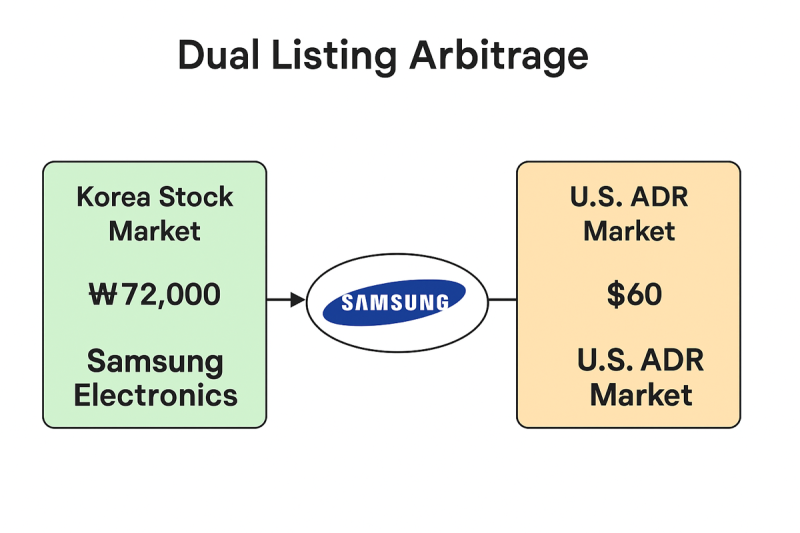
Dual Listing Arbitrage is a representative example.
Large-cap stocks like Samsung Electronics or SK Hynix are traded not only on Korean exchanges
but also in the form of U.S. ADRs (American Depositary Receipts),
and price differences can arise from exchange-rate movements or time-zone gaps.
For example, if Samsung Electronics stock trades at 70,000 KRW in Seoul,
while in New York it trades at the equivalent of around 72,000 KRW on an ADR basis once the exchange rate is taken into account,
then an arbitrage opportunity arises
to buy in Seoul and sell in New York.
Of course, in reality there are constraints such as currency-conversion fees,
trading-hours differences, and settlement periods,
so it's not quite that simple.
ETF arbitrage is another interesting case.
This is an arbitrage opportunity that arises
when an ETF's (exchange-traded fund's) price diverges
from the net asset value (NAV) of its underlying assets.
For example, if the KODEX 200 ETF
trades at a discount relative to the actual KOSPI 200 index,
you can buy the ETF and simultaneously sell futures to capture the spread.
Likewise, if there's a difference between the price of a semiconductor ETF
and the prices of the ETF's constituent stocks,
you can buy one side and sell the other
to capture a spread.
This kind of arbitrage
can be applied to what the crypto market calls the spot–spot gap, the spot–futures gap, the futures–futures gap, and so on.
1-2. Arbitrage in the Bond Market
In the bond market, Yield Curve Arbitrage is a representative example.
When the yield relationship between government bonds of different maturities is temporarily distorted,
it's a strategy of buying long-term bonds and selling short-term bonds, or vice versa, to capture a profit.
For example, normally
the 3-year government bond yield should be higher than the 1-year,
but if an inversion temporarily appears,
an arbitrage opportunity exploiting it arises.
Of course, such strategies involve interest-rate risk
and liquidity risk, among others,
so they are not pure risk-free arbitrage.
Not exactly the same, but based on a similar principle,
there is the funding rate strategy.
This is a strategy that exploits the fact that, on average, longs dominate
the funding rate in the crypto perpetual futures market,
by buying spot and selling futures
to collect only the funding rate without being exposed to coin price movements.
For those confused by the concept of the funding rate, I'll explain it in detail in a separate post.
1-3. Triangular Arbitrage in the Forex Market
In the forex market, there is an interesting strategy called Triangular Arbitrage.
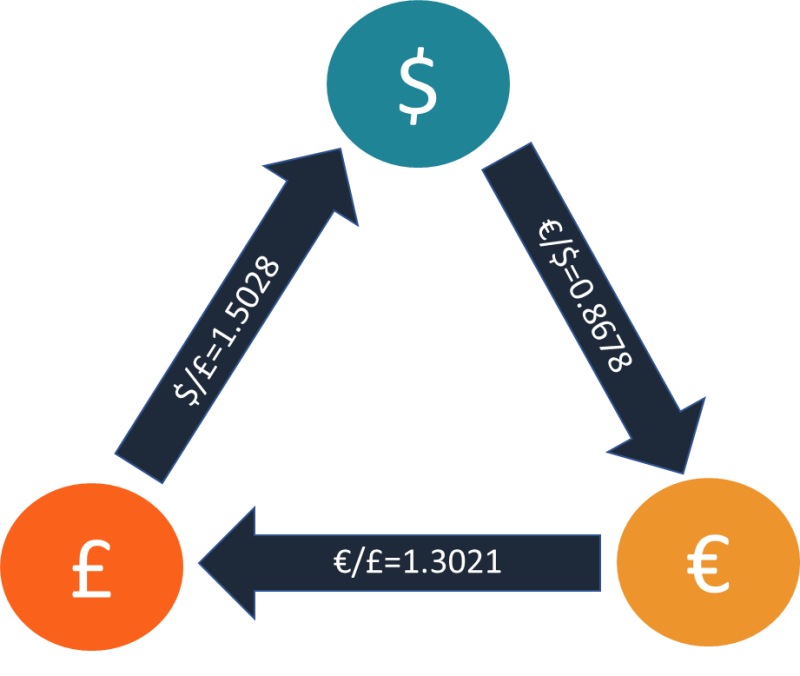
It's an opportunity that arises when the exchange-rate relationships among three currencies temporarily fall out of balance.
For example,
suppose USD/KRW is 1,300 KRW,
EUR/USD is 1.1 USD,
and EUR/KRW is 1,440 KRW.
In theory,
EUR/KRW = USD/KRW × EUR/USD = 1,300 × 1.1 = 1,430 KRW
is what it should be,
but if it's actually trading at 1,440 KRW, there's a 10 KRW arbitrage opportunity.
In such a case, you can trade in the following sequence:
Buy dollars with won (1,300 KRW/USD)
Buy euros with dollars (1.1 USD/EUR)
Sell euros for won (1,440 KRW/EUR)
Through this process, you can theoretically capture a 10 KRW spread.
But in reality, such opportunities exist only for a very brief time,
and because high-frequency trading (HFT) algorithms
seize these opportunities in milliseconds,
it's almost impossible for an individual to take advantage of them.
Triangular arbitrage is also possible in the crypto market,
and in fact, larger opportunities arise more often
than in the traditional forex market.
In particular, on large exchanges with a variety of trading pairs,
you can find triangular arbitrage opportunities
based on BTC, ETH, USDT, and the like as base currencies.
1-4. Arbitrage Between Futures and Spot
Cash and Carry Arbitrage
is a strategy that exploits the difference between the futures price and the spot price.
The theoretical price of futures
is calculated from the spot price by factoring in the risk-free interest rate, storage costs, dividends, and so on,
and an arbitrage opportunity arises when the actual futures price diverges from the theoretical price.
For example, if KOSPI 200 futures
trade excessively expensively relative to spot,
you can take the strategy of selling the futures and buying the spot stocks
and holding them to maturity.
Conversely, if futures are too cheap,
you can use the strategy of buying futures and selling spot.
Similar to the futures–spot arbitrage of traditional finance,
spot–futures gap trading is also actively practiced in crypto.
It's a strategy that exploits the spot–futures price difference of major coins like Bitcoin or Ethereum.
For example, if spot Bitcoin trades at 70,000,000 KRW on Upbit
while futures trade at 71,000,000 KRW,
you can buy spot and sell futures to target a 1,000,000 KRW spread.
With dated futures, you can hold to maturity,
and with perpetual futures, you simply close the position when the prices converge.
2. The Difference Between Arbitrage in Traditional Financial Markets and Arbitrage in the Crypto Market
We've looked at various arbitrage cases in traditional financial markets,
and now let's compare in more concrete terms how arbitrage differs
between traditional finance and the crypto market.
Understanding these differences
will be very important for you in grasping the characteristics and opportunities of crypto arbitrage.
1) A stark difference in barriers to entry
Arbitrage in traditional financial markets
is mostly the domain of institutional investors and professional traders.
Take triangular arbitrage as an example:
exchange-rate differences arise at the level of 0.01%,
and to capture them you need large-scale capital and expensive systems
capable of executing trades in milliseconds.

The high-frequency trading systems that investment banks like Goldman Sachs or JP Morgan
have built by investing enormous sums
snatch up these opportunities in an instant.
In the crypto market, by contrast,
individuals can readily participate in arbitrage too.
Due to issues like KRW listings, network delays, and deposit/withdrawal suspensions,
price differences of around 2–5% between exchanges are common,
and with a difference of that size, even capital of a few million won
can generate meaningful returns.
It's not that it's completely easy, of course,
but considering that in traditional finance individuals don't even get a chance to enter, it's far more approachable.
2) Persistence and frequency of opportunities
In traditional financial markets, pure arbitrage opportunities usually
vanish within seconds, or even milliseconds.
The market is so efficient that the moment a price imbalance is discovered,
algorithms resolve it.
For example, if a price difference arises for the same stock
between the NYSE and NASDAQ,
high-frequency trading systems equalize it in less than 0.1 seconds.
But in the crypto market,
arbitrage opportunities sometimes persist for minutes to hours,
and occasionally even days.
In particular, something like Korea's Kimchi premium
tends to always be present to some degree without being eliminated.
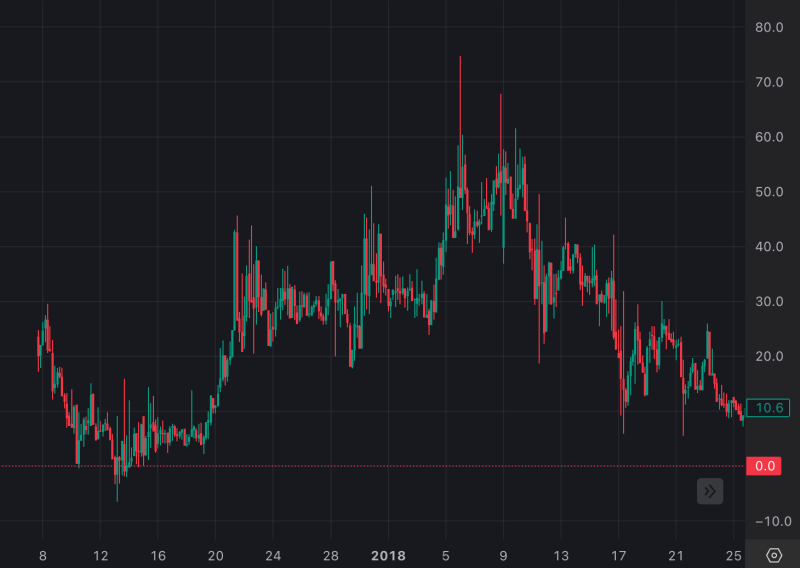
During the frenzy at the end of 2017, Bitcoin on Korean exchanges
traded more than 50% higher than overseas,
and such a difference was sustained for several months.
Now, eight years after that 2017 episode,
the crypto market too has become far more efficient,
and market imbalances this large and long-lasting no longer occur,
yet compared with traditional finance,
opportunities still arise frequently and tend to persist longer.
3) Differences in capital efficiency and returns
Arbitrage in traditional financial markets
has a low-risk, low-return structure.
In the case of government bond arbitrage,
the annual return may be only about 0.1–0.5%,
but there's correspondingly almost no risk.
Instead, the common approach is to mobilize enormous capital
and use leverage of up to 10–20×
to maximize returns.
Crypto arbitrage, by contrast,
has a medium-risk, high-return structure.
A single trade can sometimes yield as little as 0.5%
or as much as several times your capital,
but there are correspondingly many risky factors.
Liquidation of hedging positions due to sharp price swings,
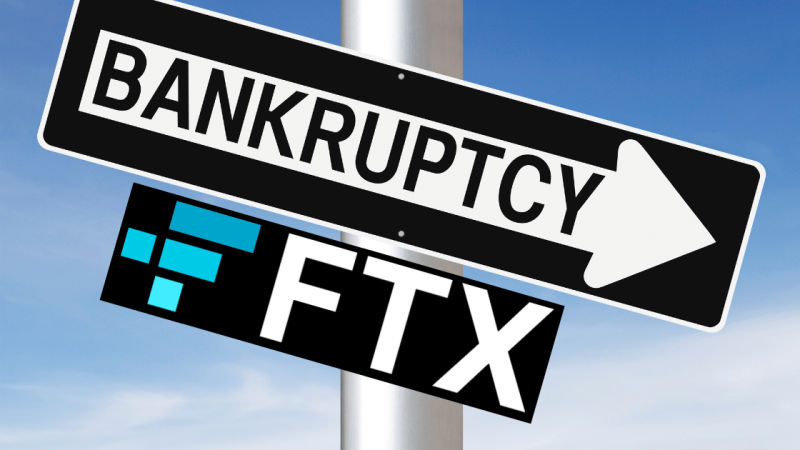
freezing of funds by an exchange, exchange bankruptcy,
account hacking, wallet hacking, and more —
various risks come along with it.
But because relatively little capital can still be expected to yield
high returns,
it can be attractive to individual investors.
4) Execution complexity and technical requirements
Arbitrage in traditional finance has high systemic complexity.
It requires prime brokerage, complex derivatives structures,
sophisticated hedging strategies, and the like,
and for that, specialized knowledge of financial engineering and
advanced systems are essential.
It's an area that's nearly impossible for an individual to attempt alone.
Crypto arbitrage is relatively simple to execute.
Fundamentally, the simplest method is spot–spot gap trading —
"buy on exchange A and sell on exchange B."
What you need is just a few exchange accounts and basic trading knowledge.
Of course, to capture more complex arbitrage opportunities or
to automate, you need deeper knowledge,
but there are plenty of opportunities to profit even with little knowledge and manual work.
5) Regulatory environment and transparency
Traditional financial markets are under strict regulation.
Every trade is monitored and recorded, and penalties for market manipulation or unfair trading are very severe.
This transparency and stability are advantages, but
at the same time they create an environment where larger arbitrage opportunities are hard to arise.
The crypto market is in a state where regulation is still developing.
This is like a double-edged sword: on one hand it provides greater opportunity and freedom,
but on the other hand there are also risks such as exchange hacks, withdrawal suspensions, and sudden regulatory changes.
As with the FTX collapse, we've witnessed that even a large exchange can fall overnight.
6) Composition and behavioral patterns of market participants
The main participants in traditional financial markets are institutional investors.
Pension funds, insurers, hedge funds, and so on are all entities with specialized knowledge,
and they act rationally based on data and models rather than emotion.
In this environment, price discovery happens quickly and inefficiencies are resolved quickly.
The crypto market has a far higher proportion of individual investors.
Individual investors sometimes make a lot of emotional and irrational trades.
And this can also create larger price imbalances and arbitrage opportunities.
7) Information flow and accessibility
In traditional finance, there is a hierarchy of information.
Institutional investors can access high-quality information first through research reports, professional data services,
in-house analysis teams, and the like.
Individual investors are relatively at a disadvantage in accessing information.
The crypto market is far more equal when it comes to information.
That's because important information like prices, trading volume, and on-chain data
is disclosed in real time.
So individual investors can see almost the same information as institutional investors.
Using a site like DataMaxi+,
you can easily compare in real time the coin prices, price differences,
trade histories, funding rates, and more across many exchanges around the world.
This is exactly what information transparency is.
DataMaxi+ becomes a powerful tool for individual investors.
Deep market analysis and fast opportunity-spotting that used to be difficult for individuals
become possible.
Thanks to this, without the disadvantage of an information shortage,
you gain the power to compete fairly with institutions.
In the end, as information accessibility improves like this,
an environment is being created where individuals too can use data more cleverly
to do arbitrage trading.
What this means for the real investor
Putting these differences together, crypto arbitrage can be summed up as an area that is highly accessible to individual investors
but also carries great risk.
Arbitrage opportunities that couldn't even be dreamed of in traditional finance are open to individuals,
but you must always keep in mind that just as many unexpected risks lie in wait.
In particular, the dynamism of the crypto market itself and
the high volatility of coin prices are a double-edged sword.
They can provide big opportunities,
but a sudden price movement in the middle of executing arbitrage
can instead result in a loss.
If you understand these characteristics well and approach accordingly,
crypto arbitrage can be
a meaningful investment strategy for individual investors too.
Wrapping Up: Understanding Arbitrage Across the Two Markets, Traditional Finance and Crypto
So far, in this second installment of DataMaxi+'s arbitrage education series,
we've looked at the differences in arbitrage between traditional financial markets and the crypto market.
The crypto market, by its nature,
provides more arbitrage opportunities than traditional financial markets.
As the market matures, these opportunities will gradually decrease, but
given the decentralized nature of crypto,
they won't disappear completely.
That's because in a crypto market with "decentralization" embedded in its DNA,
the Law of One Price is hard to make hold perfectly.
To sum up the key points: the basic principle of arbitrage
is very simple — "buy the same asset where it's cheap and sell it where it's expensive" —
but whereas in traditional financial markets high barriers to entry make it hard for individual investors to access,
in the crypto market, relatively low barriers to entry
leave the opportunity open to individuals as well.
That said, because new forms of risk exist to the same degree,
you shouldn't approach it simply as "easy money,"
and sufficient understanding and preparation are required.
Next time, we'll cover the concept and importance of hedging,
which you absolutely must know before executing an actual arbitrage strategy.
Thank you for reading this long post!
- arbitrage
- crypto
- education
- market-structure