Lecture 4. What Is the Kimchi Premium? (Causes, History, Characteristics, Meaning)
An in-depth look at the causes, history, characteristics, and meaning of the Kimchi premium.
Hello everyone,
this time we'll look at one of the most prominent arbitrage opportunities —
the Kimchi premium.
Even if you've never done any arbitrage trading,
I imagine you've heard the term "Kimchi premium"
at least once through the news.
1. What Is the Kimchi Premium?
"Kimchi premium" (often shortened to "Gimp" in Korean) refers to the phenomenon
where coin prices on Korean exchanges are higher than overseas.
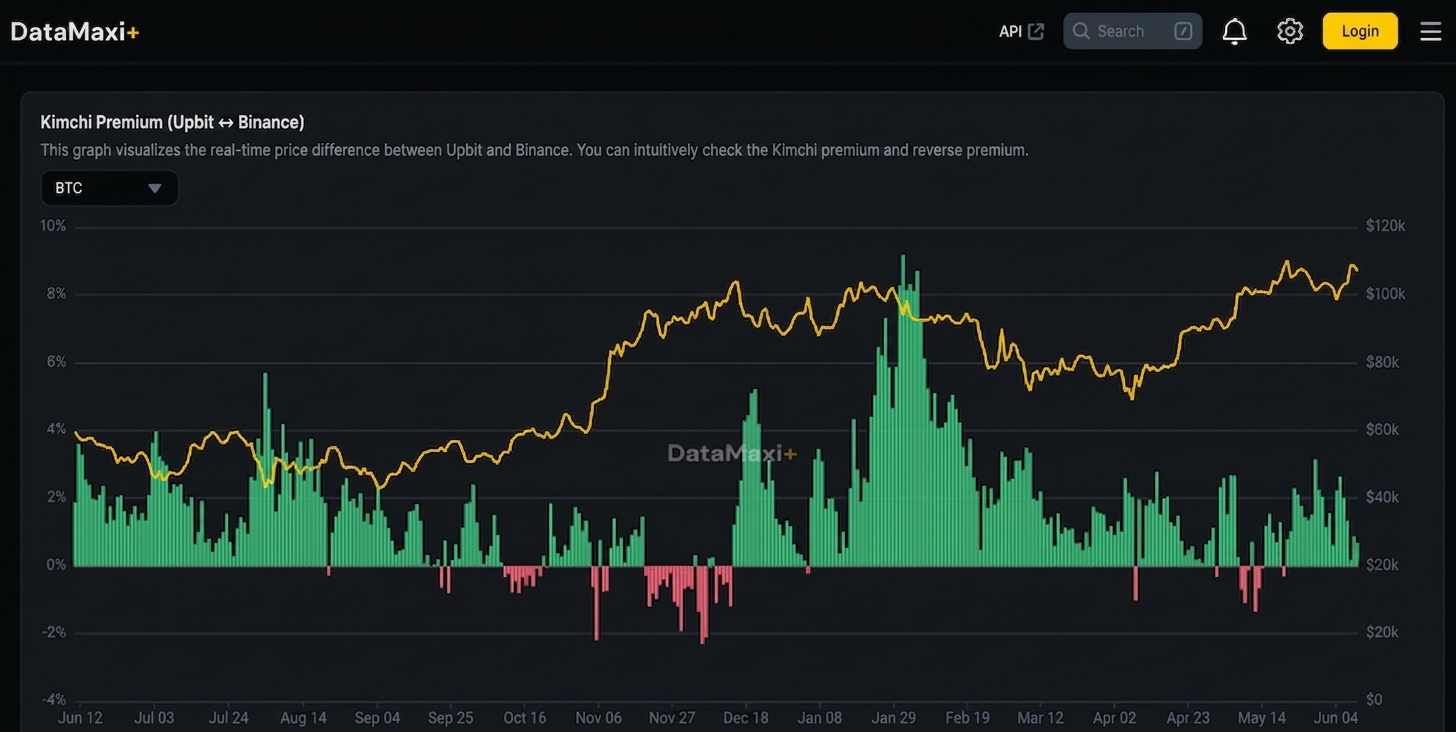
This chart shows by what percentage Bitcoin was more expensive in Korea than overseas.
Green marks the days Korea was more expensive than overseas, and red marks the days Korea was cheaper than overseas.
You can see that in most cases Korea is more expensive than overseas.
So how exactly is this premium calculated?
Many people are curious about this,
and while the calculation itself is simple, it includes one important variable: the "exchange rate."
Kimchi premium formula =
(domestic exchange price − overseas exchange price converted to KRW) / overseas exchange price converted to KRW * 100
For example, let's calculate it based on the time of writing this post.
Overseas exchange Bitcoin price: $105,000
Current USD/KRW exchange rate: 1,400 KRW
Domestic exchange Bitcoin price: 150,000,000 KRW
In this case, we first convert the overseas Bitcoin price into KRW.
$105,000 * 1,400 KRW = 147,000,000 KRW
Now, plugging this value into the formula gives us the Kimchi premium.
(150,000,000 KRW − 147,000,000 KRW) / 147,000,000 KRW * 100 ≈ 2.04%
In other words, the Kimchi premium at this moment is about 2.04%.
2. Why Does the Kimchi Premium Arise, and Why Doesn't It Disappear?
Why does the Kimchi premium arise,
and why, once it exists, does it persist instead of disappearing?
Let's look into the reasons.
1. The difficulty of moving capital
The Korean won is a closed currency,
so it's difficult for Koreans to directly remit large sums abroad.
Moreover, under foreign-exchange law, Korea prohibits
converting won into foreign currency for the purpose of arbitrage.
Because of this, the arbitrage route where a Korean sends won overseas,
buys cheaply abroad, and moves it back to Korea
is effectively blocked.
Foreign-currency remittance through a bank is also cumbersome and time-consuming for individuals,
and there are purpose restrictions, so it's practically very hard to pull off.
These constraints isolate the Korean crypto market from the global market,
and let an independent price form within it.
2. KRW crypto exchanges are usable only by Koreans
Unless they are foreigners residing in Korea, foreigners cannot sign up for KRW exchanges like Upbit and Bithumb.
And if a foreigner resides in Korea and uses a domestic bank,
they are subject to foreign-exchange law just like Koreans.
This means the route where a foreigner buys a coin cheaply abroad
and sells it at a higher price on a Korean exchange is blocked.
Because global capital cannot flow into Korean exchanges,
even when a price difference arises, the supply route that could resolve it is cut off.
This is the core structure that keeps the Kimchi premium from naturally disappearing.
3. Korea's coin trading volume is quite large relative to its economy, and Korea's overheated buying sentiment
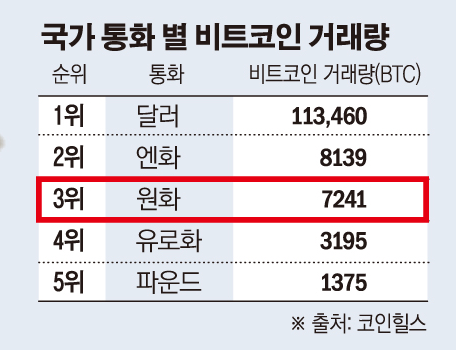
By world GDP ranking Korea is an upper-middle country,
but its share of crypto trading is large enough to rank in the global TOP 5 — trading volume is very high.
In particular, Korea has a large pool of young investors
and a strong speculative tendency to make big money in "one shot."
When a bull market begins, individual investors pour in en masse
through YouTube, communities, recommendations from acquaintances, and so on,
and as the FOMO mindset of "if I don't buy now, I'll be too late" explodes,
buying pressure piles up.
This kind of psychological overheating
pushes demand up abnormally
and acts as a structure that further widens the Kimchi premium.
4. The language barrier
Because of the language barrier, investors in the Korean market
have fewer opportunities to access English-based global crypto news,
on-chain data, options-position information, and similar data,
and they receive that information more slowly.
Also, the Korean government
prohibits overseas exchanges from offering Korean-language services.
As a result, most Korean investors
end up using only domestic exchanges
and tend to ignore price differences with overseas exchanges.
In addition, even when selling pressure arises overseas alongside news,
it often takes time for Korean investors to become aware of it.
In the end, the information gap becomes another invisible wall that lets the Kimchi premium form and persist.
Overseas exchanges that are written only in English whenever you try to look something up
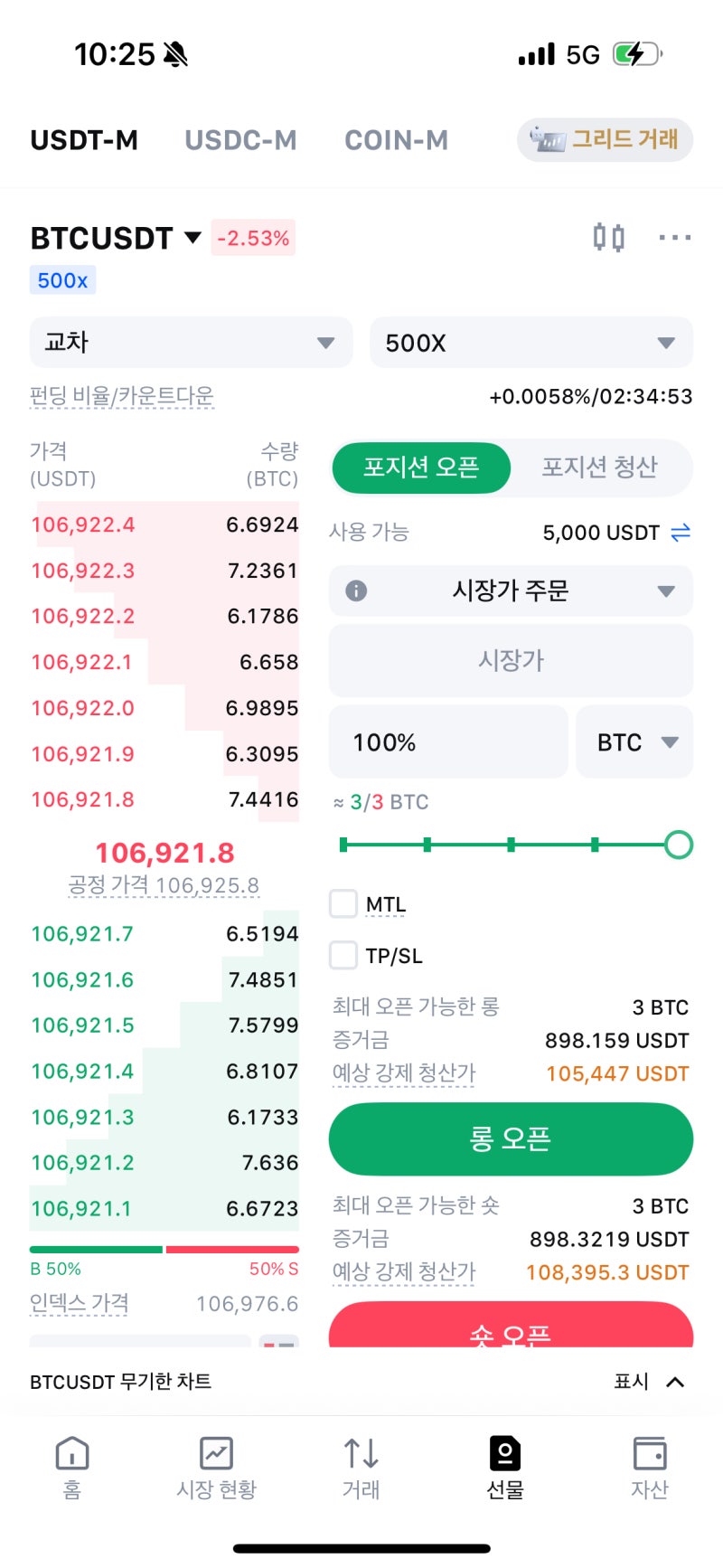
5. The absence of downward pressure and the Tether (USDT) premium
Domestic KRW exchanges, unlike overseas exchanges,
don't have a "short selling (short position)" feature that bets on price declines.
Because of this, even when the market overheats,
the downward pressure that pulls prices down is relatively weak,
so a price that has risen doesn't easily fall, and the premium tends to persist.
6. A market structure centered on individual investors
In the Korean crypto market, participation by corporations or institutional investors is very limited,
and almost everything is driven by individual investors.
Institutional investors usually play the role of
resolving market inefficiencies through arbitrage,
but with such players absent,
individuals' speculative demand is reflected directly in prices,
making price distortions likely to appear.
This market structure, which blocks the inflow of professional and large-scale capital,
is also one of the important causes that generate and sustain the Kimchi premium.
3. The History of the Kimchi Premium
The Kimchi premium is not a fixed figure;
it has changed dynamically along with the history of the Korean crypto market.
Looking at how the Kimchi premium behaved
through the last several major bull markets
provides important clues for understanding today's Kimchi premium.
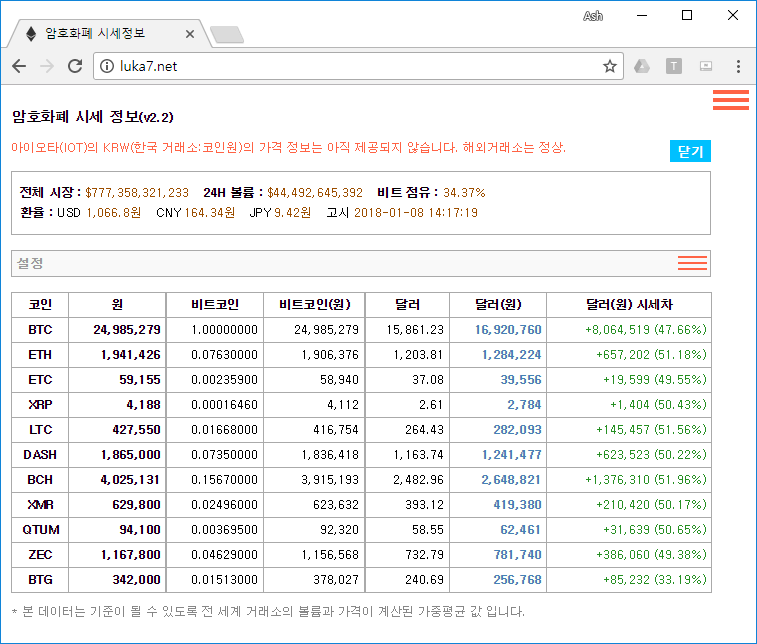
1. Late 2017 to early 2018: The great 60% premium frenzy, and the era of huge windfalls
This was the first period when the words "Bitcoin" and "Kimchi premium"
became imprinted on the public's mind.
In this period, when understanding of crypto was lacking,
a "buy-anything" investment craze swept in and domestic demand quite literally exploded.
Amid this abnormal overheating, the Kimchi premium
soared to a peak of 50–60% — a bizarre phenomenon.
Bitcoin that cost 10,000,000 KRW overseas
traded for over 15,000,000 KRW domestically.
This enormous price difference
brought immense wealth to the peddlers
who bought coins abroad and sold them domestically.
It's known that a significant portion of the startup capital for FTX —
once the world's No. 2 exchange, though now bankrupt —
came from profits earned through Kimchi premium arbitrage.
But in early 2018, alongside the government's strong regulatory remarks (the so-called "Park Sang-gi Rebellion"),
the market cooled sharply, and the Kimchi premium that had reached tens of percent
disappeared in just a few days,
delivering a major shock to investors.
This was the first case to show just how extreme the Kimchi premium's volatility can be.
2. 2020 to 2021: The bull market's return and a premium in the 20% range
In the bull market that returned on the strength of liquidity
after the COVID-19 pandemic,
the Kimchi premium reared its head once again.
In the first half of 2021, as the market overheated again,
the Kimchi premium hovered around and above 20%, staying at a high level.
That said, it didn't climb to the extreme levels of over 50% seen in 2017.
This was because investors who had experienced the first bull market
had come to recognize the risks of the Kimchi premium,
and arbitrage strategies like "entry/exit"
began to become known among some investors,
so the same complete inefficiency as in the past
didn't repeat.
Even so, a Kimchi premium in the 20% range
was still a figure that showed how severe
the disconnect between the global market and the Korean market was.
3. 2023 to 2024: The ETF era and a "New Normal" of around 10%
In the most recent bull market, sparked by the approval of U.S. spot Bitcoin ETFs,
the Kimchi premium showed yet another pattern than before.
The market was extremely hot, with Bitcoin breaking 100,000,000 KRW,
but the Kimchi premium was largely kept in check at around 10%.
Of course, there were spike periods where it shot well past 10% in the short term,
but the prolonged, ultra-high-premium state of the past did not appear.
This is thought to be because market participants have grown more mature,
and as more traders monitor and respond to the premium in real time
through professional information platforms like DataMaxi+,
the market's efficiency has become higher than in the past.
In other words, the Kimchi premium is still a core feature of the Korean market,
but the range of its fluctuations appears to be gradually finding a more stable "New Normal."
In this way, the history of the Kimchi premium is like a mirror
that directly reflects the maturity of the Korean crypto market
and the changes in investor psychology.
From the frenzies of the past to the gradually stabilizing picture of the present,
understanding the flow of the Kimchi premium
will provide important wisdom for building future investment strategies.
4. Key Features and Patterns of the Kimchi Premium
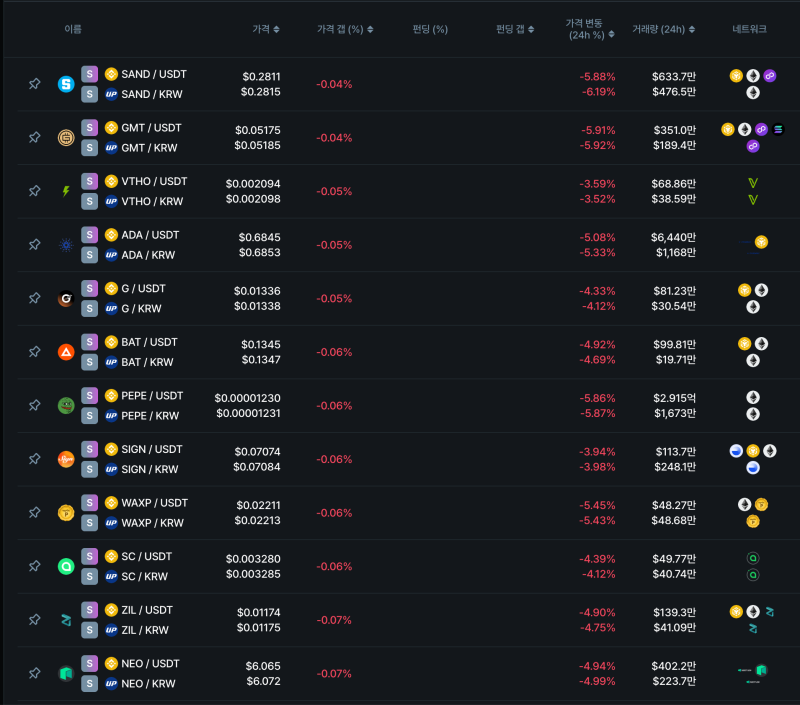
1. The Kimchi premium stays similar across all coins
The Kimchi premium is not a phenomenon that occurs only on one specific coin;
it tends to apply across the entire Korean won (KRW) market.
So the Kimchi premium tends to stay similar across all coins.
If Bitcoin's Kimchi premium is 3%, in most cases the Kimchi premium of other coins
also forms within a similar range of 2.5%–3.5%.
This too is a market equilibrium created by arbitrage traders.
For example,
suppose every other coin has a Kimchi premium of 3%,
but only coin A has a Kimchi premium of 8%.
Then arbitrageurs will buy another coin,
sell it for dollars overseas,
and then buy coin A overseas.
And by bringing coin A back into Korea and selling it,
they earn a 5% profit.
If this process repeats,
the continued selling of coin A
naturally shrinks coin A's Kimchi premium.
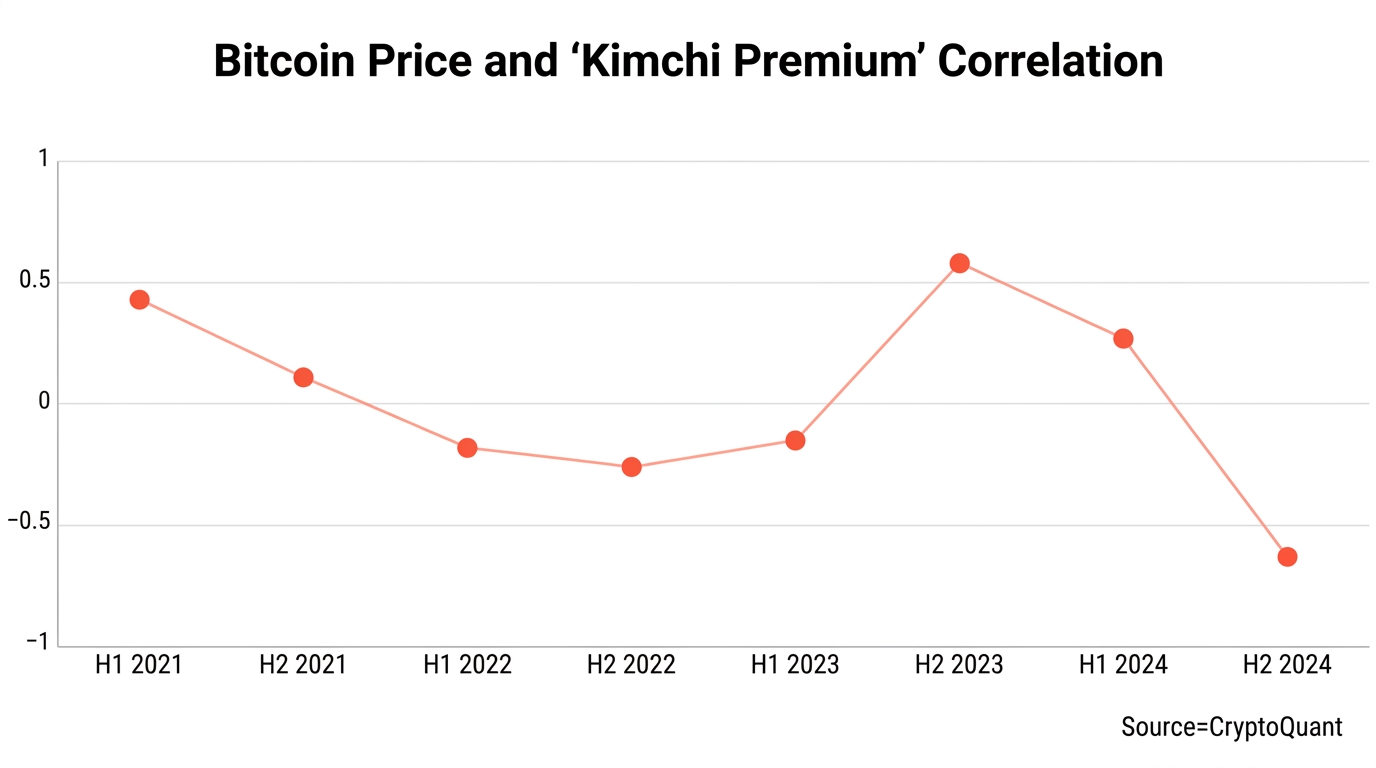
2. It tends to grow in bull markets, and shrink or turn into a reverse (negative) premium in bear markets
The size of the Kimchi premium is very closely related to the overall trend of the market.
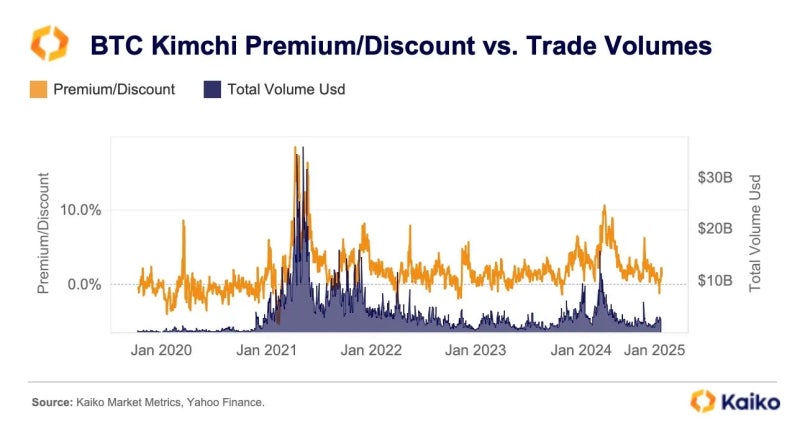
In general, in a bull market the Kimchi premium tends to grow.
This is because domestic individual investors caught up in FOMO
flow in aggressively with buying pressure
and are willing to pay higher prices than overseas.
Conversely, in a bear market
the Kimchi premium shrinks, and in severe cases prices fall below overseas —
the "reverse (negative) premium" phenomenon arises.
This is because, gripped by fear, investors'
selling pressure to convert assets back into won
acts more strongly.
This is strongly tied to the investment psychology of Korean individual investors.
3. It serves as a "thermometer" reflecting domestic investor sentiment
Connected to the feature above,
the Kimchi premium serves as an excellent
"sentiment indicator" or "thermometer" that lets you gauge the degree of overheating
or stagnation in the domestic crypto market.
For example, if the Kimchi premium exceeds 5% and keeps rising,
this can be interpreted as a warning signal
that the domestic market is overheated in the short term.
Conversely, if a reverse premium arises and its depth grows,
this means that panic selling in the domestic market has reached its peak,
and for some people it can even become an indicator for gauging the bottom.
Also, when doing "Won-Sangttari" (KRW-listing arbitrage), which we'll cover later,
it can serve as a supplementary indicator for reading domestic buying pressure and investor sentiment.
(in order to judge whether a "Sangttari" will be a winner or a loser)
4. When specific events occur, premiums for individual coins can temporarily diverge
Basically the Kimchi premium of all coins stays similar (Feature 1),
but when a specific event occurs, this balance can temporarily break.
For example, when a specific coin newly lists exclusively on a domestic exchange,
buying pressure piles up early on, and that coin alone can pick up an
abnormal "listing premium" of 20%, sometimes over 100%.
Also, if deposits and withdrawals for a specific coin are suspended for a long time
due to a wallet maintenance or network issue,
that coin becomes isolated from the external market
and forms its own independent premium (or reverse premium).
Arbitrageurs sometimes catch these "individual coin" imbalances
to target additional profit opportunities.
We'll cover the fine details of this, with real cases and investment methods, in a later post.
5. Price-Divergence Phenomena Similar to the Kimchi Premium
5-1. The opposite phenomenon: what is the reverse (negative) premium?
The characteristic where Korea's crypto prices stay different from overseas
also works in reverse.
Often the so-called reverse premium (reverse Kimchi premium) appears —
the phenomenon where Korea's coin prices are cheaper than overseas.
In this case, you can buy in Korea and then
transfer the coin to an overseas exchange to sell it for a profit.
Small-scale reverse premiums occur frequently as the market rises and falls,
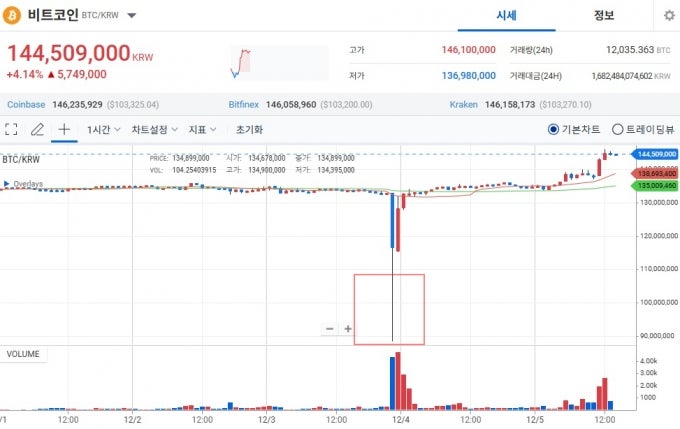
but there have also been times when a very large reverse premium occurred, like last December.
This is the so-called "martial-law beam" incident.
Last December, when former President Yoon Suk-yeol declared martial law,
domestic investors fell into panic,
and immediately after the martial-law declaration, panic selling emerged in Korea,
creating a reverse-premium situation where coins traded tens of percent cheaper than overseas.
The imbalance in the market was so severe that there were even considerable premium differences between coins.
At that time, some arbitrageurs caught this opportunity
and built positions by buying coins with large reverse premiums on Upbit and Bithumb
while hedging through futures short selling on overseas exchanges.
Then, after transferring the spot they bought on Upbit overseas,
they sold the spot and simultaneously bought futures,
realizing the reverse-premium profit.
In this way arbitrageurs can resolve market imbalances
and generate profit at low risk.
5-2. A premium on another asset: the gold Kimchi premium phenomenon
In fact, this premium phenomenon
isn't found only in the crypto market.
Notably, in the gold (Gold) market — a safe-haven asset —
a "gold Kimchi premium" exists.
If you examine the gold Kimchi premium too,
you can see that it forms through a structure similar to crypto.
The process of formally importing gold domestically is complex,
and gold for individuals or retail use
can be subject to taxes such as value-added tax (10%).
Because of these institutional barriers,
price differences can arise, but
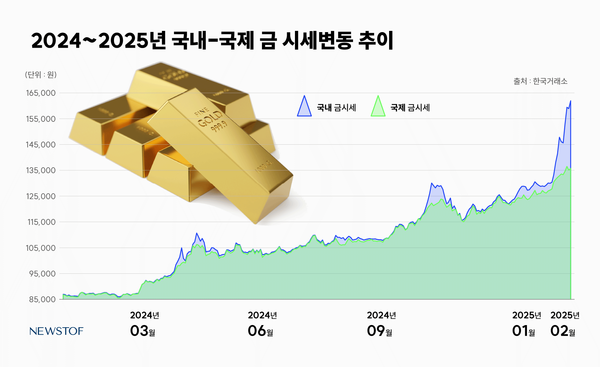
under normal circumstances the domestic gold price
typically maintains a slight premium of, on average, less than 1%
compared with the international price.
But in February of this year, 2025, when safe-haven preference exploded
and domestic gold demand surged,
this "gold Kimchi premium" at one point approached 20% — an unusual event.
This was because, due to the structural barriers of taxes and customs procedures,
the formally imported supply couldn't keep up with the explosive domestic demand.
The gold market's barrier of "taxes and customs"
plays the same role as the crypto market's barrier of "foreign-exchange law and regulation."
Both markets normally show small price differences, but
when the demand shock of strong domestic buying pressure is added,
the premium increases explosively.
Just as, when a Kimchi premium attaches to crypto,
many arbitrageurs bring coins they had placed on overseas exchanges back into Korea
and sell them for won,
when a Kimchi premium attaches to gold too, peddlers try to bring gold into Korea from abroad.
In the end, the Kimchi premium is not a bizarre phenomenon unique to the crypto market;
it's a universal economic phenomenon that arises when an isolated market meets demand,
and you can think of it as a case where, due to the nature of digital assets, its volatility appears even more dramatically.
5-3. Premium cases in other countries
You might think the Kimchi premium is a peculiar phenomenon unique to Korea,
but in fact this kind of price divergence appears in various forms
in several countries that meet certain conditions.
Each country's case clearly shows the common principle that,
even though the cause of the premium may differ,
when "disconnection from the outside" meets "internal demand,"
a premium is bound to arise.
1. A "lookalike premium" created by speculative demand — Japan's Sushi premium
The case most similar to Korea is
the "Sushi premium (スシプレミアム)" that arises in Japan.
Japan also has strict crypto regulation,
and trading centered on its own currency, the yen (JPY), dominates.
Because of this, the phenomenon where coin prices on Japanese exchanges
form higher than overseas is often observed.
It arises in a much smaller range than the Kimchi premium, and only occasionally.
In that it arises mainly from market overheating and speculative demand,
it can be said to most closely resemble the Kimchi premium.
2. A "survival premium" to escape inflation — Nigeria and Argentina
There are also cases where the premium goes beyond speculative demand and becomes a matter of "survival."
In countries like Nigeria and Argentina, where the value of the national currency is unstable
and hyperinflation occurs,
citizens turn to Bitcoin
as a desperate means of preserving the value of their assets.
Amid strong foreign-exchange controls,
as "survival-based demand" to buy Bitcoin surged,
the Bitcoin price in those countries naturally
came to form a premium far higher
than the international price.
3. An "asset-escape premium" born of financial collapse — the Afghanistan case
The most dramatic cause of a premium
is the collapse of the social system itself.
When the Taliban seized Afghanistan in August 2021,
the U.S. freezing of assets and the halt of SWIFT transactions
effectively paralyzed the country's banking system.
The value of the Afghani currency plummeted,
even withdrawing cash from ATMs became impossible,
and the route for overseas remittance was blocked.
Amid this financial catastrophe,
Bitcoin — which allows borderless peer-to-peer (P2P) transfers —
emerged as almost the only "financial lifeline"
and means of "asset escape."
As desperate demand to obtain Bitcoin exploded within a completely isolated market,
the Bitcoin price in Afghanistan at the time
recorded an enormous premium up to 50% higher than the international price.
What's interesting is that while even dollar-pegged stablecoins
were not free from the impact of U.S. financial-system sanctions,
decentralized Bitcoin showed it could circumvent these controls.
This was a case that showed Bitcoin can have real value
in extreme crisis situations, beyond being a mere speculative asset.
Although the premium later disappeared due to the Taliban's crypto ban,
this event clearly shows how geopolitical instability and the collapse of the financial system
generate extreme premiums.
In this way, although the backgrounds of each country's premium differ —
speculative demand (Korea, Japan),
store-of-value demand (Nigeria), asset-escape demand (Afghanistan) —
the core principle that price divergence arises
when an isolated market meets strong internal demand
operates identically.
6. So What Does the Kimchi Premium Mean for Investors?
So what does this Kimchi premium
mean for domestic investors?
Beyond the simple fact that it's more expensive than overseas,
it becomes another variable that directly affects
your actual investment profit and loss.
In other words, a domestic investor's investment performance is determined
by two factors:
"the price movement of the coin itself" + "the movement of the Kimchi premium"
For example, suppose I buy Bitcoin
and the global price of Bitcoin then rises 10%.
If at this time the Kimchi premium also rose together from 2% to 4%,
my actual return in won (KRW) terms gets a double benefit that comfortably exceeds 10%.
Conversely, if despite Bitcoin's price rising 5%,
the Kimchi premium plunged from 5% to 0%,
it could become an ironic situation where the coin's price went up
but my account shows a minus.
Therefore, investing in crypto in the Korean market
is essentially the same as simultaneously investing in the value of that coin
and in the volatility of the Kimchi premium.
The Kimchi premium is sometimes called "key money" among domestic crypto investors.
This is because it has something in common with the key money in commercial real-estate deals.
A person buying a commercial property
may at first find it galling to pay
for the intangible value called key money.
The Kimchi premium is the same: when a Korean first buys a coin
with the won they hold, they have no choice but to pay the Kimchi premium.
But just as you can also receive key money when you sell the store and leave,
even though it's somewhat unfair to pay it at first,
the feature is that in the end, when you sell for won, you too can sell and collect the Kimchi premium.
There's even a professional Kimchi-premium trading method
that trades only the fluctuations of this key money — we'll cover this in detail in the hands-on installment.
Among Kimchi premiums, the one that forms on Bitcoin or Tether (USDT)
is sometimes separately called the base premium (jeongpeu).
The base premium serves as the reference point for the Kimchi premium.
And comparing each altcoin's premium
against this "base premium" is very important.
This is because, beyond a simple price difference with overseas,
it lets you grasp which coins within the domestic market
are relatively overvalued or undervalued.
This lets you catch new arbitrage opportunities
that exploit the premium gaps between coins,
and it also becomes a measure for judging whether sentiment toward a specific coin is overheated.
For this kind of precise comparison,
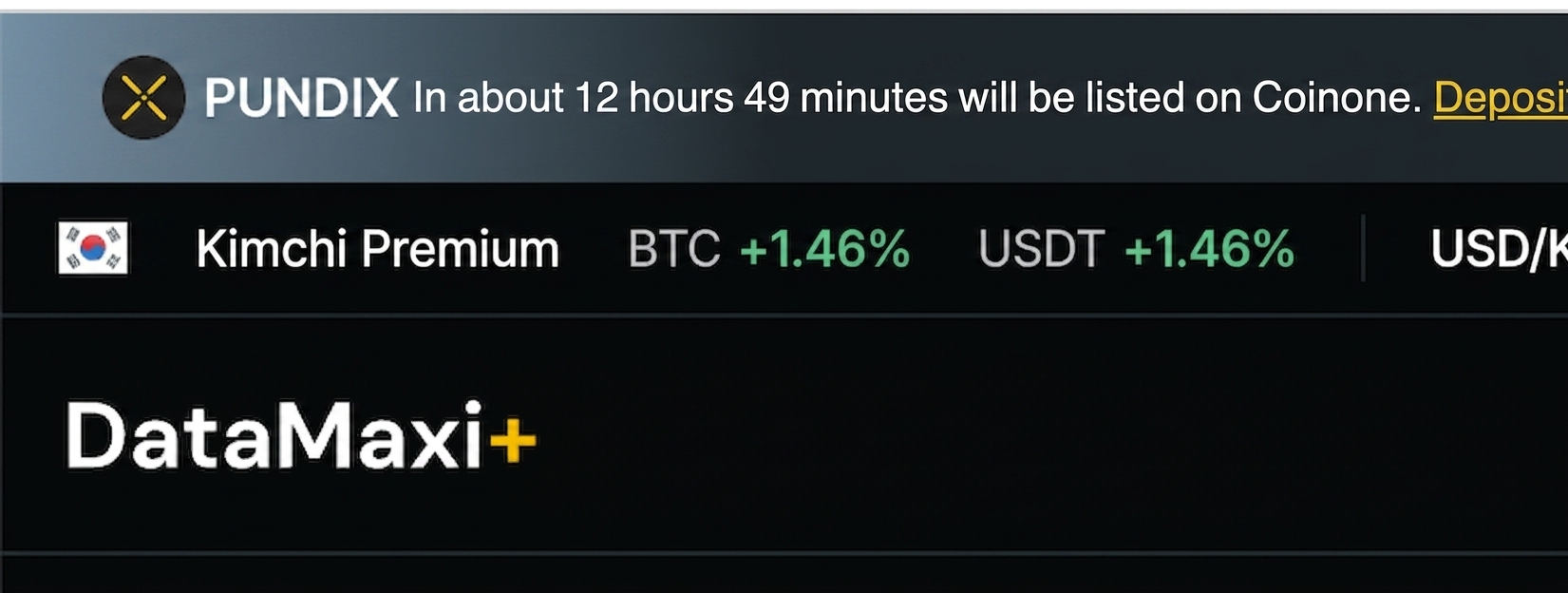
DataMaxi+ calculates and provides the "base premium" based not on
the simple most-recent trade price but on the average of the real-time
best bid/ask quotes,
helping arbitrageurs make more accurate judgments.
Wrapping Up
Today, through the single phenomenon of the Kimchi premium,
we looked at it from many angles — from its definition and calculation method to the fundamental causes of its emergence,
its dynamic history, and the various features
that reveal the market's temperature.
Now we've learned that the Kimchi premium, beyond the surface-level fact that
"Korea is more expensive," is a "living market indicator"
created by the intertwining of the structural characteristics of Korea's crypto market (regulation, constraints on capital flow)
and investors' complex psychology.
Therefore, understanding the Kimchi premium
is not merely a homework assignment for arbitrageurs alone.
This is because, for every investor trading coins in won (KRW) on a domestic exchange,
the Kimchi premium acts as a "second variable" that, alongside the price movement of the coin itself,
determines their final return.
These characteristics of the Kimchi premium can be a source of unexpected losses
for an uninformed investor, but for an investor who properly understands
its principles and features and prepares for them,
it opens the door to a new opportunity to generate stable profit
regardless of the market's ups and downs.
I hope today's content has become a solid foundation for you to understand the Kimchi premium more deeply,
and further, to make wise use of it.
Building on the theoretical knowledge we covered today,
in the next installment I'll introduce, with detailed cases,
various trading strategies that exploit the actual volatility of the Kimchi premium,
along with hands-on tips using DataMaxi+.
Thank you for reading this long post.
- arbitrage
- crypto
- education
- kimchi-premium