Lecture 5. How Funding Rates Work and Basic Strategies (The Core Mechanism of Perpetual Futures)
How funding rates — the core of perpetual futures — work, and the basic arbitrage strategies built on them.
What Is the Funding Rate and Why Does It Matter?
What if there were a way to earn steady returns,
almost like bank interest, regardless of whether coin prices rise or fall?
Most investors think of crypto investing only as
directional trading — "buy when it's cheap, sell when it's expensive."
But if you look deeper into the derivatives market,
there are various other opportunities hidden beyond price prediction.
At the center of these is a unique mechanism called the "funding rate (Funding Fee)."
If the "Kimchi premium" we covered in Part 4
was a strategy that exploits the inefficiency between two places (domestic vs. overseas),
the "funding rate" we'll cover this time is
a more advanced arbitrage strategy that targets the structural gap
between two products (spot vs. futures).
Understanding this "funding rate (Funding Fee)" mechanism,
which is like the heart of the crypto derivatives market,
can be the key that opens the door to new profits beyond the realm of price prediction.
And it's a concept you absolutely must understand
in order to execute arbitrage strategies.
This time, we'll learn from A to Z about what the funding rate is,
why it exists, and the principle by which it works.
1. The Basic Principle of the Funding Rate
1-1. The Backdrop of the Funding Rate: The Birth of Perpetual Futures
To understand the funding rate, you first need to know
the backdrop behind the birth of a product unique to the crypto market:
the "perpetual futures contract."
The limitations of traditional futures
In the ordinary stock or commodity markets, futures contracts have
an "Expiration Date."
When this expiration date arrives, the spot asset is delivered to the futures holder,
the futures price is forced to equal the actual asset's price (the spot price),
and all positions are terminated (settled).
For traders who want to predict long-term price increases (long)
or decreases (short) and keep holding their positions,
this was a very inconvenient constraint.
Each time expiration approached, they had to liquidate their existing position
and newly buy/sell a futures contract for the next expiration —
a "Roll-over" process —
and this process incurred an additional trading cost, the roll-over cost, as well as hassle.
A new invention: the perpetual futures contract
To overcome these limitations of traditional futures,
crypto derivatives exchanges
created an innovative financial product that lets you hold a position
forever, with no expiration date.
This is exactly the "Perpetual Futures Contract."
As long as they aren't forcibly liquidated, traders can now
hold their positions indefinitely for as long as they want,
and this provides an intuitive trading experience much like spot trading,
which led to its explosive popularity.
The funding rate as a fundamental question and its answer
But here a fundamental problem arises. "If there's no expiration, how can you make the futures price move together with the actual coin's spot price?" In traditional futures products, the spot and futures prices converged as the time value disappeared while expiration approached, but in the perpetual futures contract, the expiration mechanism is gone. So perpetual futures came with the risk of the price drifting away from the spot price, and a way to solve this was needed.
The ingenious and elegant device devised to solve this problem is exactly the "funding rate (Funding Fee)." The funding rate serves to periodically anchor the perpetual futures market's price to the spot price.
1-2. How the Funding Rate Works
What is the funding rate?
The funding rate is a periodic settlement payment
that long-position holders and short-position holders
exchange directly with each other in the perpetual futures market.
Many people mistake it for a fee that the exchange takes,
but the exchange generally doesn't take a single cent.
(For the unusual case of B-book exchanges, I'll explain in a later advanced installment.)
The funding rate is purely money that moves between market participants,
and the exchange does not intervene in this process.
The funding rate's sole purpose is to balance the price of the futures market and the price of the spot market.
The direction of the funding rate: who receives and who pays?
The direction of the funding rate and who pays it are determined by the difference between the futures price and the spot price.
Positive (+) funding rate (a typical bull/sideways market, or strength in an individual coin)
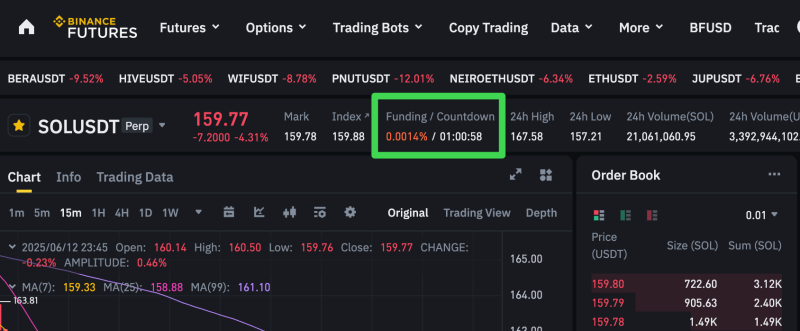
The area marked in the image above is the area that displays the funding rate.
A positive funding rate (so-called "yang-pun" or "yang-pun-bi") occurs when the futures price is higher than the spot price. This is a signal that market participants view future prices more optimistically, and it means an overheated state where long (buy) positions dominate. It's a situation similar to "Contango" in traditional markets.
In this case, to balance the market, long-position holders pay the funding rate to short-position holders like a "penalty." This raises the cost of holding a long position to cool the overheating, and conversely provides an incentive to enter short positions, producing the effect of pulling the futures price back toward the spot price.
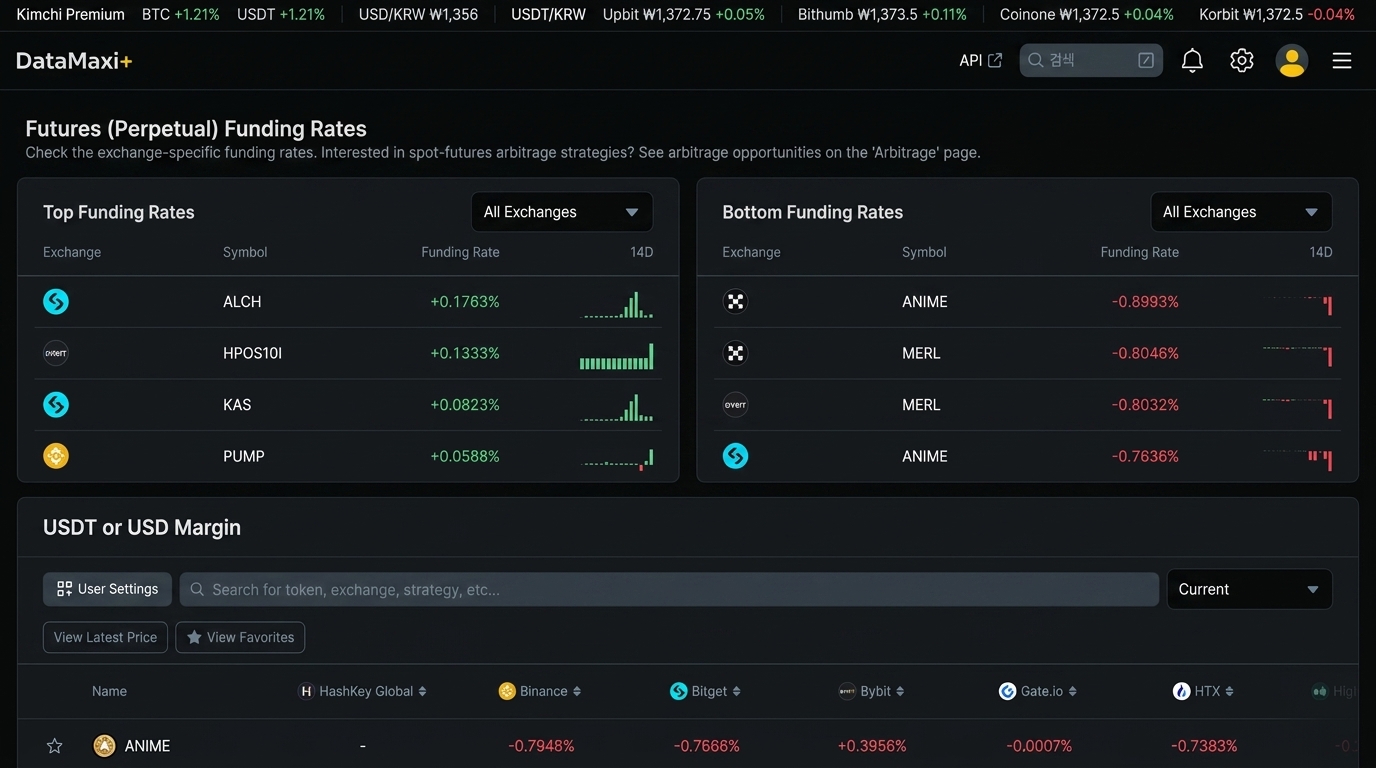
When you go into DataMaxi+'s funding rate menu like this, you can check the funding rate status of all major exchanges in real time, with no delay.
Negative (−) funding rate (a typical bear market, or a downtrend in an individual coin)
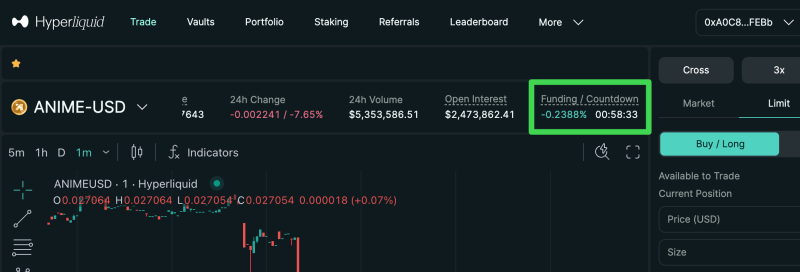
A negative funding rate (so-called "eum-pun" or "eum-pun-bi") occurs when the futures price is lower than the spot price.
It means market participants view the future pessimistically,
and it's a depressed state where short (sell) positions dominate.
It's similar to "Backwardation" in traditional markets.
This time, conversely, short-position holders pay the funding rate to long-position holders.
This imposes a cost on holding short positions
to curb excessive pessimism,
and provides an incentive to enter long positions,
producing the effect of pulling the futures price up toward the spot price.
2. Practical Analysis and Use of Funding Rate Data
2-1. Reading Advanced Indicators Together: Funding Rate and Open Interest (OI)
Open interest isn't directly related to arbitrage,
but looking at the funding rate and open interest together helps when forming a directional-trading view.
Analyzing open interest (Open Interest, OI) together with the funding rate
lets you understand the market's direction more deeply.
Open interest is the total quantity of futures contracts currently outstanding and not yet settled,
and it's a key indicator of the scale of capital that has flowed into the market and the level of participation.
High positive funding rate + high open interest:
This means a healthy and strong uptrend formed
as new capital keeps flowing into the market.
There's a high probability it's a "real rally" that many participants agree on.
High positive funding rate + low open interest:
If the funding rate is high but open interest is stagnant or declining,
this may be a situation driven by a small number of positions.
The trend's sustainability may be low, or it may be artificial movement by so-called "whales," so caution is needed.
Sharp changes in open interest:
A sharp decline in open interest means
large positions are being liquidated along with the end of the existing trend.
This becomes an important signal that the funding rate's direction may change abruptly.
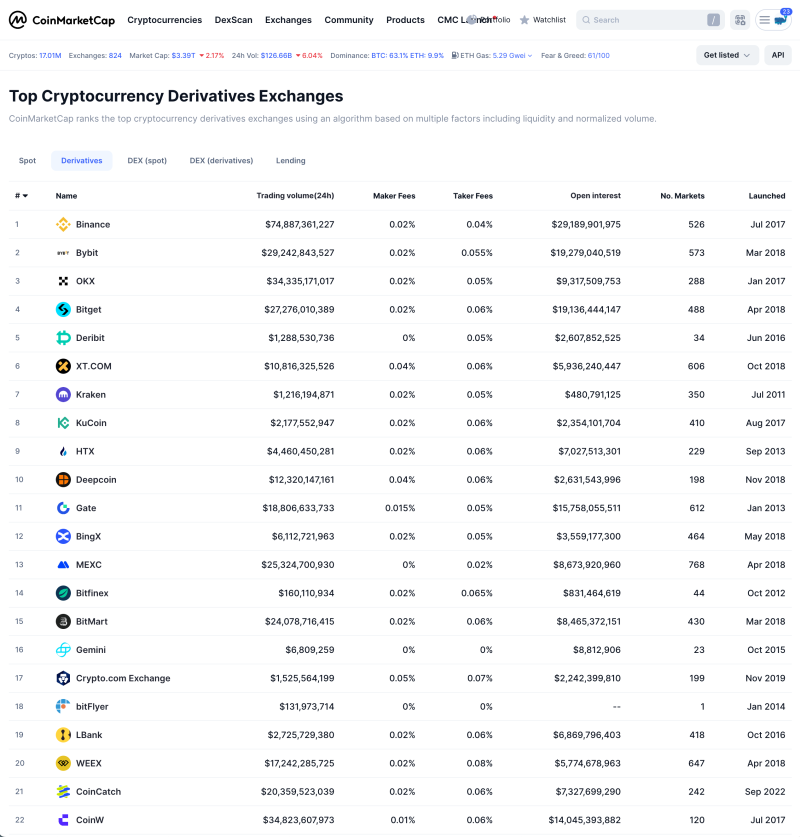
2-2. Reading Market Sentiment: The Interaction Between the Funding Rate and Price
The funding rate is not a direct cause that moves price.
Rather, it's more accurate to say that the "cause" of a price difference produces the "result" that is the funding rate.
However, the funding rate indirectly affects price.
A sentiment indicator:
The funding rate is an excellent "thermometer" that reflects the collective psychology of market participants.
A persistently positive funding rate indicates market optimism and greed, while a negative funding rate indicates pessimism and fear.
Pressure on price:
A very high positive funding rate induces longs to exit (taking profit or cutting losses),
forming potential selling pressure.
Conversely, an extremely negative funding rate puts heavy pressure on short-position holders,
causing them to liquidate their positions (short covering),
which triggers a "Short Squeeze"
and can become a powerful catalyst for a short-term price rebound.
This mechanism is also something you should know when targeting arbitrage opportunities in a coin being driven by manipulators,
in order to predict the manipulators' intent and movements.
The GAS incident of November 2023 is presumed to have been driven by manipulators,
who accumulated GAS and pushed the price up more than tenfold.
And as countless market participants took short positions,
an enormous negative funding rate occurred, and if the manipulators had taken a long position at that point,
they could have received an enormous funding rate of 17% of their position size in just two days.
And at that time, every few hours on Upbit
a Kimchi premium of more than tens of percent appeared and disappeared
repeatedly, giving arbitrageurs opportunities too.
2-3 Catching the "Event" Signal: The Negative Funding Rate Created by Hedging Demand
The negative funding rate environment created by hedging demand
Arbitrageurs build spot-long + futures-short positions in order to capture
various arbitrage opportunities — KRW listings, airdrops, Launchpools, DeFi incentive programs (so-called "Daedong River water") and more —
while at the same time avoiding exposure to price movements.
In this case, because futures sell positions become abundant across the entire market,
a negative funding rate occurs.
And the people who built positions keep paying the funding rate as a cost of holding the position.
When building an arbitrage position,
you must consider both the holding period and the expected funding-rate cost that comes with it
in order to set up a high-accuracy arbitrage strategy.
And if a particular coin's futures funding rate is unusually large,
there may be an arbitrage opportunity somewhere that you don't know about.
Using a special situation: the relationship between the "KRW-listing beam" and the funding rate
Understanding the funding rate becomes an even more powerful weapon in special situations related to the "Kimchi premium."
When an announcement drops that a particular coin will be listed
on an influential market such as the Upbit KRW market,
a listing beam and a spot–futures gap occur,
and with high probability a Kimchi premium also occurs after trading begins.
This is a phenomenon caused by the strong buying pressure of Upbit retail investors (so-called "Upbit-ssi").
I'll cover arbitrage related to KRW listings in detail in the next post,
but there's a reason you need to know the funding rate when participating in KRW-listing arbitrage (so-called "Won-Sangttari" — KRW-listing arbitrage).
It's precisely because, when you buy spot on an overseas exchange to do Won-Sangttari
and sell futures to build a hedging position,
you have to pay a cost if the holding period overlaps with the funding-rate payment time.
Sometimes, when the start of trading is delayed, arbitrageurs
keep paying the funding rate and suffer for it.
In this case, calculating the funding rate accurately is a very important factor in setting up an arbitrage strategy.
3. Core Funding Rate Arbitrage Strategies
Once you understand the principle of the funding rate, it's now time to learn how you can actually use it in investment strategies.
And we'll look at the specific types and structures of funding rate arbitrage strategies.
3-1. The Common Principle: The Delta-Neutral Position
As briefly mentioned earlier, at the heart of every funding rate arbitrage strategy
is the concept of "Delta Neutral."
This refers to a hedged state that makes the profit and loss from a coin's price movement "zero."
It means designing your position so that your asset value is unaffected whether the price rises or falls.
Depending on the situation and strategy, the funding rate can be your cost,
or the funding rate can be your source of income.
But maintaining delta-neutral so as not to be exposed to price movement and direction
is the basic mindset of the arbitrageur.
3-2. Strategy A: The Spot–Futures Funding Rate Collection Strategy
This is the most basic and widely used stable funding rate trading strategy.
For large-cap coins, most market participants think they'll trend upward.
So many people build long positions.
Because of this, the funding rate is positive for most of the time.
In other words, this means that if you build a short position, you can receive the funding rate for most of the time.
Without being exposed to coin price movements,
if arbitrageurs buy spot and sell an equal quantity of futures,
they can continuously receive the funding rate on the amount sold.
For instance, in the case of Ripple, the cumulative total on Binance over one year
came out to about an 11% funding rate.
With a total of 200,000,000 KRW in assets, if you buy 100,000,000 KRW worth of Ripple spot
and build a 100,000,000 KRW worth of futures short position,
funding rate income of 11,000,000 KRW per year is generated.
This position is in a perfect delta-neutral state.
If Bitcoin's price rises 10%, you make a 10% gain on the spot,
but you take a 10% loss on the futures short position, which offsets it.
If the price falls, it's the reverse.
With price-movement risk completely removed,
the sole source of income in this strategy is to stably collect
the positive funding rate paid periodically as a short-position holder.
3-3. Strategy B: The Cross-Exchange Funding Rate Spread Strategy
This strategy is a higher-level technique that generates funding rate income with only futures positions, without any spot.
The key is to exploit the fact that, for the same coin, the funding rate differs from exchange to exchange.
DataMaxi+ provides the funding rates of multiple exchanges in real time.
On the funding rate page, you scan the funding rate difference for each coin,
and find the coin-and-exchange pairs where the funding rate difference is meaningfully large.
For example, let's say that for Coin A,
Binance has a funding rate of +0.05% and Bybit has +0.01%.
In this case, you can build a funding rate arbitrage position like this:
- Sell (short) futures on the exchange with the higher funding rate (Binance)
- At the same time, buy (long) an equal value of futures on the exchange with the lower funding rate (Bybit)
This position is also in a delta-neutral state.
The profit and loss from coin price movement offsets between the long/short positions on the two exchanges.
The final profit comes only from
"(funding rate received on Binance, 0.05%) − (funding rate paid on Bybit, 0.01%)" = 0.04%
the pure "funding rate spread."
One thing you need to know is that,
while most exchanges settle the funding rate every 8 hours,
there are also exchanges like Hyperliquid that settle the funding rate every 1 hour,
and even within the same exchange, a different funding-rate settlement cycle
may be applied depending on each coin's situation.
For the same coin, when one exchange settles the funding rate every 1 hour
and another exchange settles every 8 hours,
you can also use this to set up a funding rate arbitrage strategy.
3-4. Strategy C: Using the Funding Rate as a Hedging Cost
While so far we've looked at strategies that earn the funding rate itself as "profit,"
this time, conversely, we'll learn a higher-level strategy that willingly pays the funding rate as a "cost"
to target a larger arbitrage gain.
The key to this strategy lies not in the funding rate,
but in safely capturing a clear profit opportunity that exists elsewhere.
For example, opportunities like
① a particular coin's KRW-market listing (listing beam),
② an airdrop targeting holders of a particular coin,
③ the high deposit interest of a particular DeFi protocol are very attractive,
but they carry the risk of having to hold that coin for a certain period.
In this case "delta-neutral" hedging is essential, and it's precisely in this process that the funding rate becomes an "insurance premium you have to pay."
The "paradox of cost" created by hedging demand
When a seemingly almost-certain profit opportunity, like a "KRW listing" or a large-scale "airdrop,"
becomes known to the market,
countless professional traders simultaneously execute the same strategy.
Collective hedging:
Countless traders all at once buy the spot of that coin,
and sell (short) futures to remove price-movement risk.Imbalance in the futures market:
In this process, an enormous volume of "sell (short)" orders floods into the futures market,
putting it into a "backwardation" state where the futures price is lower than the spot price.Negative funding rate occurs:
By the principle of the funding rate, when the futures price is lower than the spot price,
the funding rate turns negative (−),
and short-position holders must pay the funding rate to long-position holders.
In the end, the wise action of "hedging (futures short)" taken to remove risk
paradoxically creates, for all participants, a new form of fixed
"Holding Cost" called the "negative funding rate."
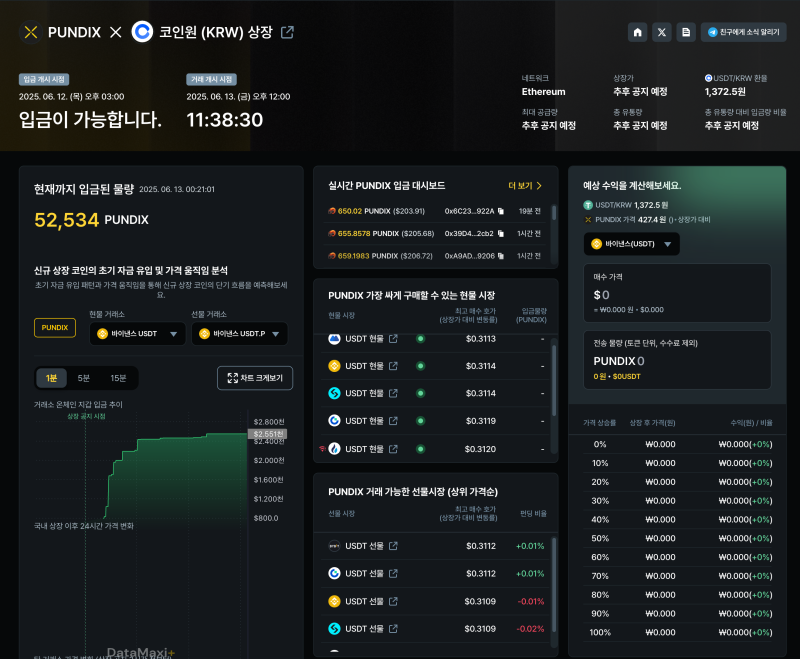
A practical example: profit-and-loss calculation for "KRW-listing" arbitrage
To aid understanding, let's look at a concrete scenario.
The opportunity:
Coin A will be listed on the Upbit KRW market in 18 hours,
and a Kimchi premium of about 20% is expected to occur at listing.The spot–futures gap situation:
Because traders who expect the above have already bought spot and sold futures,
the spot price is already 10% more expensive than the futures.Building the position:
With 11,000,000 KRW, the trader buys n units of Coin A spot on an overseas exchange,
and at the same time hedges by selling (shorting) the same quantity for 10,000,000 KRW in the futures market.Negative funding rate occurs:
As traders targeting this opportunity flock in,
Coin A's funding rate has turned to −1%, settled every 4 hours.Holding cost calculation:
Funding rate cost per settlement: 10,000,000 KRW × 1% = 100,000 KRW
Total funding rate cost (18 hours): 100,000 KRW × 4 times = 400,000 KRW
Final profit-and-loss calculation:
10,000,000 KRW × 20% − 10,000,000 KRW × 10% = 1,000,000 KRW
(the premium at KRW-market listing minus the premium that already existed when entering the position)
Total funding rate cost: 400,000 KRW
Expected net profit (excluding other fees): 1,000,000 KRW − 400,000 KRW = 600,000 KRW
If the listing is postponed by a few more hours,
the funding rate burden can significantly erode the profit.
And if the expected Kimchi premium falls to 14% or below,
since you entered the position having paid a confirmed loss of a 10% premium at entry,
it can likewise turn into a loss.
Like this, in arbitrage that targets a specific event,
the funding rate is no longer profit but an "opportunity cost" that you must absolutely consider.
In addition, the funding rate also serves as a "congestion indicator"
showing how many people that arbitrage opportunity has become known to and flocked toward.
If a particular coin's negative funding rate is abnormally high,
this means countless people are already holding the same position,
and the amount being deposited into KRW exchanges grows accordingly and selling pressure increases too,
which can be a warning sign that the size of the listing beam or the profit may be lower than expected.
Therefore, a successful trader always
(expected arbitrage gain) > (total expected funding cost + all trading fees)
strictly checks this inequality, and keeps the principle of entering only when the net profit is sufficiently attractive.
4. Risk Management and Key Tips for Executing the Strategy
4-1. The Funding Rate Paradox: The Holding Cost of a Hedging Position
As briefly mentioned earlier, when a clear profit opportunity like a "KRW listing" or "airdrop" arises,
countless arbitrageurs set out to hedge with "futures selling" to remove risk.
Their collective action drives the futures price down, inevitably creating a "negative funding rate" environment.
In the end, the action taken to avoid risk
creates a paradox in which a new form of fixed cost
called the "negative funding rate" is generated.
Because this cost occurs throughout the entire time the position is held,
it becomes a key variable that determines the final return of the arbitrage.
4-2. The Importance of Timing: Targeting the Funding Rate Settlement Time
The most basic yet important technique
is to use the funding rate payment time.
The funding rate isn't charged in real time around the clock;
it's "settled" once at set times.
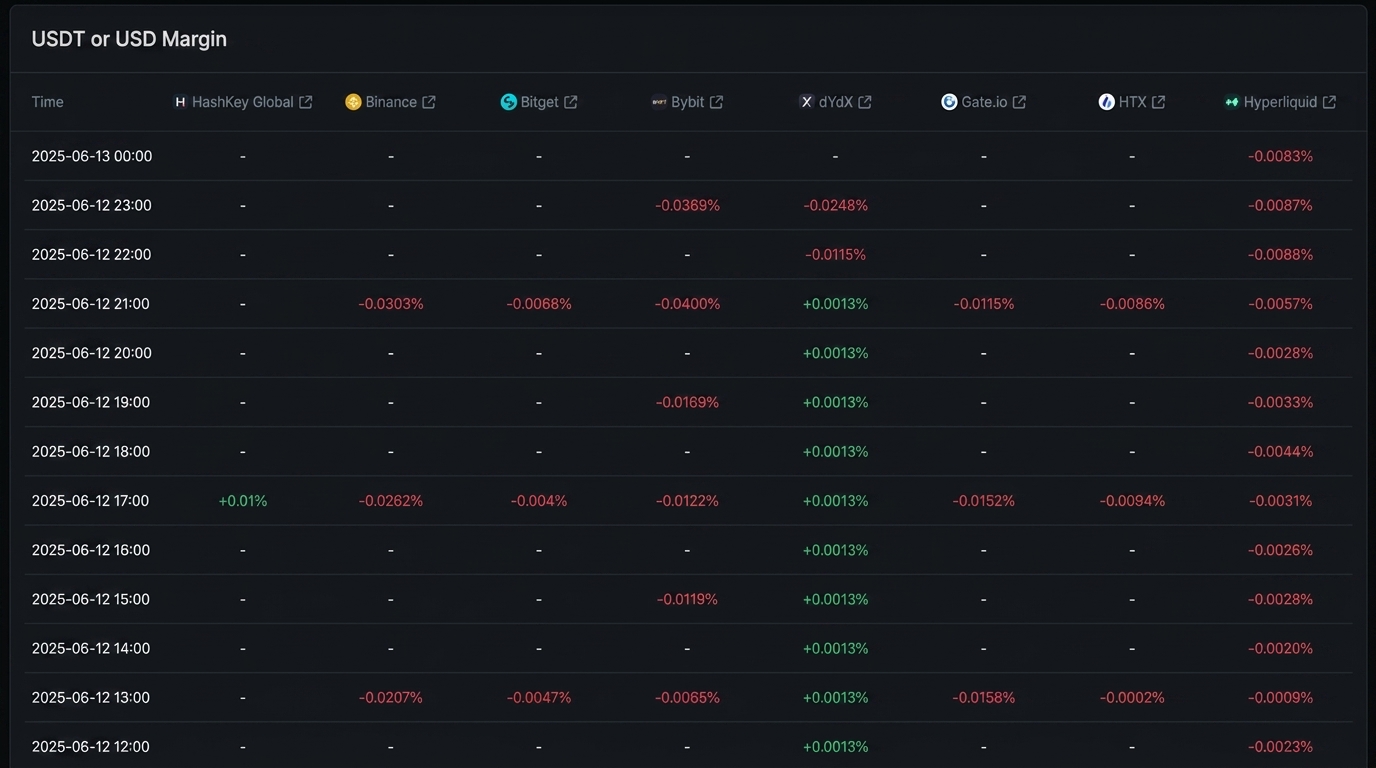
(An 8-hour cycle at many exchanges; 4-hour, 2-hour, or 1-hour cycles at some exchanges or some futures contract pairs.)
When building an arbitrage position,
you have to pay close attention to this funding rate payment time, because
when the spot–futures gap is wide,
this gap fluctuates significantly around funding-rate time.
The reason is that people who built positions via spot-long, futures-short hedging
close their positions to avoid paying the funding rate,
or build positions after funding-rate time has passed,
and in this process the spot–futures gap widens and narrows.
4-3. Exchange Risk: Algorithm vs. Manual Intervention
Choosing an exchange is a key factor that determines a strategy's stability.
And arbitrageurs must understand the characteristics of each exchange.
There's a lot to say about each exchange's characteristics for arbitrage,
but to speak only about the funding rate,
there are exchanges where the funding rate is determined automatically by an algorithm,
and exchanges where the funding rate is determined by manual intervention.
Major exchanges, mainly large ones like Binance, Bybit, and OKX,
calculate the funding rate transparently according to a published formula
based on an algorithm, so anomalies are rare.
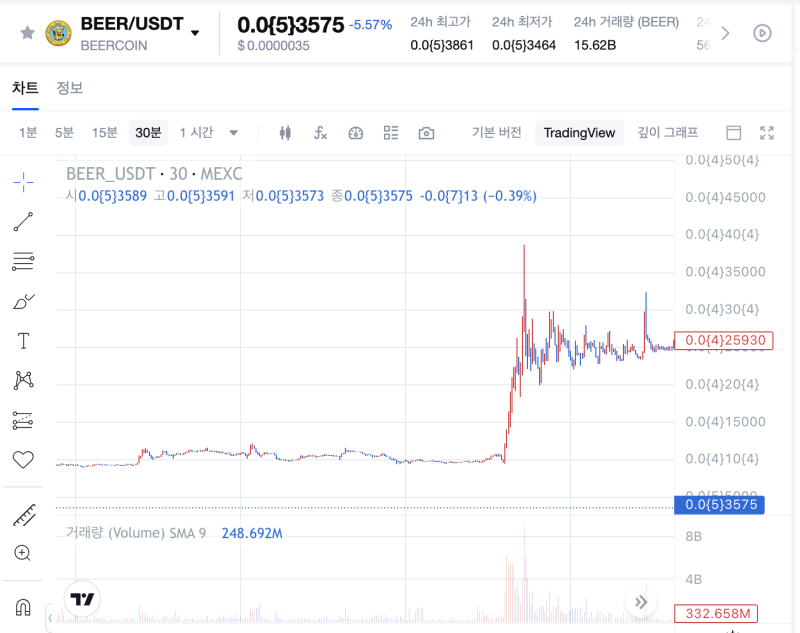
In contrast, small and mid-sized exchanges like Gate and MEXC
frequently have incidents of manual intervention in the funding rate.
So there are cases where Binance and MEXC had a 2% funding rate gap
and you entered to do arbitrage,
but a few minutes before MEXC's funding rate settlement time it suddenly applied a funding rate of over 2%,
causing a loss — the so-called "MEXC backstab" incident, among others.
A MEXC-backstab case:
https://blog.naver.com/sucking_honey/222949116257
On the matter of getting MEXC-funding-rate backstabbed...
4-4. Liquidity and Liquidation Risk
While the delta-neutral strategy is theoretically indifferent to price movement,
in actual trading the following important risks exist.
Specifically, suffering slippage losses due to liquidity risk.
Liquidity risk (slippage occurs)
Liquidity refers to the degree to which you can instantly trade the quantity you want at the price you want.
If you attempt arbitrage with an altcoin that lacks liquidity, the following problems can occur.
1. Slippage at entry
Even if you place a spot buy order and a futures sell order at the same time,
the order book is thin, so there can be a difference in the average price at which the orders fill.
For example, if the spot is bought at 1,005 KRW
but the futures is sold at 995 KRW,
you start out already carrying a loss from the moment you build the position.
2. Slippage at liquidation
The same goes when you close the position;
the difference between the spot sell price and the futures buy (short-covering) price
can cause unexpected losses.
Therefore, when doing funding rate arbitrage,
you must also include in your calculations how large the losses from liquidity and slippage will be
by looking at the exchange's order book.
Forced liquidation risk
Even a delta-neutral position isn't completely free from the danger of forced liquidation.
1. Excessive leverage
The higher the leverage you use,
the more your margin becomes insufficient even with a tiny price movement,
and the risk of being liquidated grows exponentially.
Funding rate arbitrage is usually a strategy of stably accumulating
a low return,
so the principle is to use safe leverage,
taking into account each coin's volatility and the risk based on how long you'll hold.
2. Sudden price movements (wicks)
Due to a sharp market move, the futures price can momentarily spike up or down
and create a long "wick."
In this case, before the spot price has a chance to react,
the futures position can reach the liquidation threshold first
and be forcibly closed.
The moment the hedge unravels, that position is exposed straight to price-movement risk.
To manage this risk,
you need to always secure spare margin in your account
and, when extreme market volatility is expected,
take measures such as reducing your position size.
Wrapping Up: Funding Rate, a Comprehensive Understanding of Opportunity and Risk
This time, we've learned everything about the "funding rate," which is like the heart of the perpetual futures market.
The funding rate is more than just a device that aligns the futures price with the spot;
it's an important element that, in itself, reveals market psychology and provides a new dimension of arbitrage opportunities.
Funding rate arbitrage is not about predicting a coin's direction;
it's a sophisticated strategy that understands the structural market mechanism that tries to align spot and futures prices,
and takes the cost (the funding rate) that arises in that process as profit.
This pursues returns close to "risk-free,"
but you must keep in mind that, with the funding rate's volatility, exchange risk, liquidation risk, and so on,
it is by no means "zero risk."
Successful funding rate arbitrage becomes possible only when a deep understanding of the theory,
the ability to analyze real-time data,
and thorough risk management that even considers operational risks like exchange policy
are combined.
In other words, it's not simply "free money" but more like intelligent "yield farming" that leverages market principles.
If you've perfectly understood the theory of the funding rate in this Part 5,
in the next series, Part 11, building on what you learned today,
we'll learn how to actually execute funding rate arbitrage using DataMaxi+ (DMP)
through a concrete step-by-step guide.
- arbitrage
- crypto
- education
- funding-rate
- perpetual-futures