Lecture 10. In-Depth Analysis of Real "Won-Sangttari" Arbitrage Cases
A deep dive into real cases of Won-Sangttari — the KRW-listing arbitrage opportunity unique to the Korean market.

"KRW-market listing arbitrage," commonly known as "Won-Sangttari" (KRW-listing arbitrage), is the event-based arbitrage that excites Korean crypto investors the most. It's a strategy that targets the sharp early price spike ("listing beam") and the Kimchi premium that arise from a supply-demand imbalance when a new coin lists on a large KRW market like Upbit. When a "Heung-ttari" (a winning listing) materializes and you successfully secure inventory, it can deliver enormous profits.
When buying pressure is strong after a KRW listing and a high Kimchi premium forms, it's called a "Heung-ttari" or "Dae-Heung-ttari" (a big win); when buying pressure is weak and no Kimchi premium forms, it's called a "Mang-ttari" (a flop).
This time, we'll take a deep dive into the complexity and the key success factors of Won-Sangttari through two historic cases that — though different in character — were both recorded as "Dae-Heung-ttari": Movement ($MOVE) and NuCypher ($NU).
Case 1. December 2024 Movement (MOVE) Dae-Heung-ttari:
The Movement ($MOVE) listing event, which fed countless arbitrage traders during the late-2024 bull market, is a historic case from which you can learn many elements of "Won-Sangttari." The differences in listing times across exchanges, the chaos caused by deposits/withdrawals resuming and halting, and the fierce competition among arbitrage traders to secure inventory amid it all prove that this event was not simple "bottari" peddling, but a high-dimensional game requiring multiple stages of strategic judgment.
(1) Situation Overview: A Detailed Timeline
Movement is an Ethereum Layer 2 blockchain network based on the "Move" programming language, which excels in security and performance. Its biggest feature is that, through "Move-EVM" technology that bridges the gap between the Move and Ethereum Virtual Machine (EVM) ecosystems, it maintains compatibility with existing Ethereum apps.
[Around 2 PM, December 9] Key listing-related developments
On December 9, 2024, Korea's three major exchanges — Upbit, Bithumb, and Coinone — announced a simultaneous listing of Movement ($MOVE), drawing all of the market's attention. The moment the three exchanges' simultaneous listing notices were released, the trader community anticipated a Heung-ttari. It had been a very long time since Upbit had carried out a listing simultaneously with a TGE (Token Generation Event). Because it was a TGE listing, almost no circulating supply had been released to the market, so expectations for an early price surge ran high.
The trading start times announced by each exchange were 9 PM for Upbit and Bithumb, and 8 PM for Coinone. Since the first airdrop claim time for the Movement coin was 8 PM, Coinone's 8 PM trading start was a rather reckless plan.
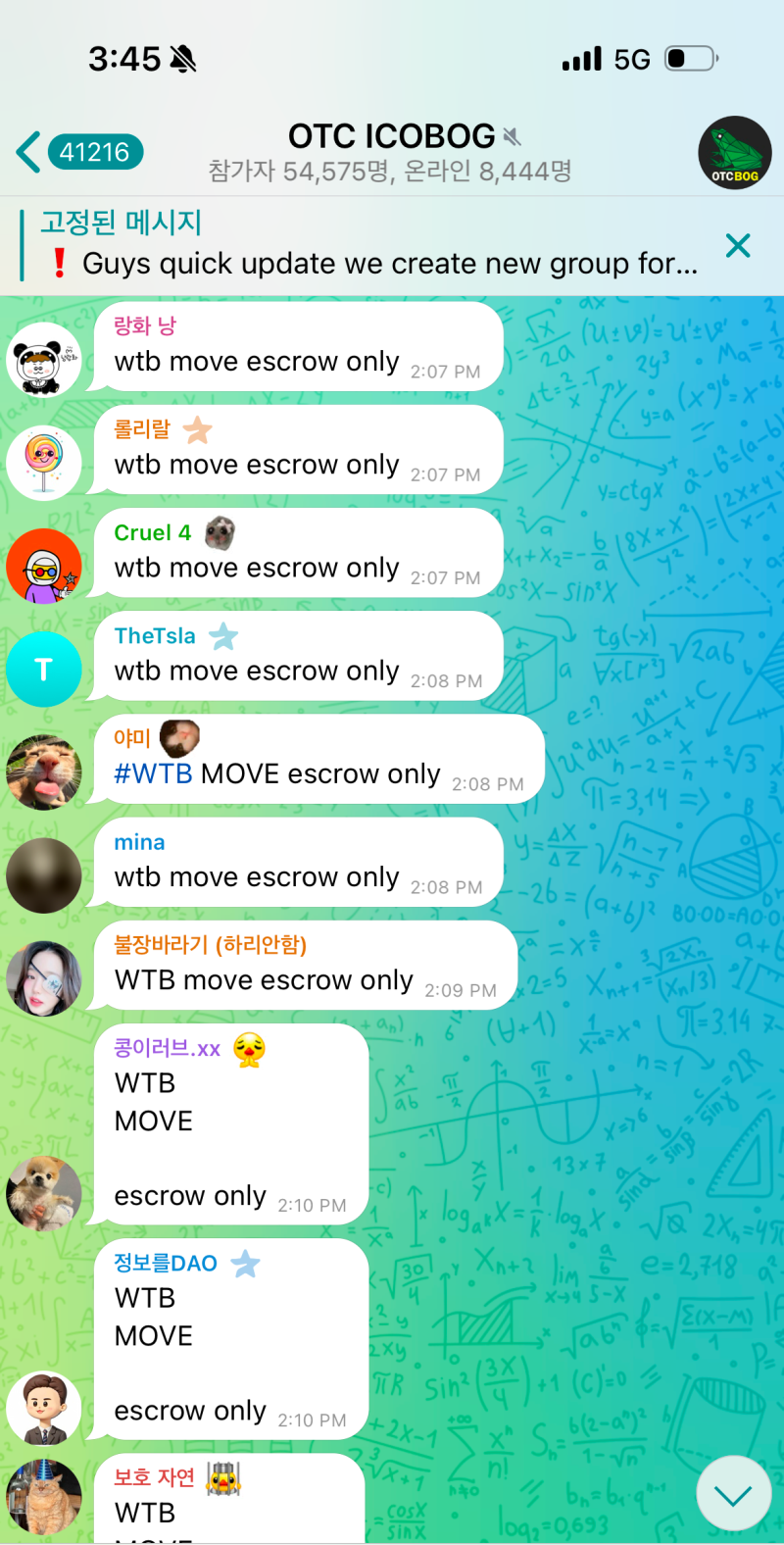
Countless Korean arbitrage traders shouted "Buying $MOVE (WTB)" in Telegram OTC (over-the-counter) groups like ICOBOG. You could spot the names of just about every well-known Korean crypto KOL (Key Opinion Leader) there — that's how hard everyone was working to secure as much inventory as possible ahead of others.
[8 PM – 9 PM, December 9] Coinone opens alone, with an extraordinary price surge
At 8 PM, Coinone began trading as scheduled, but there was only silence. That's because the $MOVE airdrop claim didn't start working until 8:30 PM. Until then, no inventory was circulating anywhere on the blockchain, so only buy orders piled up in Coinone's order book and not a single trade was executed.
Around 8:40 PM, when some of the inventory from successful claims was deposited into Coinone for the first time, the first trade was finally executed. After that, the market showed signs of rapid overheating.
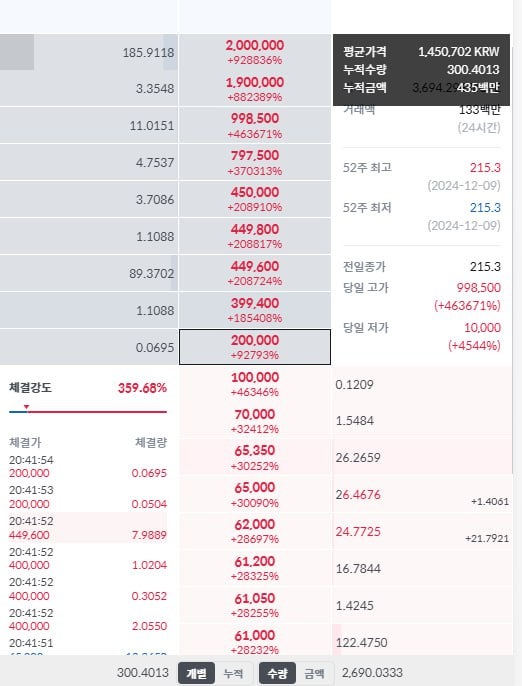
With absolutely no sell-side inventory, speculative buying flooded in, and $MOVE — whose listing price was 215 KRW — shot up to a high of 998,500 KRW, setting an unprecedented record of a 4,600x surge. That said, the volume executed at that price was extremely small, around 100,000 KRW, and in reality most trading happened around 200,000 KRW. Even this price was more than 100 times higher than the overseas price. For a moment, Movement's market cap was even higher than Ethereum's. At the time, the quantity of Movement coin in Coinone's hot wallet was only 27,000.
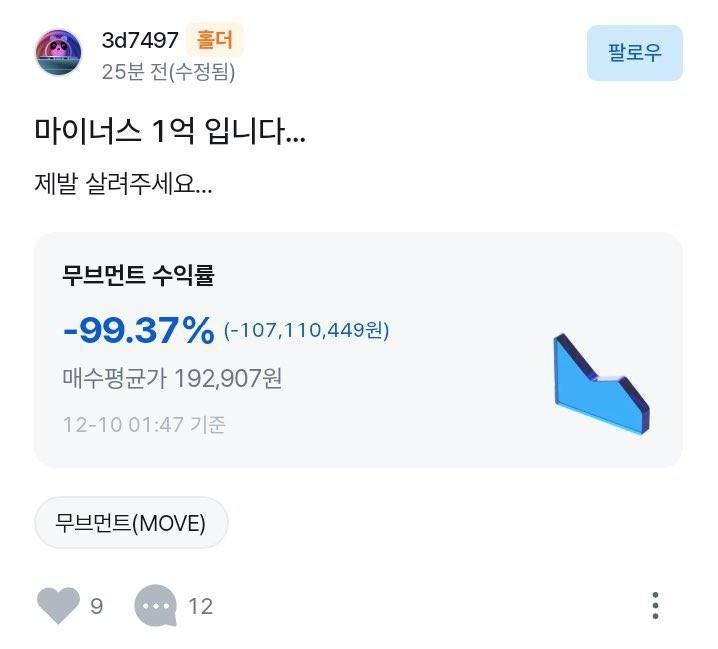
Watching this abnormal situation, Upbit and Bithumb postponed trading from 9 PM to 10 PM just five minutes before the 9 PM listing. Even when the scheduled 10 PM arrived, deposit volumes were still insufficient to absorb the buying pressure, and with online news articles about the Coinone situation appearing, Upbit and Bithumb issued an indefinite postponement notice with just one minute left before the trading start. At the time, the two exchanges' hot-wallet holdings were about 1,000,000 and 200,000 coins respectively.
Overseas exchanges such as Binance and OKX went ahead with their listings at 9 PM as planned, and as of 9:05 PM the price was 6,500 KRW on Coinone versus $0.76 on overseas exchanges — meaning Coinone was still maintaining a price roughly six times higher than abroad.
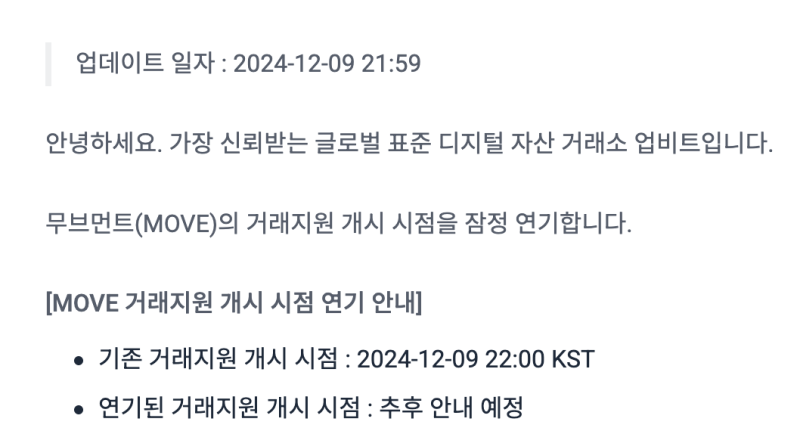
Upbit notice
https://upbit.com/service_center/notice?id=4706
Coinone notice
https://coinone.co.kr/info/notice/3621
Bithumb notice
https://feed.bithumb.com/notice/1645302
Bithumb hot wallet at the time
https://intel.arkm.com/explorer/address/0x5B11944cd309C4C4cAC8251d821882c44B748B48
[Night of December 9 – early morning December 10] A 14-hour waiting phase and the race to secure inventory
When the listing was postponed, the real action began. The traders' sole objective was to "get hold of $MOVE by any means and send it to Upbit and Bithumb, which would open the next day."
Gate.io was the first among overseas exchanges to intermittently open withdrawals, and it became the key route for securing inventory. Traders tracked Gate.io's hot-wallet balance all night, using the brief windows in which withdrawals repeatedly opened and closed to move inventory into their personal wallets.
Gate.io, too, kept replenishing its hot-wallet balance from Bybit
https://etherscan.io/token/0x3073f7aAA4DB83f95e9FFf17424F71D4751a3073?a=0x64BFE53f741903463D1bE013Ae75a5353c01de3c
Amid this chaos, Coinone's $MOVE price held steadily around 1,200 KRW through the early-morning hours, and Gate.io, an overseas exchange, also showed signs of forming a base around a similar price range. This established the market's minimum price expectation for the next day's listing.
In addition, arbitrage traders kept sourcing $MOVE in OTC groups even through the early morning, in order to secure as much inventory as possible.
[9:30 AM, December 10] Upbit announces the trading start time
At 9:30 AM, Upbit gave a surprise notice that trading would start one hour later at 10:30 AM, and Bithumb immediately matched the same time, fixing the listing time. After an all-night race, about 40,000,000,000 KRW worth of $MOVE had been deposited into Upbit and was poised for the trading start.
[10:30 AM – 11:10 AM, December 10] The Upbit and Bithumb listing and the "after-pump"
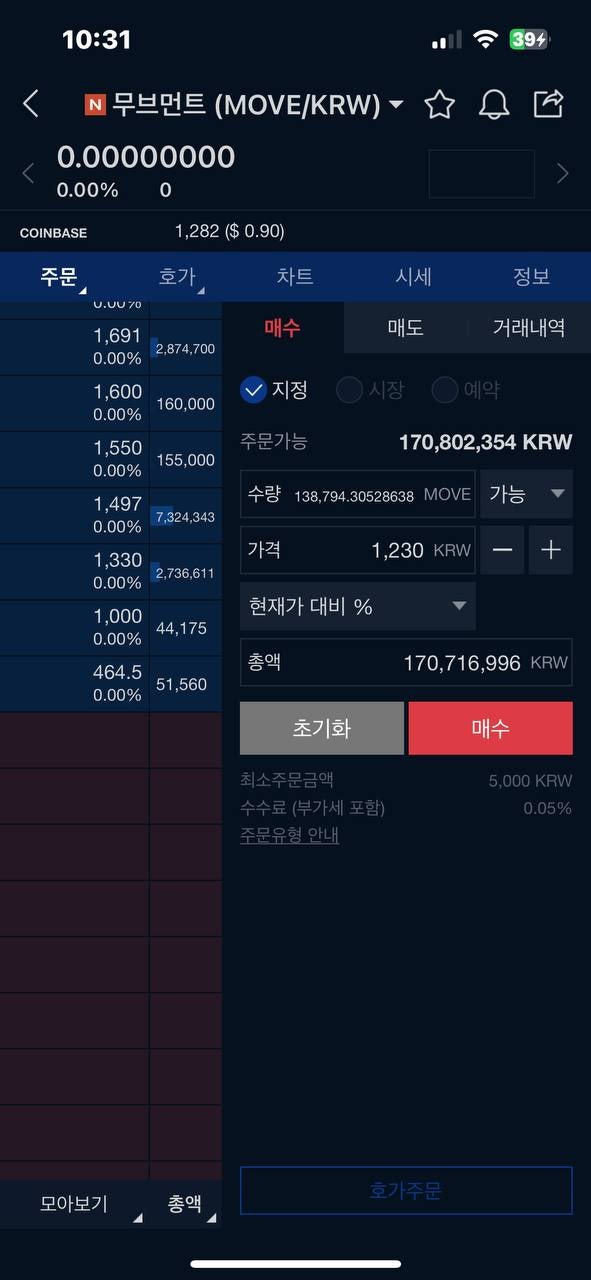
At 10:30 AM, trading finally began on Upbit and Bithumb.
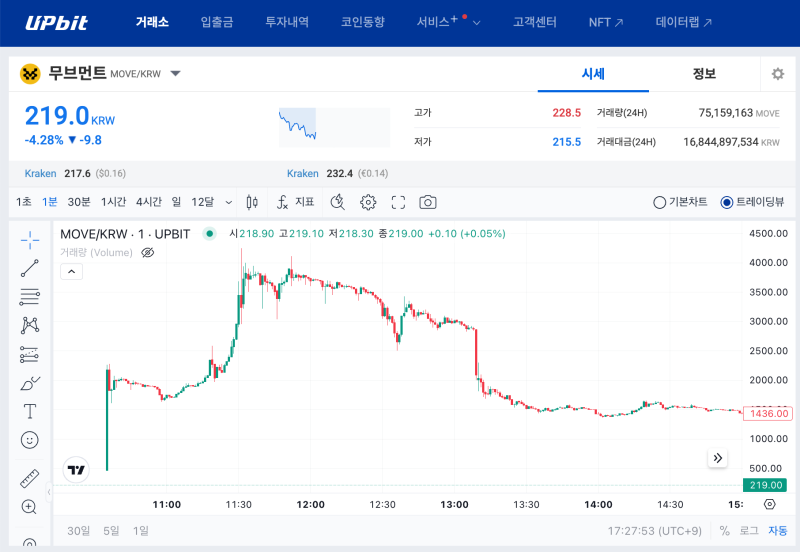
Price and volume: The initial execution price formed between 1,600 KRW and 2,000 KRW. After that, buying pressure exploded, recording an astonishing trading volume of 180 billion KRW in just 5 minutes and 1.55 trillion KRW in 90 minutes.
After-pump occurs: The price shot up to 4,200 KRW, completing the "Dae-Heung-ttari." In particular, after trading sideways at 1,600–2,000 KRW early on, the price began a full-blown surge toward the 4,000 KRW range 30–40 minutes later — an "after-pump" pattern. This is presumed to be because retail investors who learned of the listing belatedly took physical time to see the news, deposit KRW via the K-Bank app, and then start buying, so buying pressure flowed in intensively at a delay.
Spot–futures gap and Kimchi premium: In this process, the price difference between spot and futures on overseas exchanges (the spot–futures gap) widened to as much as 20%, and the Kimchi premium reached a peak of 170%.
That said, even though the deposit inventory differed greatly from Upbit's, Bithumb instead lagged behind Upbit's price movements and showed relatively little buying pressure. Upbit churned out 2 trillion KRW in trading volume in just over 2 hours, displaying a frenzy that seemed to absorb every last bit of the market's capital.
(2) Opportunity Analysis:
The Movement ($MOVE) event was not a single arbitrage opportunity. It was a composite event in which multilayered games — each with different rules and risks across various phases — unfolded simultaneously.
In particular, this listing happened thanks to a convergence of several coincidences: the crypto market had kept rising sharply for the two months before the listing, drawing attention, and it came right after the crypto market had once again become a topic of nationwide interest due to the historic-scale reverse premium triggered by the "Yoon Suk-yeol martial law incident" a few days before the listing — so the market's speculative interest was hotter than ever. Successful traders divided this opportunity into several stages and executed the optimal strategy suited to each stage.
Front 1: The race to secure spot inventory
The starting point of every strategy was "who secures $MOVE first, and cheaper." It was right after the TGE (Token Generation Event), and because the foundation deliberately did not supply DEX liquidity, securing inventory was itself a fierce competition.
1. Over-the-counter (OTC): Traders with trusted networks reached out to foreigners to source inventory. They also tried to grab airdrop inventory first by shouting "WTB $MOVE" in Telegram OTC groups. This was the way to get a large amount of liquid inventory the fastest, but it was a high-risk strategy that meant accepting the risk of scams and sellers failing to honor their deals.
2. The overseas CEX withdrawal race (the Gate.io route): Gate.io was the first among overseas exchanges to open withdrawals, making it a key supply line for arbitrageurs. Traders tracked Gate.io's hot-wallet balance all night, seizing the brief gaps in which withdrawals repeatedly opened and closed to pull inventory out into their personal wallets.
3. Advanced DEX play: Some top-tier traders turned the foundation's failure to supply liquidity to their advantage, executing the sophisticated strategy of creating their own LP (liquidity provider) pools on Uniswap and farming the fees.
Front 2: Predictive trading using derivatives
While most traders focused on securing spot, there were also those who approached it from a different angle. They generated profit not by predicting the spot price, but by predicting "the behavior of other arbitrageurs."
Forming a hypothesis: They predicted that "the moment withdrawals open on a large exchange like Binance, massive spot-buying and futures-hedging demand for Won-Sangttari will explode, and the spot–futures price gap will widen to an extreme."
Execution scenario: Before Binance withdrawals opened, while the spot–futures gap was negligible, they built spot-long + futures-short positions in advance. Then, once withdrawals opened and other traders rushed in and the spot–futures gap widened to 20%, they liquidated both positions simultaneously, executing a sophisticated "basis trade" that captured the expansion of the spot–futures gap as profit. This was a "meta-game" that, one level above the market's flow, predicted the behavioral patterns of market participants.
Front 3: The Upbit "Dae-Heung-ttari" bet and the secret of the after-pump
In the end, all inventory headed to its final destination, Upbit. The bet here was "whether Upbit's overwhelming buying pressure would absorb the roughly 40 billion KRW of deposit inventory and still have room to spare." Traders believed in the hot bull-market mood of 2024 and the special market sentiment in which nationwide attention had been drawn to the crypto market by the "martial law incident" a few days earlier.
The process after the Upbit listing: The Upbit listing offered two clearly distinct opportunities.
Stage 1 (the first 30 minutes): Arbitrageurs realize profits and prices stabilize
When trading started, the sell inventory of the arbitrageurs ("ttari-kkun") who had secured inventory all night began to pour out. Their inventory meshed with the initial buying pressure to form a price range between 1,600 KRW and 2,000 KRW. Even at this price range, a stable Kimchi premium of about 50% over the overseas price was being maintained, so early entrants were able to realize sufficient profits. In this process, selling gained the upper hand and the price gradually fell to 1,600 KRW, with the market absorbing the arbitrageurs' first wave of supply.
Stage 2 (after the latter 30 minutes): Additional retail entry and the after-pump
Just as the initial selling pressure was being exhausted, the market's character changed abruptly. The capital of retail investors who had learned of the listing belatedly began flooding in en masse. The background of this delayed pumping is presumed to be the physical time lag between seeing the news, depositing KRW to Upbit via the K-Bank app, and actually starting to buy.
This enormous "Upbit retail buying pressure" began pushing the price — which had fallen to 1,600 KRW — back up, and in an instant created a second frenzy that broke through 4,000 KRW: the "after-pump." This "after-pump" created a new arbitrage opportunity. Traders could buy $MOVE — trading at 1,100–1,200 KRW overseas — in real time and sell it on Upbit as it raced toward 4,000 KRW, capturing an enormous Kimchi premium of up to 170%. Skilled traders predicted this retail time lag and buying pressure, and maximized profits by selling inventory in time with the retail inflow.
Final phase: The "Geom-meo-oe" Coinbase-to-Upbit arbitrage
Korean arbitrage traders brought in Movement tokens they could source overseas and sold them on Upbit, but Korean retail investors absorbed all of this selling, and Movement maintained a high price. So the Kimchi premium was there but there was no way to realize it — yet there was a group that sourced additional inventory overseas to realize the arbitrage opportunity right up to the very end. They were the "Geom-meo-oe" (literally "black-haired foreigners" — Koreans with foreign nationality/accounts) who held both U.S. Coinbase and Korean Upbit accounts. That's because, in the final stretch, the only exchange that had Movement inventory and allowed withdrawals was U.S. Coinbase. At the time the price was about $1 on Coinbase and around $2.6 on Upbit and Bithumb. Calculating based on the inventory they moved, it appears they realized profits in the billions of KRW.
The on-chain record of that arbitrage trader at the time: https://etherscan.io/tokentxns?a=0x1cc00cc60f0b031bb8d460358e27ab2857a07c0d&ps=100&p=5
Most Korean traders other than these had no access to Coinbase, so all they could do was watch the transactions heading from the Coinbase wallet to the Upbit wallet in real time on Etherscan, envious. This was a scene that showed yet again how a difference in access privileges creates an edge.
Side note: The "labor arbitrage" of the 60-account airdrop hunter
Separate from all this arbitrage activity, there was also someone who generated profit at a different stage. The $MOVE project's airdrop was extremely tedious and complicated, so most people gave up partway. But one Korean airdrop hunter quietly kept at the Movement Discord chat-grinding and quest tasks. Over three months, using a whopping 60 accounts, he completed over 400 quests and reached chat-grind level 16, securing an enormous amount of $MOVE tokens almost purely through labor and persistence. On the listing day, this person is estimated to have made up to 3 billion KRW in profit from this inventory.
(3) Outcome and Implications: The Dae-Heung-ttari Completed, and the Lessons Left Behind
After an 18-hour wait, at 10:30 AM on December 10, 2024, $MOVE hit a high of 4,200 KRW on Upbit, successfully completing a "Dae-Heung-ttari." Traders who had secured inventory in the $1 range via OTC or Gate.io reaped enormous returns of more than 2–3x, and especially those who held inventory at near-zero cost through the airdrop realized profits in the billions of KRW, achieving a "quantum jump."
This event left several important lessons for understanding the complexity and essence of modern KRW-listing arbitrage.
First, the core of Won-Sangttari is the ability to manage the "supply chain."
The $MOVE event made it clear that success or failure in arbitrage no longer lies simply in learning listing information first or pressing the buy button fastest. Winning and losing came down to supply-chain management — "who can supply this inventory to the market." Especially in a situation like this one where the foundation deliberately blocked DEX liquidity, traders had to solve the supply-chain problem in their own ways: ▲the risk of scam-ridden OTC trades, ▲the competition to monitor overseas CEXs (Gate.io, Binance) that opened intermittently and quickly closed again, ▲the advanced technical skill of building one's own liquidity pool. The fact that the group that stably realized arbitrage right to the end was the "Geom-meo-oe" who supplied inventory via Coinbase suggests that "asymmetry of access privileges" can also be a powerful weapon.
Second, market sentiment can overwhelm data.
About 40 billion KRW of massive inventory being deposited into Upbit was, in ordinary circumstances, a strong sell-pressure signal foreshadowing a "Mang-ttari." But the hot bull-market sentiment of 2024 and the special situation in which the nation's attention had been drawn to crypto-market price dislocations through the "martial law incident" overturned all expectations. Upbit's retail investors — the so-called "Up-ajeossi" (Upbit uncles) — overwhelmed the selling pressure, and the enormous retail capital that flowed in belatedly absorbed all of the supply and still pushed the price above 4,000 KRW. This is a lesson showing how important it is, when analyzing arbitrage, to read the macro sentiment and narrative dominating the market just as much as the quantitative data.
Third, a single event is made up of multiple battlefields.
The $MOVE listing was not a single game.
The "game of negotiation and trust" in the OTC market
The "battle of patience and monitoring" at Gate.io
The "basis-prediction game" in the derivatives market
The "retail psychological warfare" of the Upbit "after-pump"
The "game of access privileges" between Coinbase and Upbit
Multiple opportunities, each requiring different rules and strategies, unfolded simultaneously. The true winners were those who understood the flow of all these situations and chose to focus intensively on the part they could do best.
In conclusion, the Movement event was a turning point that showed the paradigm of KRW-listing arbitrage had evolved a step further. "Alpha" (excess returns) now comes not merely from learning publicly available information first, but from the ability to pioneer supply chains others cannot access, the analytical power to turn the market's collective psychology to your advantage, and the comprehensive judgment to combine the optimal strategies amid complex situations. This 18-hour record will remain the single most important learning material for analyzing every future KRW-listing event.
Case 2. October 2021 NuCypher ($NU) post-KRW-listing surge
(1) Situation Overview:
Pre-listing situation and background
On October 15, 2021, NuCypher ($NU) was already a well-known project in the market even before its Upbit listing. Since its mainnet launch in October 2020, it had completed listings on major domestic and overseas exchanges, including Coinbase (November 2020), the Bithumb KRW market (May 2021), and Binance (June 2021). Right up until the listing notice, the price had held in the 200–300 KRW range, and the circulating supply was about 590 million. In particular, NuCypher had a track record of "cordoned-off pumping" in which the price surged when deposits/withdrawals were blocked at Bithumb due to an ERC-token inspection, so a specific group was suspected of having carried out price manipulation on a domestic exchange.
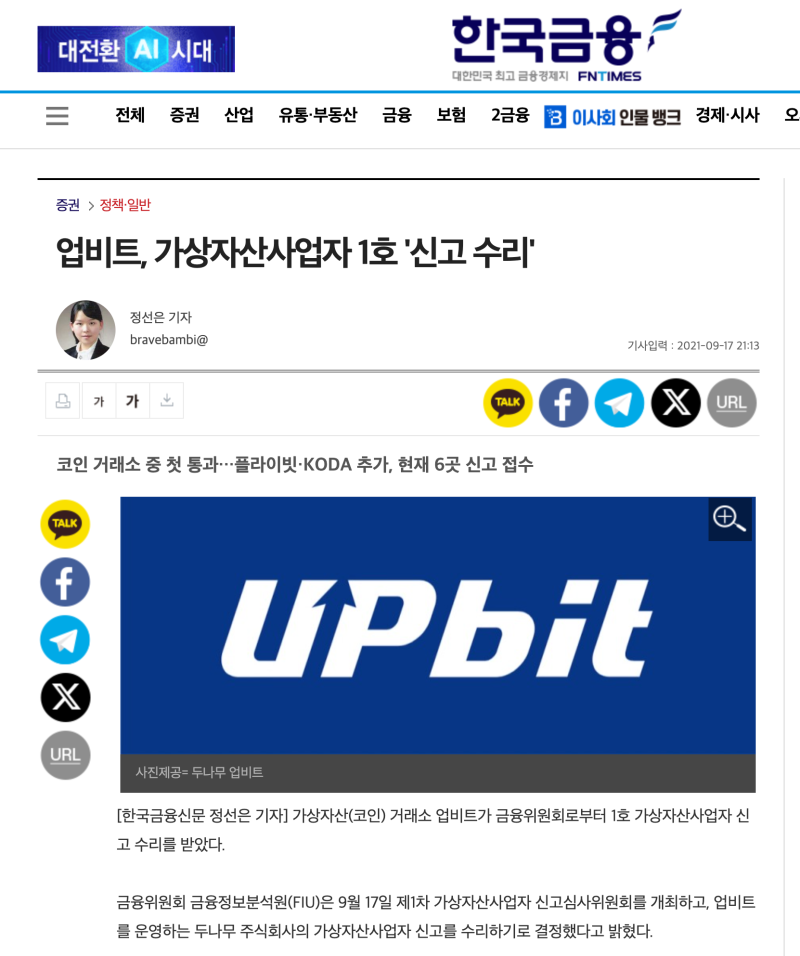
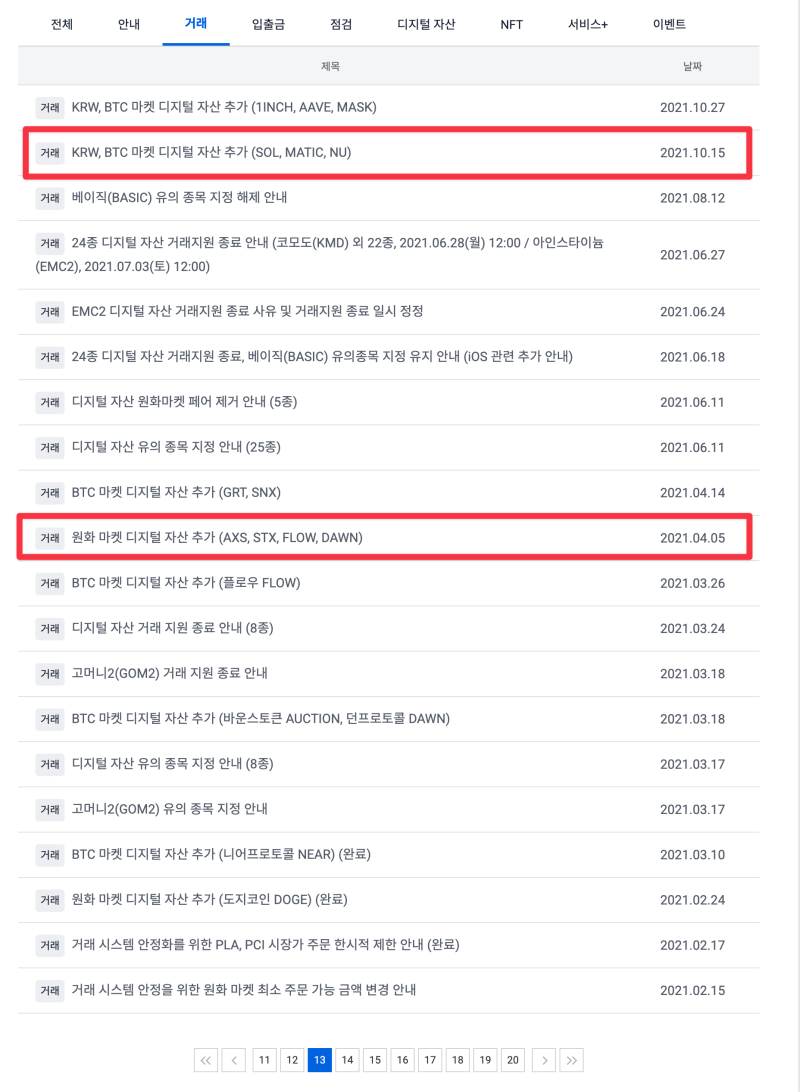
The reason this listing was special was Upbit's particular circumstances. After completing Korea's first Virtual Asset Service Provider (VASP) registration on September 17, 2021, Upbit carried out its first new KRW-market listing in six months. This long gap raised the market's expectations to their peak. In addition, it came at a time when, due to the customer-verification system (KYC) that started on October 6, countless users had to log into the Upbit app, making the potential buying base extremely thick.
The impact of the listing notice and the problem of sourcing external inventory
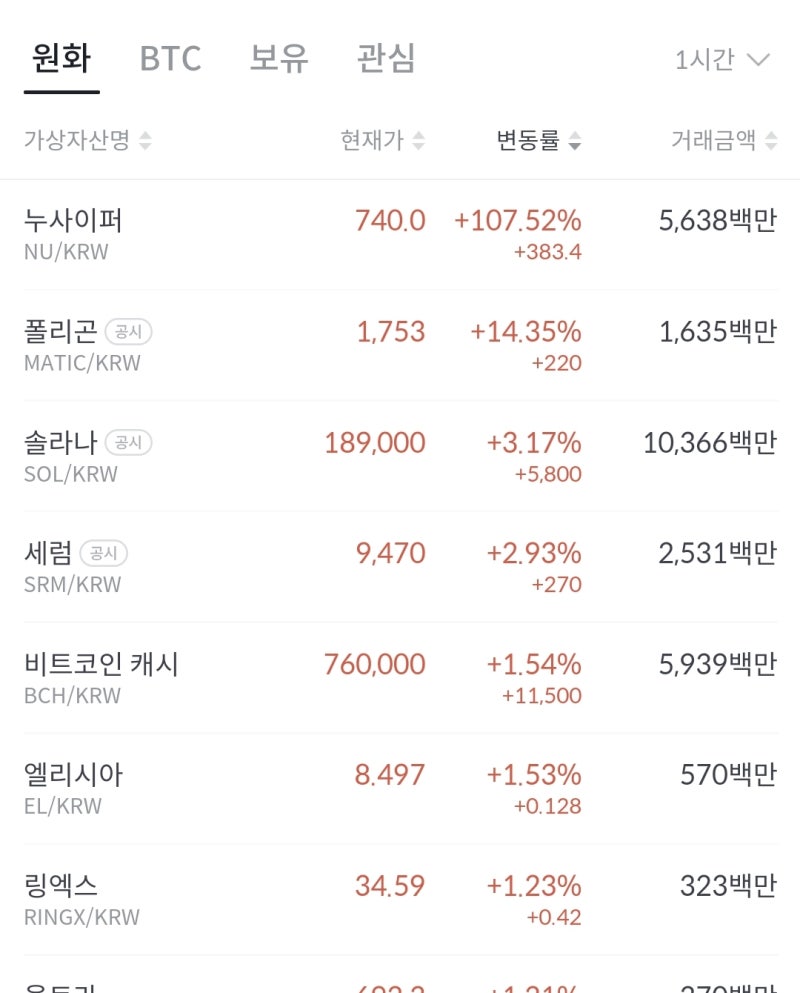
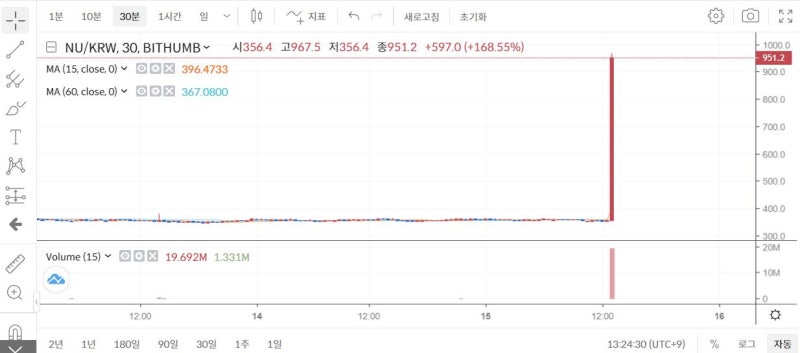
At 1 PM on October 15, when Upbit announced the simultaneous listing of NuCypher, Solana, and Polygon, the market reacted immediately. NuCypher in particular proved the anticipation by surging nearly threefold right after the notice — from the 300 KRW range to the 900 KRW range on Bithumb.
There was even a move to sell other altcoins to raise KRW for trading NuCypher, which caused declines in those other altcoins at the time. This was a clear signal that all of the market's liquidity and attention was concentrating on NuCypher alone.
Arbitrage traders immediately set out to secure inventory, but ran into a serious supply-chain problem.
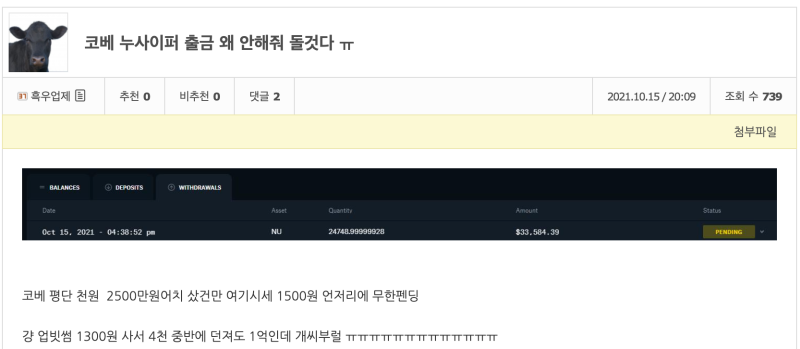
Overseas exchange withdrawals blocked: Right after the listing notice, Binance halted withdrawals, and Coinbase took withdrawal requests but only processed them after 11 PM, so the main overseas supply routes were effectively paralyzed.
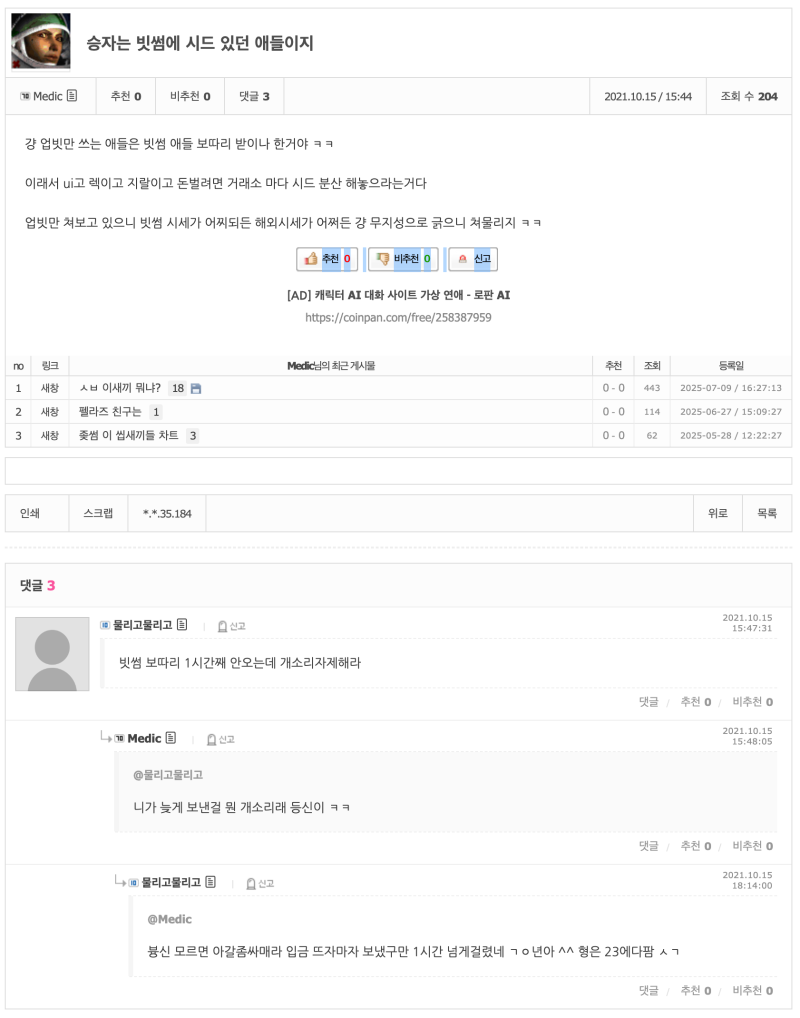
Domestic exchange withdrawal delays: Even Bithumb, the only alternative, took a very long time to process withdrawal requests, making it hard to move inventory to Upbit.
Hedging impossible: At the time, NuCypher had no futures market, so there was no hedging means whatsoever to offset price-movement risk. As a result, all arbitrage had to be carried out as naked positions, fully exposed to the risk of a price drop during the time required for withdrawal, transfer, and deposit.
Hourly price flow and key developments on the listing day
15:35 (trading start):
Upbit announced a listing price of 348.6 KRW based on the previous day's close, but the actual market was preparing to start in the 900 KRW range. At the time, the price on Bithumb was around 930 KRW. At this point, one trader placed a small sell order at the system's lowest price of 314 KRW to deliberately lower the first execution price — a "gain-rate trickery" strategy. As a result, even though actual trading began around 930 KRW, Upbit's screen displayed an abnormal gain rate of "+200%" right from the start, stoking ordinary investors' FOMO.
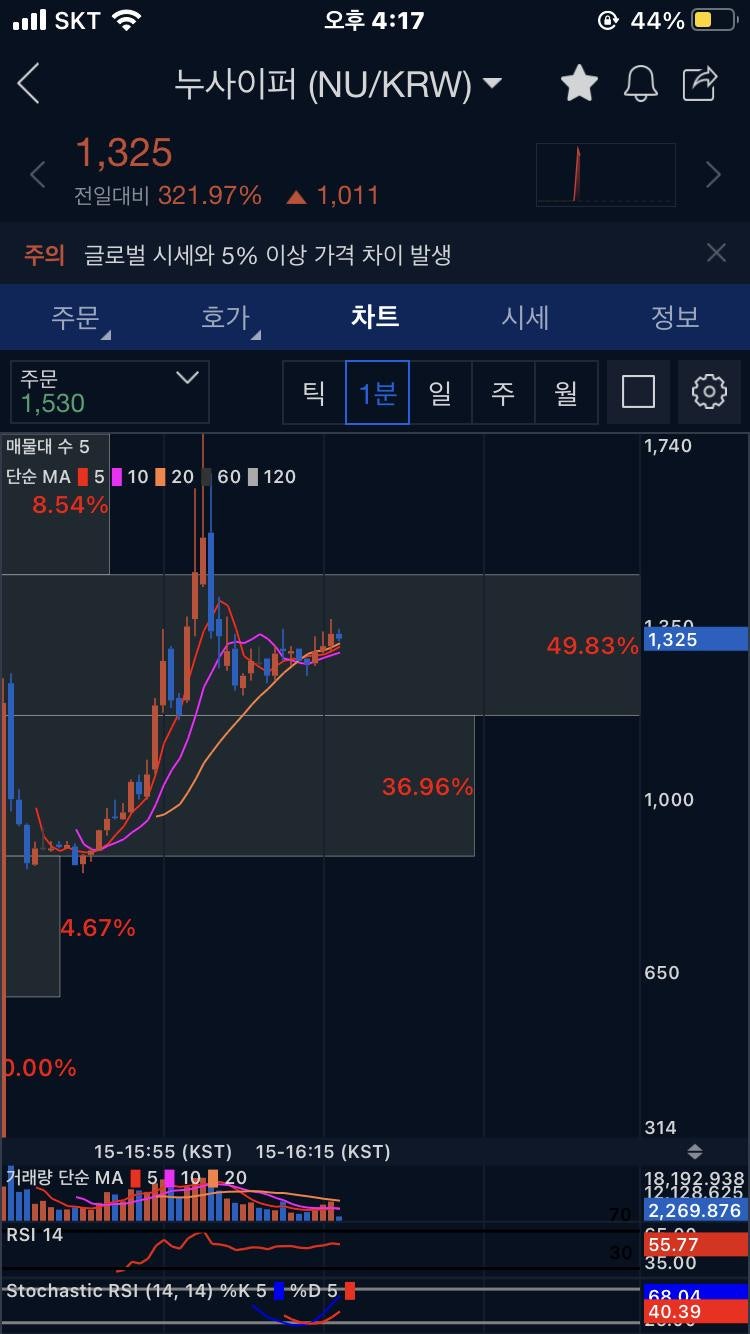
15:36 – 17:00 (first rise and consolidation):
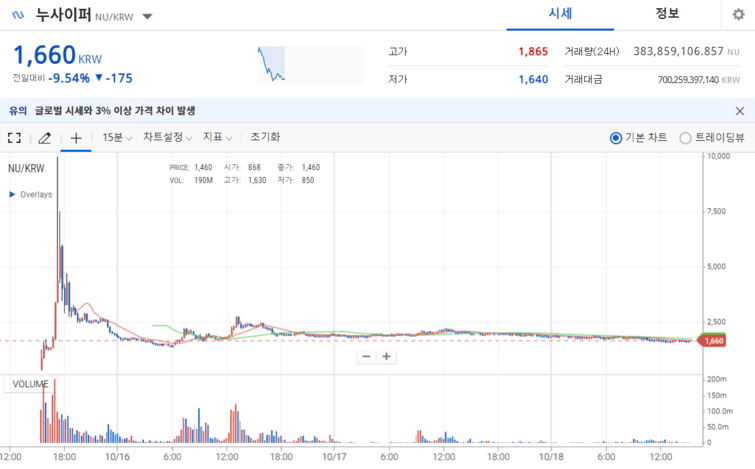
Right after trading started, the price began in the 1,200 KRW range, pulled back to the 800 KRW range, and then surged to the 1,700 KRW range around 4 PM. After that, it consolidated around 1,200–1,600 KRW for about an hour and held a flat range. During this time, the Kimchi premium stayed in the 20–30% range.

17:00 – 17:21 (second surge and frenzy):
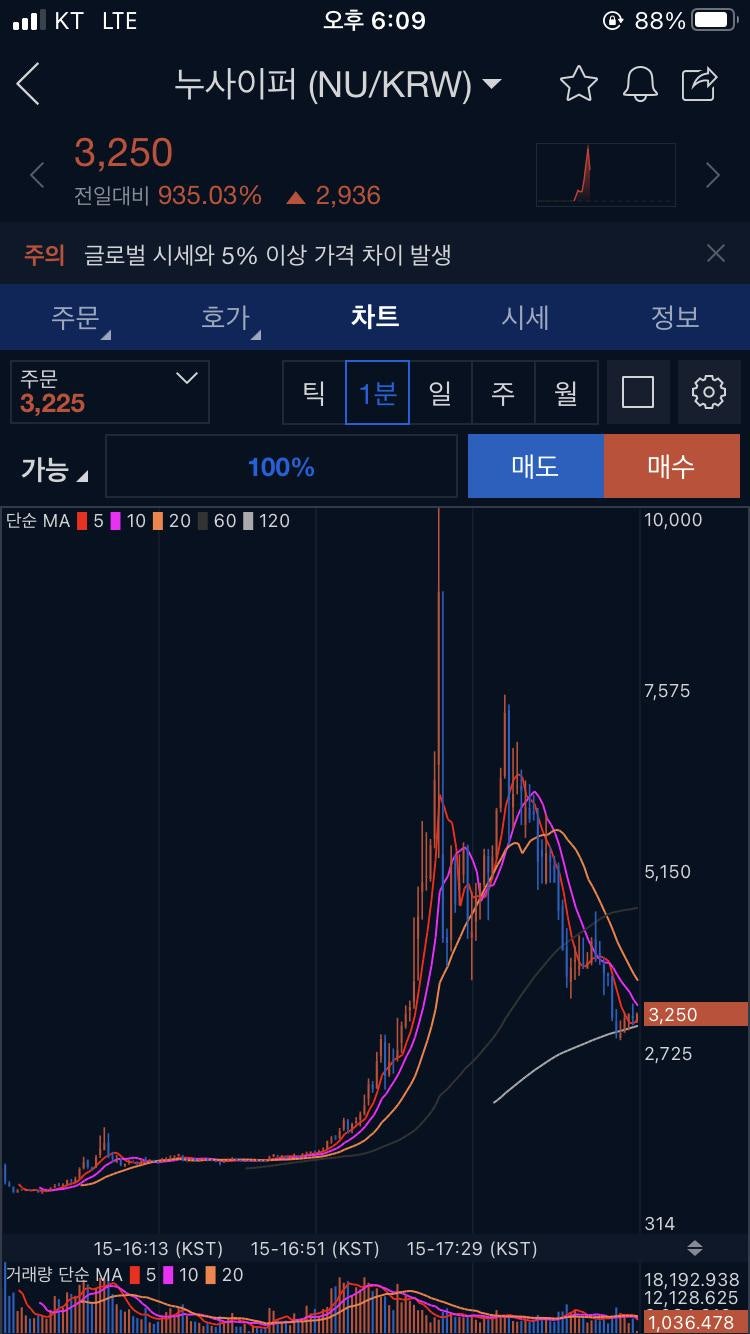
The market's frenzy began at 5 PM. In just 20 minutes, the price began to climb vertically from 1,600 KRW.
17:02 / 1,795 KRW (market cap breaks 1 trillion KRW; Binance at 1,468 KRW, Coinbase around 1,000 KRW)
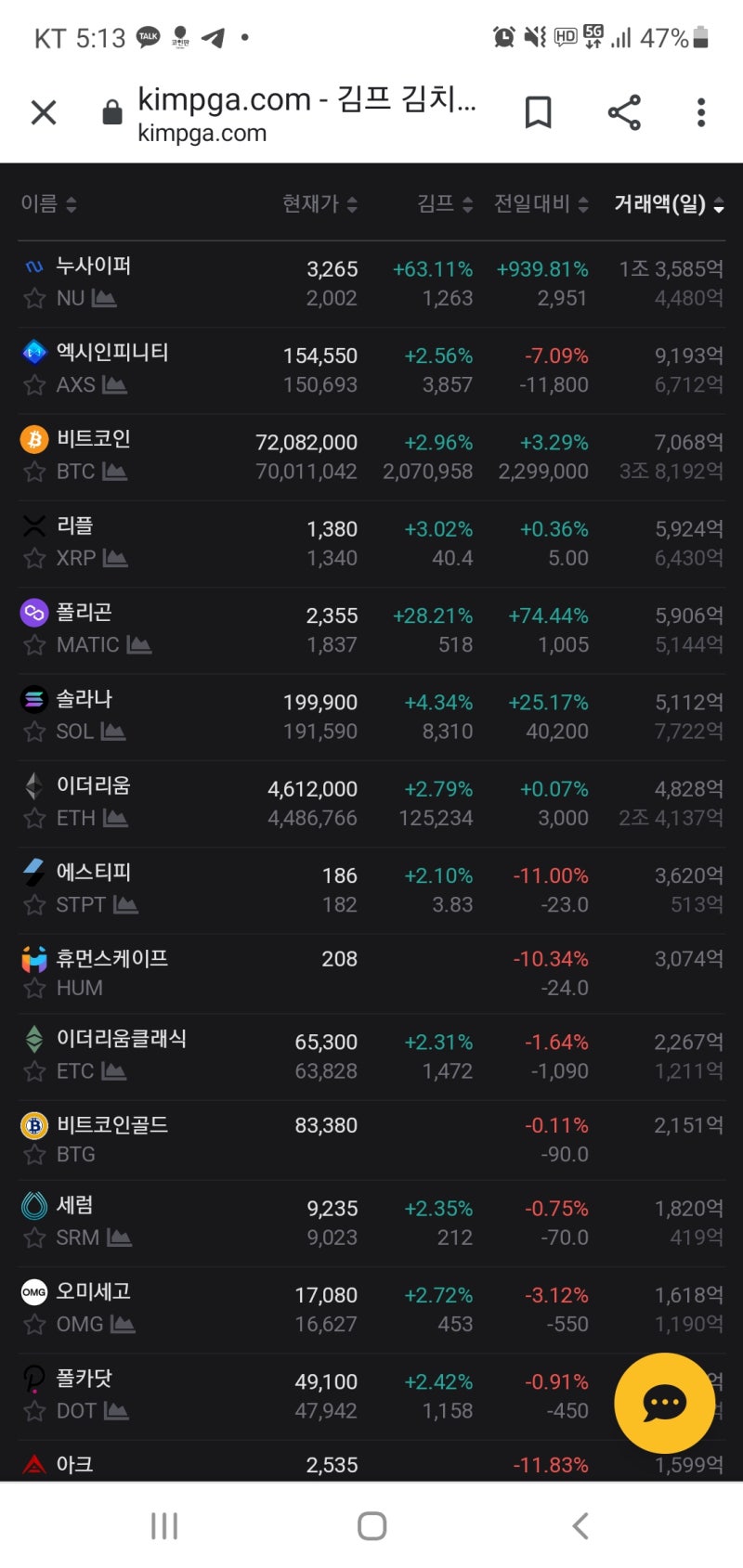
17:13 / 3,265 KRW (Kimchi premium breaks 63%)
17:16 / 5,000 KRW (Upbit execution delays occur)
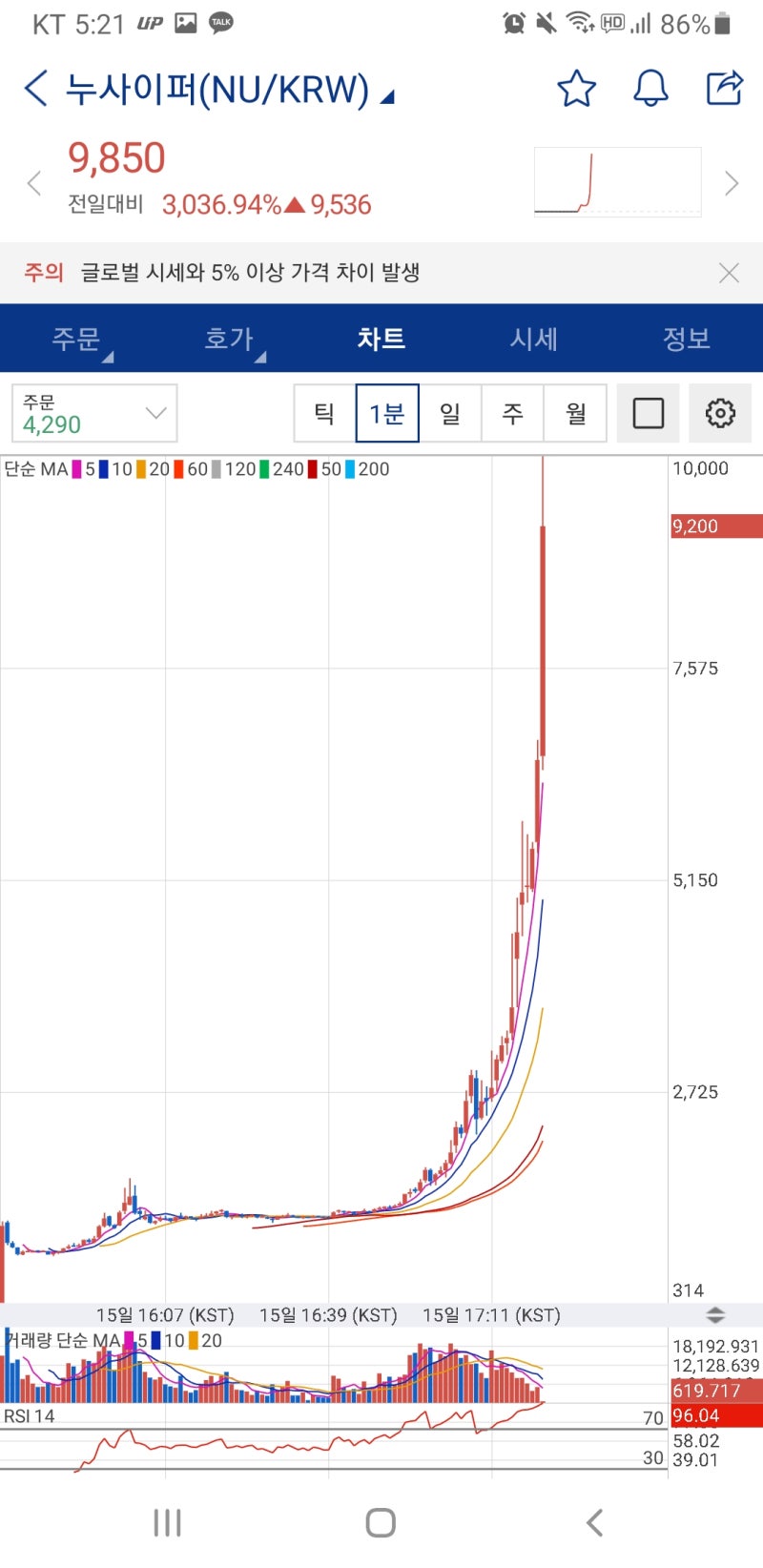
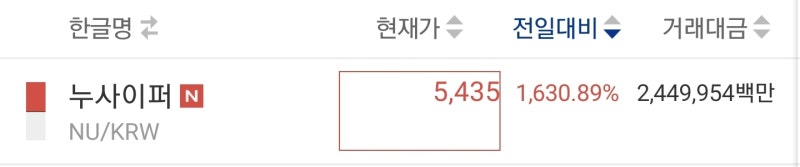
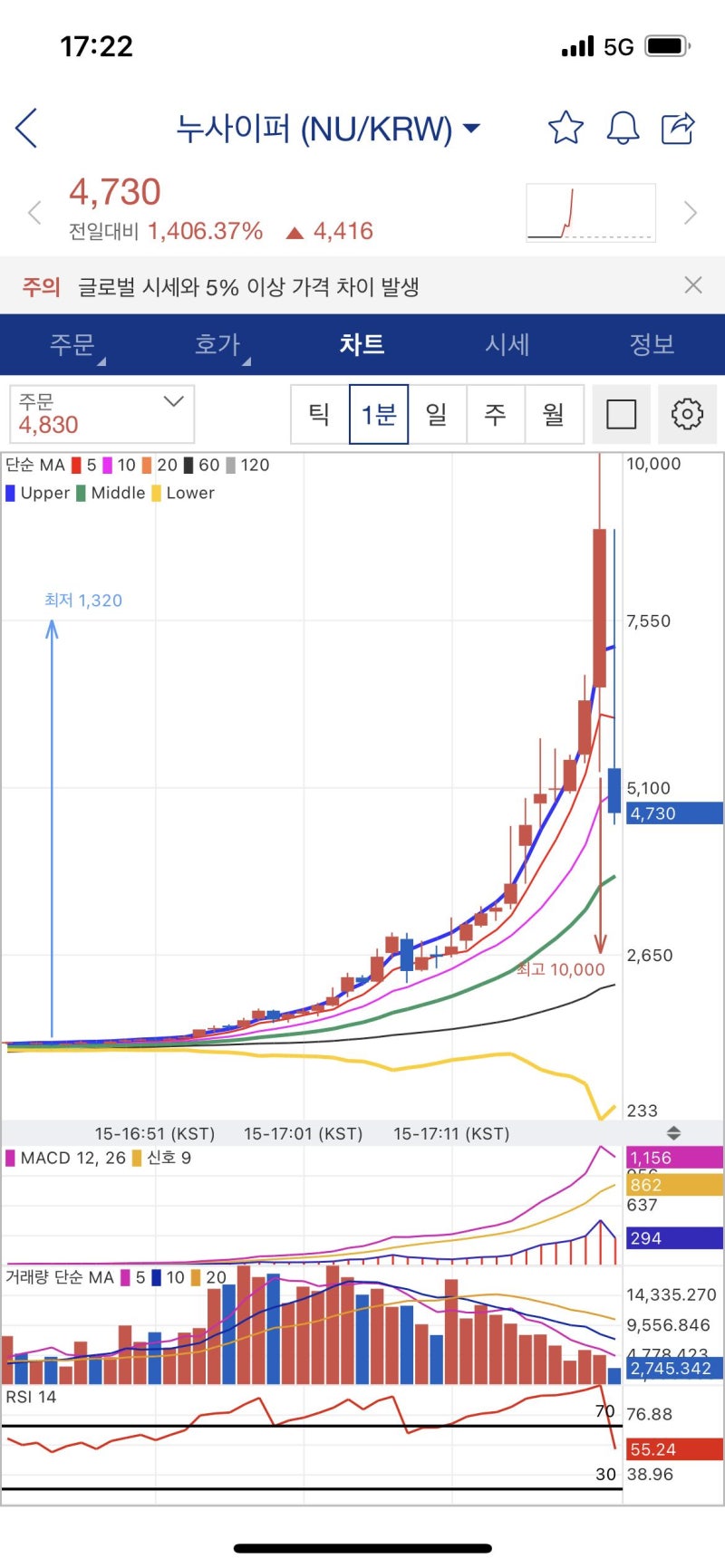
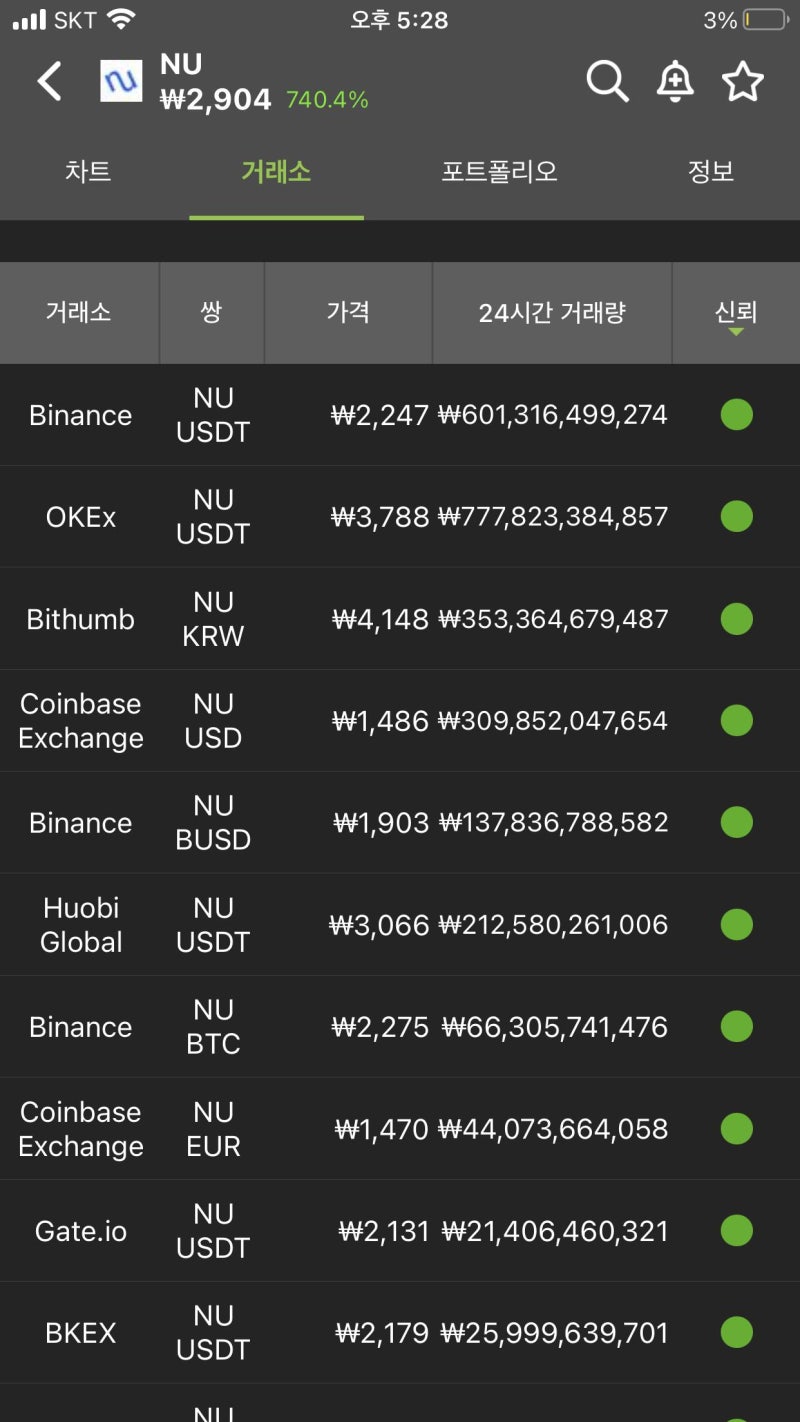
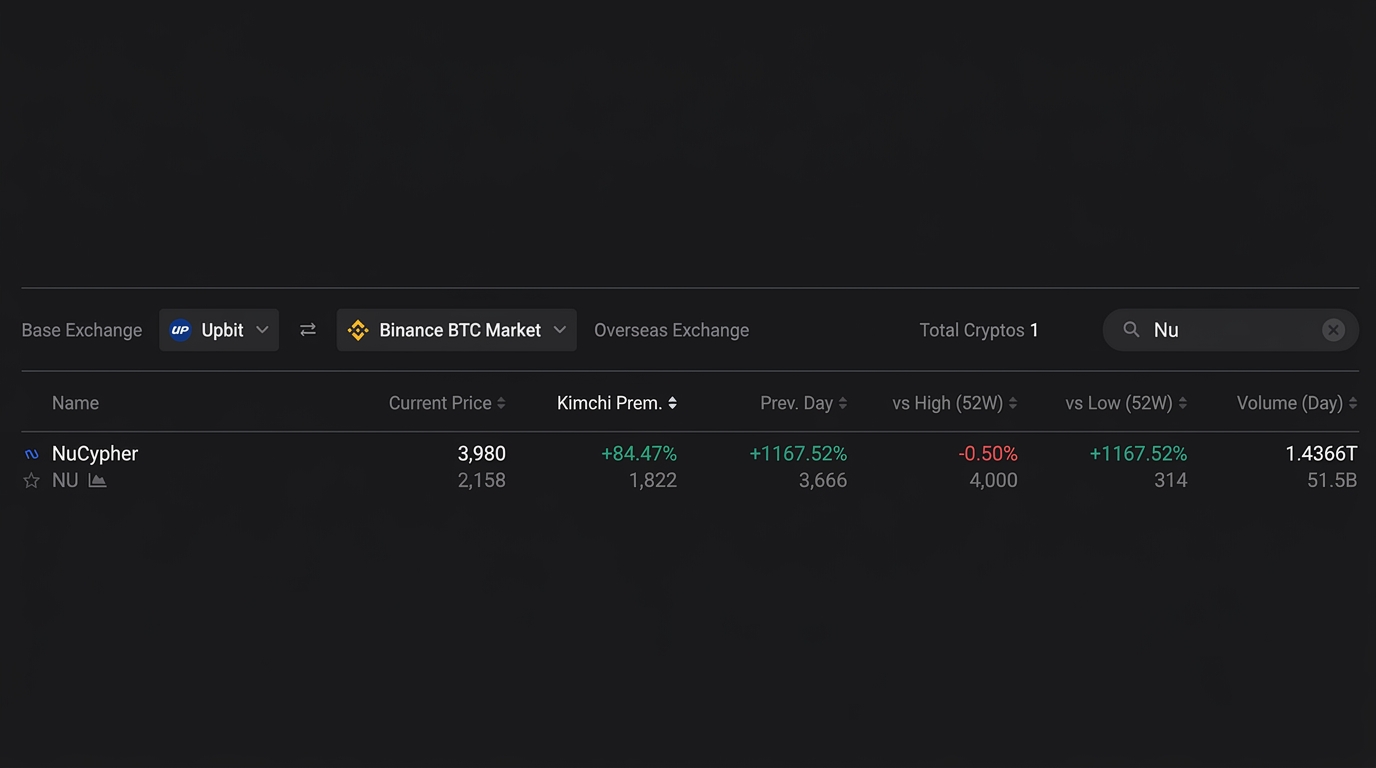
17:21 / 10,000 KRW (all-time high recorded, Kimchi premium 260%, market cap 6.9 trillion KRW)
The 1-minute candle at 17:21, the peak, recorded enormous volatility with a low of 5,400 KRW and a high of 10,000 KRW, and at the time the waiting buy orders on Upbit reached 2 trillion KRW. This was a phenomenon in which pent-up demand exploded amid blocked supply, coinciding with the intervention of a group suspected of price manipulation.
After 17:22 (sharp drop and correction):
Right after the peak, the price plunged to the 4,000–5,000 KRW range in just one minute, then showed high volatility for about 30 minutes, swinging between 3,500 KRW and 6,000 KRW.
Listing outcome and summary
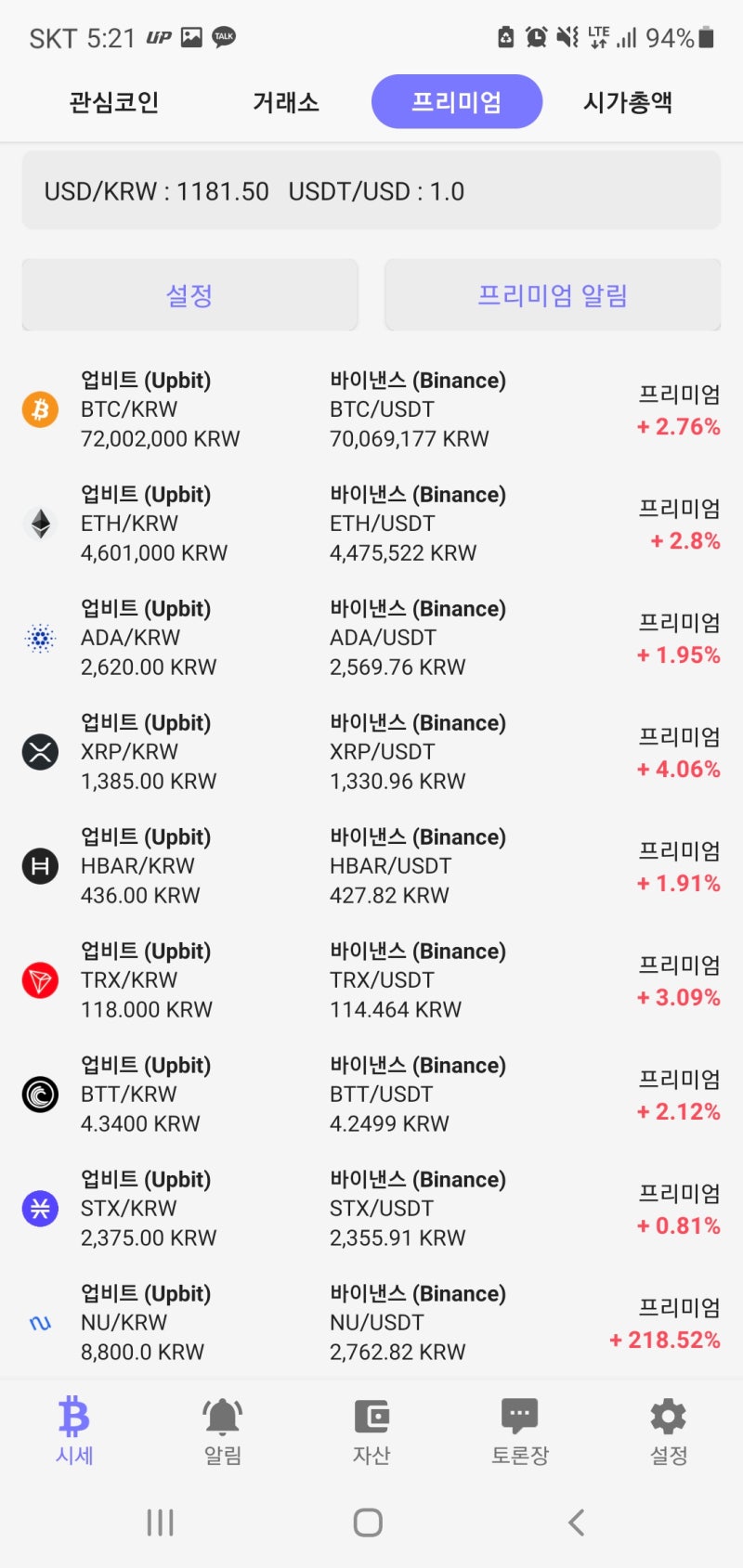
NuCypher set a record of 7 trillion KRW in trading value on its first day listed on Upbit, rising as much as 3,000% or more over the official opening price (314 KRW). At its peak, the Kimchi premium reached 260%, an abnormal overheating that far exceeded the overseas market cap (a high of $2.2B). This process was recorded as a historic Kimchi-premium case created by the combination of the market's anticipation of "a listing after six months," the concentration of users due to the customer-verification system, and, decisively, a situation in which every supply chain was paralyzed.
(2) Opportunity Analysis:
The NuCypher listing event offered arbitrage opportunities through several routes simultaneously. But at the time, NuCypher had no futures market, so hedging was impossible, and withdrawals were delayed across all exchanges, so only high-risk spot-spot arbitrage (colloquially "saeng-ttari," or "raw arbitrage") was possible, with positions exposed to price movement for long periods. The opportunities were divided as follows, according to the route by which one could secure inventory.
1. Bithumb-Upbit arbitrage: This was the route most easily accessible to domestic investors. It's a strategy of buying NuCypher on Bithumb, where KRW trading was already possible, and moving it to Upbit to sell. Direct profit realization using the price difference between the two exchanges was possible, but there was the variable of Bithumb's withdrawal review and processing delays.
2. Binance-Upbit arbitrage: This was the opportunity that demanded the fastest execution speed. It's a strategy of immediately buying and withdrawing on Binance, the world's largest exchange, right after the listing notice. If successful, you could supply inventory to Upbit first and sell at a high price, but there was the risk of Binance halting withdrawals without warning.
3. Coinbase-Upbit arbitrage: This was the opportunity that demanded the most patience. It's a strategy of securing inventory on Coinbase and sending it to Upbit, which could be an alternative when other routes were blocked. However, withdrawal processing times were very long, so you had to accept long-duration price-movement risk.
4. Predictive trading based on situational analysis: Instead of direct arbitrage, this is the opportunity to analyze the given situation, predict a price surge, and bet on direction. It's a strategy of using clear catalysts such as "a listing after six months" and "supply-chain problems" as grounds to avoid withdrawal-delay risk and buy in advance on Bithumb or buy right after Upbit trading begins, aiming for the large upside.
(3) Arbitrage Execution Scenarios: Strategy and Risk by Route
The scenarios traders executed differed by opportunity.
1. Bithumb route scenario: The arbitrage trader bought NuCypher on Bithumb before Upbit trading began and requested a withdrawal to Upbit. But Bithumb's withdrawal took far longer than expected, and during that time Upbit's NuCypher price repeatedly surged and crashed. After a long wait, when the inventory arrived at Upbit, fortunately a high premium was still being maintained, so they were able to realize a profit through selling. Had the price crashed, it was a nerve-racking situation that could have led to a large loss.

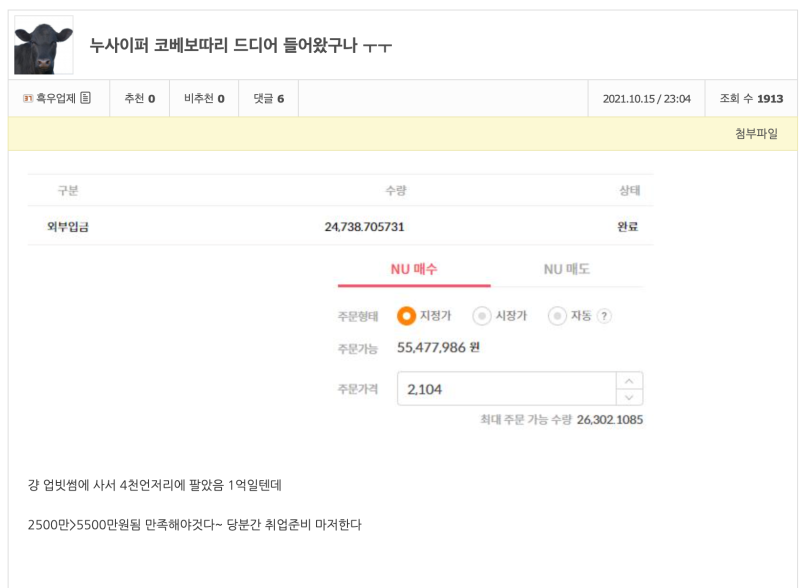
2. Binance route scenario: A trader with very fast judgment and execution speed market-bought NuCypher on Binance the moment the notice appeared and immediately completed a withdrawal request. He was lucky enough to pull the inventory out just before Binance closed withdrawals due to hot-wallet inventory shortages and the like. Thanks to this, he deposited inventory into Upbit relatively faster than others and sold in the early phase as the price began shooting toward its peak, securing a large profit stably.
3. Coinbase route scenario: Yet another trader bought inventory on Coinbase and requested a withdrawal around 3 PM. But the withdrawal wasn't processed until after 11 PM. For about 8 hours, all he could do was watch the market, fully exposed to price-movement risk. Fortunately, thanks to Upbit's buying pressure holding strong, he was able to sell the belatedly arrived inventory and still earn about a 2x average profit.
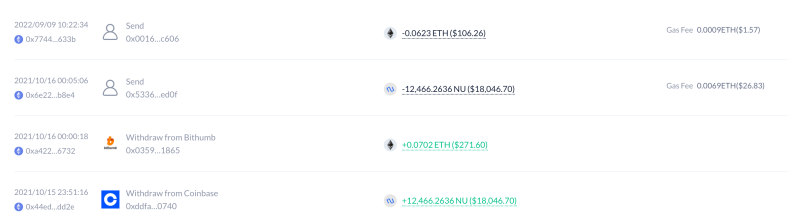
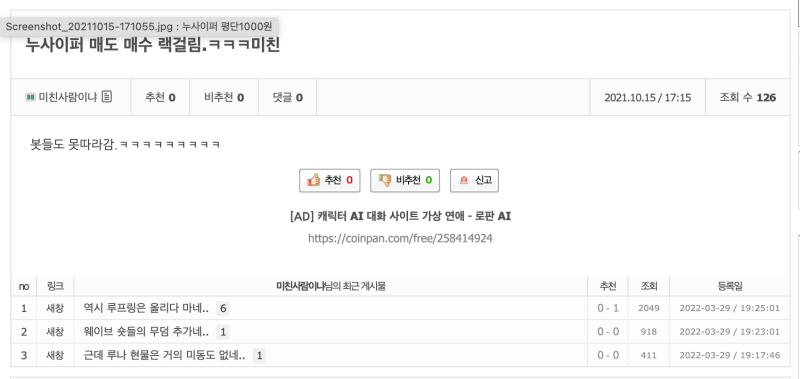
4. Predictive trading scenario: One analytical investor, instead of taking on withdrawal risk, bet on the price surge itself. Judging that "supply shortage" and "demand explosion" were certain, he bought inventory when the first rise occurred on Bithumb. Then, as soon as Upbit opened he sold a portion, and around 5:21 PM, when retail buying pressure peaked, he cleared all of his remaining inventory at the top — earning one of the largest profits through directional investing.
The endlessly increasing Kimchi premium records:












(4) Outcome and Implications
NuCypher successfully completed a "Dae-Heung-ttari," leaving record-breaking figures of 7 trillion KRW in trading value and a peak Kimchi premium of 260% on its first day listed. In this process, traders who successfully supplied inventory reaped enormous profits. This case left several important implications for arbitrage in high-risk situations.
1. Opportunities existed across multiple routes: the strategic choice between speed, accessibility, and patience
The NuCypher listing opportunity was not singular, and success or failure depended on which supply route you chose. The Binance route, which was open for only a few minutes right after the notice, was a first-come-first-served alpha demanding extreme speed; the Bithumb route, which was open to domestic investors, had good accessibility but came at the cost of having to accept the risk of little price difference from Upbit — or even prices frequently reversing. Finally, the Coinbase route was one where you could only earn a profit by enduring long price-movement risk, with withdrawals pending for over 8 hours. Each route demanded different capabilities like this, and the judgment to choose the optimal strategy suited to one's own conditions was the key.
The NuCypher listing was not a single opportunity. Multiple routes existed simultaneously, each with different risks and rewards: Binance, which was first-come-first-served because there was no inventory; Bithumb, where you had to carefully account for timing and gap volatility; Coinbase, which had plenty of inventory but required a long wait; and simple long bets. Success depended on the ability to accurately judge and choose which route matched your own resources and risk tolerance.
2. The inherent danger of naked-position arbitrage (saeng-ttari)
The most central feature of this NuCypher arbitrage was that there was no hedging means whatsoever. This means every participant took a "naked" position that was, in effect, a directional bet, rather than theoretically risk-free arbitrage.
Arbitrage in the true sense is the act of taking an opposite position the instant you find a price difference, eliminating risk and earning a locked-in profit. But in NuCypher's case, traders faced a gap of anywhere from at least tens of minutes to as long as 8 hours or more between the moment they "bought on exchange A" and the moment they could "sell on exchange B (Upbit)." During this time, traders were defenselessly exposed to the price-movement risk of the NuCypher they had bought.
As a result, because NuCypher's price surged, most participants earned large profits — but that was merely a lucky outcome. Had a negative catalyst hit the market during those few hours, or had the supply-chain problem been resolved faster than expected and Upbit's price plunged, everyone who attempted the arbitrage would have suffered enormous principal losses. This case gives us an important lesson: spot-spot arbitrage where hedging is impossible — that is, "bottari" — is inherently a high-risk directional investment, and before discussing expected returns, you must first clearly recognize the size of the "maximum risk" you'd have to bear before entering.
3. A "listing drought" condenses demand:
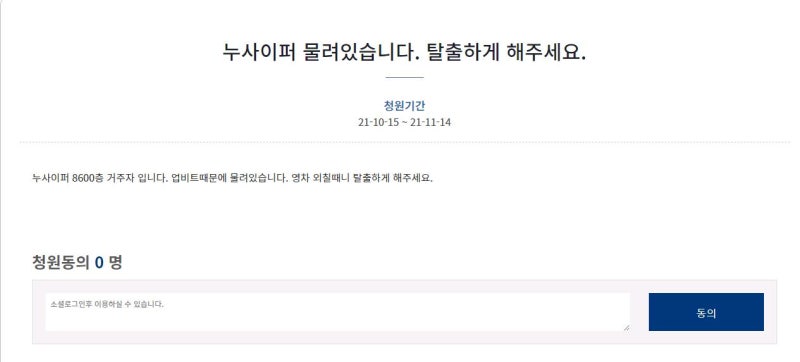
The rarer new listings are, the more the market's demand for the next listed asset tends to snowball. NuCypher was the first KRW listing Upbit carried out in six months after acquiring its VASP license. During this long "listing drought," the "pent-up demand" of users who had been unable to find new places to invest had built up to an enormous scale. NuCypher held symbolic meaning in that, rather than for the value of the project itself, it was the first target onto which this condensed demand would erupt. The market wasn't so much investing in the asset NuCypher as it was investing in the event itself — "the first listing in six months." This suggests that how long it has been since the previous KRW-market listing can be an important indicator for gauging the expected demand for the next listing. The longer the listing gap, the higher the probability that investor attention and capital concentrate, raising the likelihood of a successful pump.
4. The key success variable: Upbit's mindshare
When you analyze various KRW-listing cases, a pattern repeats in which how often ordinary mass investors think of and log into Upbit in their daily lives has a decisive impact on listing success. Heung-ttari often came out during periods when ordinary people who had Upbit accounts but didn't usually log in frequently were accessing Upbit often — due to events like the martial-law beam, the reverse premium, and viral moments. At the time of the NuCypher listing, this mindshare was maximized by the special event of the "customer-verification system" rollout. With all users obligated to log into the app, Upbit was able to effectively expose the new-listing news to millions of potential investors. This became the driving force that created a massive retail buying pressure overwhelming the initial sell inventory supplied by professional traders and arbitrageurs. Ultimately, when analyzing a listing event, grasping how concentrated ordinary investors' attention is on Upbit at that point in time becomes an important gauge for predicting the likelihood of a "Heung-ttari."
5. The phenomenon of capital concentrating in light market caps
It's a basic principle of speculative markets that the lower the market cap and the smaller the circulating supply, the larger the price movement you can cause with little capital. At the time of the NuCypher listing, Upbit listed it alongside blue-chip, large projects like Solana and Polygon, but the market's capital and attention clearly poured into the "lightest" one, NuCypher. That's because moving the price of low-cap NuCypher by 100% is possible with far less capital than moving the price of the giant project Solana by 10%. This is a natural choice not only for individual investors but also from the standpoint of the so-called "driver" who wants to lead the price. They target low-cap coins that can produce the greatest return and market impact with limited capital. Therefore, this case clearly shows that when multiple assets are listed simultaneously, speculative capital tends to concentrate on the asset with the lowest market cap and the greatest volatility potential.
Wrapping Up: The Shadow Behind the Success Stories
Today we took a deep dive into two historic cases — Movement and NuCypher — that, though different in character, were both recorded as "Dae-Heung-ttari." If NuCypher was the primal frenzy born of pure "supply-chain collapse" and a "listing drought," Movement showed the evolved form of recent Won-Sangttari, with multiple fronts complexly intertwined: OTC, the CEX withdrawal race, a meta-game using derivatives, and the retail psychological warfare of the after-pump. Both cases prove that successful Won-Sangttari requires more than simply getting information first — it demands the execution to secure a supply chain, the analytical power to read the market's macro sentiment, and the strategic judgment to bear different risks.
But behind these dazzling success stories lie "invisible risks" we haven't yet covered deeply. Behind the stories of the successful few hide countless failure cases of people who suffered enormous losses due to unforeseen variables.
In the next installment, Lecture 11, under the theme "The Invisible Risks of Arbitrage," we'll look — with concrete cases — at how unpredictable changes to exchange policy, the heart-stopping moment a hedge position gets liquidated, and sudden external variables can threaten our profits.
Thank you for reading.
- arbitrage
- crypto
- education
- case-study
- krw-listing