The Basics of Crypto Market Structure
A primer on the basics of crypto market structure — exchanges, order books, and how prices form across venues.

The cryptocurrency market has grown exponentially since the creation of Bitcoin in 2009. Despite this rapid growth, it differs significantly from traditional financial markets. These differences, particularly in market structure, have led to both new opportunities and inefficiencies. This post explores the key differences in market structure, the role of decentralized exchanges, and how these dynamics contribute to market inefficiencies.
How Cryptocurrency Markets Differ from Traditional Financial Markets
Cryptocurrency markets function in a decentralized manner, unlike traditional financial markets, which are centralized and heavily regulated. In traditional markets, you have centralized exchanges (CEXs) like the New York Stock Exchange (NYSE) and NASDAQ, where trading occurs in a controlled environment with regulatory oversight.
In contrast, crypto markets operate across numerous exchanges — some centralized (e.g., Binance, Coinbase) and others decentralized (e.g., Uniswap, PancakeSwap). Crypto exchanges often run 24/7, unlike traditional stock exchanges that follow regular business hours. The lack of uniformity and fragmentation across exchanges creates opportunities for price discrepancies that do not exist in traditional markets.
The Decentralized and Fragmented Nature of Crypto Exchanges
One of the most fundamental aspects of crypto markets is their decentralized nature. Decentralized exchanges (DEXs) allow users to trade directly from their wallets without the need for intermediaries. This contrasts sharply with centralized exchanges, where users need to deposit their assets onto the exchange before trading. DEXs rely on smart contracts and automated market makers (AMMs) for price discovery and trade execution.
This decentralized infrastructure is powerful but also leads to market fragmentation. Different exchanges might list the same asset, but due to the lack of central coordination, prices may vary significantly across platforms. These disparities create arbitrage opportunities for traders but also lead to inefficiencies that are less common in centralized markets.
How Market Inefficiencies Arise in This Structure
In traditional markets, high-frequency traders (HFTs) and arbitrageurs ensure that price discrepancies between different exchanges are quickly corrected. In crypto, the fragmentation between centralized and decentralized exchanges — combined with varying liquidity and trading volumes — leads to more persistent inefficiencies.
For example, liquidity on DEXs can fluctuate more than on CEXs, especially during periods of market volatility. Transaction fees, slippage, and time delays when moving funds between exchanges also contribute to inefficiencies. As a result, traders can take advantage of price differences between DEXs and CEXs, or even between different CEXs, to generate profits through arbitrage strategies.
Linkage to DataMaxi+

For those looking to capitalize on these inefficiencies, tools like DataMaxi+ offer invaluable resources. DataMaxi+ provides users with real-time insights on arbitrage opportunities across various exchanges, helping traders identify and exploit price differences.
- CEX<>CEX Arbitrage Page: DataMaxi+ supports traders looking for opportunities across different centralized exchanges. While prices on CEXs are generally more aligned due to higher liquidity and tighter spreads, differences still arise, especially during periods of high volatility or across less-traded assets.
In conclusion, the decentralized and fragmented nature of the crypto market presents both challenges and opportunities. Understanding these dynamics — and utilizing tools like DataMaxi+ — can help traders navigate this unique landscape and take advantage of its inefficiencies.
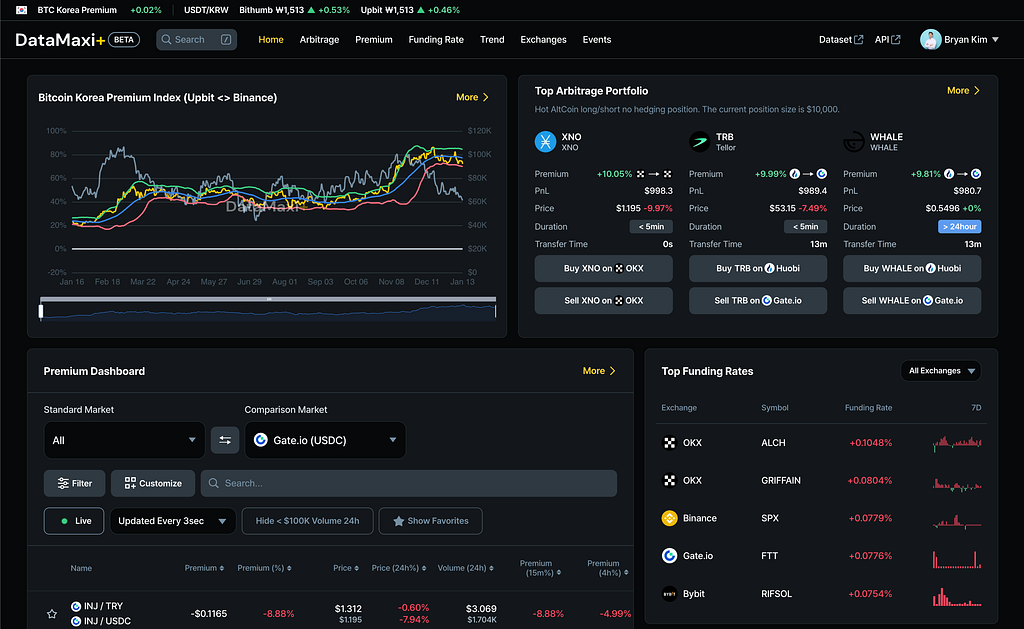 Landing page screenshot of DataMaxi+.
How Do I Find Out More About DataMaxi+?
- crypto
- education
- market-structure