The Rise of Korean Exchange Listing Alpha: Capturing Upbit and Bithumb Listing Pumps
The rise of Korean exchange listing alpha — how to capture the price pumps that follow Upbit and Bithumb listings.
Background — The Fading “Binance Effect” and the Strong Upbit and Bithumb Listing Pumps
Historically, a token listing on Binance often led to a substantial surge in price. As a result, listing on Binance has been regarded as a major milestone for many project teams. However, this “Binance Effect” has notably diminished in 2025, with only a few exceptions (source).
While the reasons for the decline of the Binance Effect are beyond the scope of this article, the DataMaxi+ team has observed that two similar listing alpha opportunities remain highly relevant today: the Upbit listing pump and Bithumb listing pump.
Based on our data collection, the maximum expected returns from Upbit and Bithumb listings in 2025 are 51.9% and 108.9% respectively at the time of writing. The strongest performers have delivered remarkable intraday returns of over 800% from their listing prices. Directional traders can benefit significantly if they can access the most recent listing announcements from Upbit and Bithumb with minimal latency.
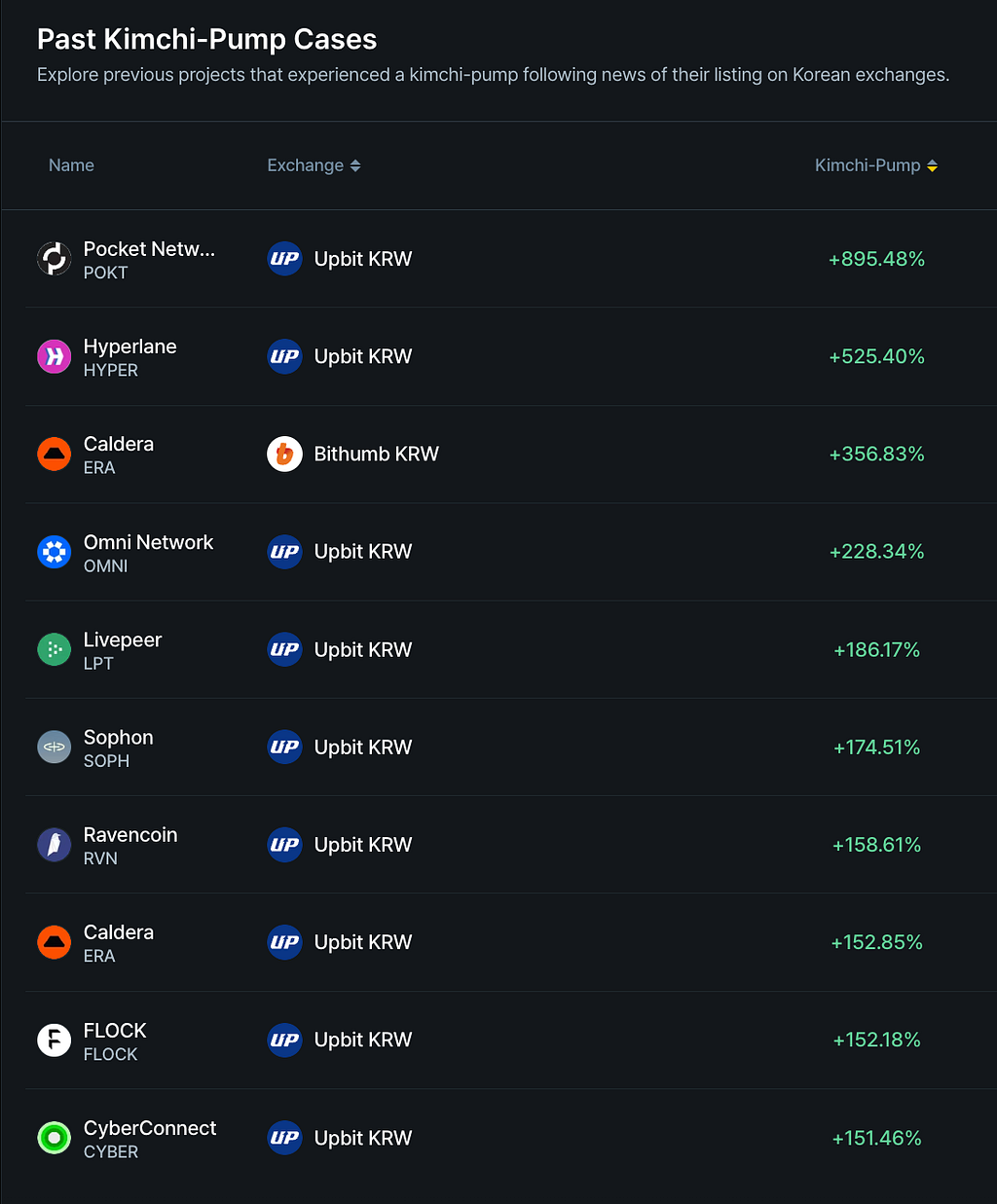 Source: www.datamaxiplus.com
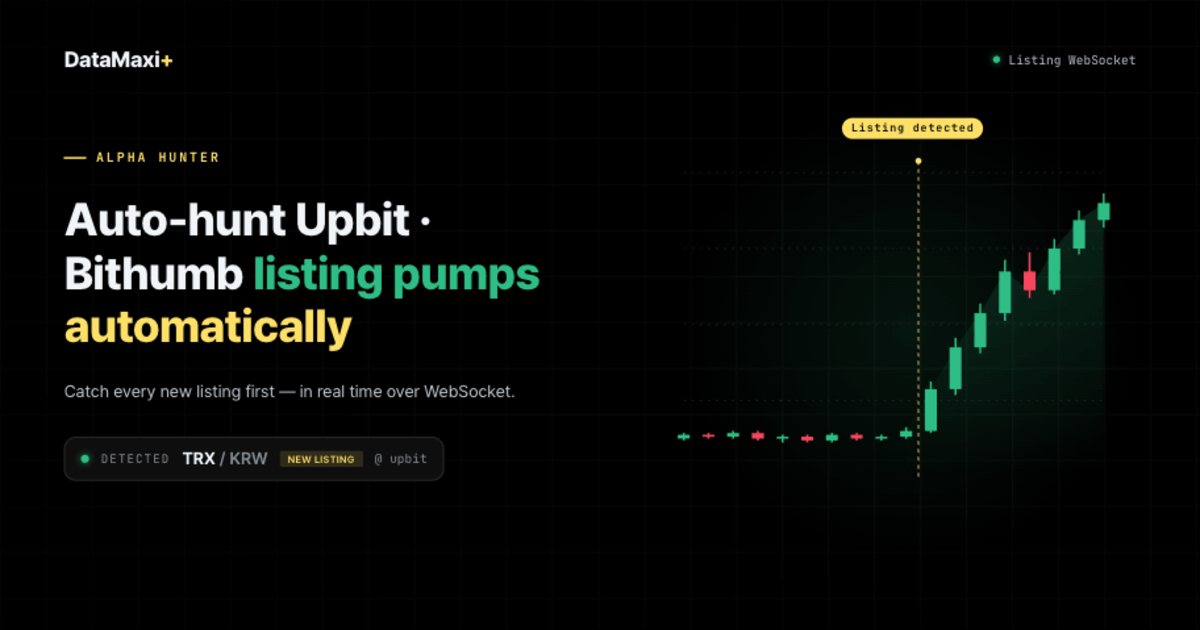
Through extensive research and development, we have successfully built a system that fetches listing announcements from Upbit and Bithumb with minimal latency — among the fastest in the industry. In this article, we will explain how to utilize our listing API and share sample code for interested traders to explore this alpha opportunity.
Step 1: Importing the Tools
import os, time, math, json
import requests, requests_cache
import pandas as pd
import numpy as np
import matplotlib.pyplot as plt
from time import sleep
from google.colab import userdata
Code Explanation:
- General-purpose libraries (os, time, math, json) help with file handling, timing functions, mathematical calculations, and working with JSON API responses.
- Requests + requests_cache → handles API calls to DataMaxi+. The cache ensures you don’t overload the server or waste API credits by making repeated identical requests.
- Pandas + NumPy → standard tools for data manipulation and analysis. Pandas organizes the raw listing data into tables, while NumPy helps with fast numerical operations.
- Matplotlib → useful for quick visualizations, e.g., plotting listing impact on price/volume.
- sleep → adds short delays between API calls (good practice to avoid rate limits).
Step 2: Setting Up the API Key
API_KEY = userdata.get('API_KEY')
Code Explanation:
- Your API key is your authentication token when using DataMaxi+. After opening up a free trial account, you can find your API key here: https://datamaxiplus.com/en/my/maxi
- By storing it in Google Colab’s userdata, you avoid exposing it in public notebooks or GitHub repos — which is critical for security.
Step 3: Defining the Base URL
BASE_URL = 'https://api.datamaxiplus.com/api/v1'
Code Explanation:
- This is the root endpoint for all DataMaxi+ API calls.
- Every query you make (e.g., listing status, exchange data) will be built on top of this URL.
- The developer documentation of the listing WebSocket API can be found here: https://docs.datamaxiplus.com/ws/announcement/listing
Step 4: Using Websocket API to get the latest Upbit and Bithumb listing
To capture listing opportunities with minimal latency, DataMaxi+ provides a real-time WebSocket API (https://docs.datamaxiplus.com/ws/announcement/listing) that streams listing announcements from Upbit and Bithumb as they happen. This WebSocket connection delivers sub-second notifications, giving you a critical timing advantage over traditional polling methods.
# !pip install websocket-client

def buy():
 print("bought")

import websocket
import json
import threading
import time

def on_message(ws, message):
    print(f"Received message: {message}")
    try:
        data = json.loads(message)
        if "e" in data and (data["e"] == "bithumb" or data["e"] == "upbit"):
            print(data)
            buy()
            ws.close()
    except json.JSONDecodeError:
        print("Received non-JSON message")

def on_error(ws, error):
    print(f"Error: {error}")

def on_close(ws, close_status_code, close_msg):
    print(f"Closed with status code {close_status_code}: {close_msg}")

def on_open(ws):
    print("Opened connection")
    ws.send(json.dumps({"method": "subscribe", "id": 1}))

    def run(*args):
        while True:
            time.sleep(10)
            try:
                ws.send(json.dumps({"method": "PING"}))
                print("Sent ping")
            except websocket._exceptions.WebSocketConnectionClosedException:
                print("Connection closed, stopping ping thread.")
                break
    threading.Thread(target=run).start()

websocket_url = "wss://api.datamaxiplus.com/ws/v1/announcement/listing"
headers = {
    "X-DTMX-APIKEY": API_KEY
}
ws = websocket.WebSocketApp(websocket_url,
                          on_open=on_open,
                          on_message=on_message,
                          on_error=on_error,
                          on_close=on_close,
                          header=headers)
ws.run_forever()
Step 5: Before executing the Trade: Wallet Status Verification
If you are an Upbit or Bithumb user, you can directly send the crypto from the source exchange (overseas exchange) to the target exchange (Upbit or Bithumb) for sale to lock in the profit. However, please note that the source exchange or target exchange may not always allow withdrawal or deposit, so it is necessary to check the wallet status of the token before building your position.
You can find the code below to inquire about the wallet status of both the source exchange and target exchange:
def call(path, method="GET", **kwargs):
    headers = kwargs.pop("headers", {})
    headers["X-DTMX-APIKEY"] = API_KEY
    r = requests.request(method, f"{BASE_URL}{path}", headers=headers, **kwargs)
    r.raise_for_status()
    return r

source_wallet_status = call("/wallet-status", params={"exchange":se, "asset":d["sb"]}).json()
target_wallet_status = call("/wallet-status", params={"exchange":te, "asset":d["tb"]}).json()

wallet_status = [source_wallet_status[0], target_wallet_status[0]]

wdf = pd.DataFrame(wallet_status)

columns_to_display = ['exchange', 'network', 'currency', 'deposit_state', 'withdraw_state']
display(wdf[columns_to_display])
Code Explanation:
- API Calls for Wallet Status: The first two lines fetch wallet information from our API endpoint. The se variable represents the source exchange, while te represents the target exchange (Upbit or Bithumb). The assets d["sb"] and d["tb"] correspond to the source and target exchange asset symbols respectively.
- Data Consolidation: We combine the first element from each API response into a single list, as the API returns wallet status data in array format.
- DataFrame Creation: Using pandas, we convert the wallet status data into a structured DataFrame for easier analysis and display.
- Filtered Display: Finally, we display only the essential columns — exchange name, network, currency, deposit state, and withdrawal state — to quickly assess whether transfers are possible between exchanges.
Conclusion: Alternative Strategy
In this article, we have revealed an interesting strategy based on Upbit and Bithumb listing alpha. You are encouraged to visit our listing arbitrage page for further case studies of previous listing cases on Upbit and Bithumb, with real-time analytics and data on spot/perpetual price movements before and after the listing announcement, spot-perpetual gap graphs, and real-time Upbit and Bithumb wallet deposit analytics.
Besides this directional “buying cheap, selling higher” strategy, there is another strategy based on arbitraging the gap between spot and perpetual markets when the market starts to price in the Upbit or Bithumb listing. We will explore this listing arbitrage strategy in future articles.
If you are interested in learning more about data-driven directional or arbitrage alphas in the crypto space, please follow our Medium page and share it with your friends!
Connect with DataMaxi+:
- Website: datamaxiplus.com
- Telegram Community (EN): @datamaxi_global
- Telegram Community (KR): @datamaxiplus
- DataMaxi+ X (EN): @datamaxiplus
- DataMaxi+ X (KR): @datamaxiplus_kr
- DataMaxi+ Github: https://github.com/Bisonai/dtmx-notebook
Disclaimer This article is provided for informational purposes only and does not constitute financial, investment, legal, or tax advice. Cryptocurrency trading and token listings are highly risky and may result in the loss of your entire investment. DataMaxi+ makes no representation or warranty as to the accuracy or completeness of the information provided, and accepts no liability for any losses arising from its use. Readers should conduct their own research and seek independent professional advice before making any investment or trading decisions.
- crypto
- listing
- upbit
- bithumb
- alpha
- korea