Lecture 12. Kimchi-Premium Arbitrage Using DataMaxi+
A step-by-step guide to executing Kimchi-premium arbitrage in practice using DataMaxi+ tools.
Introduction
Hello everyone. This is the twelfth installment of DataMaxi+'s arbitrage education series.
For this post, I strongly recommend reading Lecture 4, "What Is the Kimchi Premium" first.
That's because if you don't understand the definition of the Kimchi premium, the meaning of the positive premium, and the idea that a Korean investor is effectively exposed to two variables at once — the coin price + the Kimchi premium — then the numbers you see on DataMaxi+ can easily look like a pile of disconnected information.
Also, in Lecture 11 we looked at the various risks of arbitrage — for example transfer delays, deposit/withdrawal suspensions, hedge-position management, exchange risk, and even plain human error.
Today we'll climb one step higher and talk about how to actually judge the Kimchi premium and how to turn that into a trade.
That said, the Kimchi premium covers quite a wide range of arbitrage strategies.
Arbitrage opportunities that span domestic exchanges — such as the spot–spot gap, the spot–futures gap, or Won-Sangttari (KRW-listing arbitrage) — are vast in scope, so they'll be covered in separate lectures later; today's focus will be on "how to read the positive premium, and how to turn that positive premium into real profit."
As we also covered in Lecture 4, the "positive premium" refers to the Kimchi premium that forms on Bitcoin or Tether (USDT).
1. The Two Types of Kimchi-Premium Arbitrage Covered in This Post
When people hear "Kimchi-premium arbitrage," many vaguely think something like this:
"If domestic prices are higher than overseas, can't I just buy overseas and sell domestically?"
In terms of pure principle, that isn't wrong. But in practice, that single sentence isn't enough. That's because the Kimchi-premium arbitrage we actually encounter splits broadly into two layers.
The first is trading the level of the positive premium itself.
Put simply, it's buying Tether when the Kimchi premium (positive premium) is low and selling Tether when the Kimchi premium (positive premium) is high.
In fact, what many people casually call "Kimchi-premium trading" is exactly this method.
That's because it separates most cleanly from directional coin trading and most directly exploits the mean-reverting nature of the Kimchi premium.
The second is reading the relative-premium outliers of individual coins, using the positive premium as the benchmark.
This isn't simply jumping in because "huh, this coin's Kimchi premium is higher," but rather looking at why only this coin has diverged from the positive premium, and then judging the arbitrage potential and the risk.
In this post I'll cover both.
But let me state the emphasis up front: the center of this lecture is the first method — Tether trading that captures the positive-premium reversion.
Individual-coin divergence analysis is extremely useful in practice, but more often than you'd expect it ties into structural problems such as deposit/withdrawal issues, hot-wallet inventory problems, bridge problems, and network mismatches. So you can't blindly treat "high Kimchi premium = good opportunity."
By contrast, Tether trading that exploits positive-premium reversion is conceptually much clearer.
What we're buying and selling isn't expectations about some altcoin, but something closer to the "dollar key money" itself that attaches to and detaches from the Korean market.
2. Why Is Tether the Core of Kimchi-Premium Arbitrage?
As I mentioned in Lecture 4, the Kimchi premium acts as a kind of key money for domestic investors.
When you first buy a coin, it feels unfair to pay extra for no reason, but later, when you sell back into KRW, you can walk away collecting that key money.
But if we dig one step deeper here, there's an asset that shows this key money most directly. That's Tether (USDT).
When you buy Bitcoin or an altcoin, you're exposed not only to the Kimchi premium but also to the direction of that coin.
For example, suppose I bought Bitcoin and the Kimchi premium attached nicely, but Bitcoin itself fell 8% on the global market — then the KRW-based profit and loss becomes an entirely different picture.
Tether, on the other hand, is different.
Because Tether is basically a stablecoin that moves almost in lockstep with the dollar,
buying Tether is effectively
close to trading "how expensively, or how cheaply, you're buying dollars in the Korean market."
In other words,
buying Bitcoin: you buy the Bitcoin price + the Kimchi premium together
buying Tether: you buy the Kimchi premium in a much purer form
This difference matters a great deal.
That's why, when trading the positive premium, the benchmark many people watch is the Tether positive premium, and they use Tether itself as the execution asset for positive-premium trading.
Before Tether was listed on domestic exchanges, many people, in order to do Kimchi-premium trading, would buy assets like Bitcoin or Ripple, send them to overseas exchanges, sell them, and hold Tether.
Since Tether was listed on domestic exchanges, you can now do Kimchi-premium trading simply by buying and selling Tether directly.
The advantages of doing Kimchi-premium trading with Tether are clear.
First, you can greatly reduce exposure to coin direction.
Second, you can exploit the mean-reverting nature of the Kimchi premium much more directly.
Third, you gain the extra option of stablecoin management while holding.
It's precisely for these reasons that many people regard positive-premium reversion trading as the most basic form of Kimchi-premium arbitrage.
3. The First Method: Buying Tether When the Positive Premium Is Low and Selling It When It's High
Now let's look at the first method in earnest.
3-1. The Essence of This Trade Is Not "Coin Trading" but "Positive-Premium Trading"
The core of this strategy is simple.
When the positive premium is low, buy Tether with KRW,
and when the positive premium has risen, sell that Tether back into KRW.
Just hearing it, it sounds so simple that you might wonder, "Can this really be a trade?"
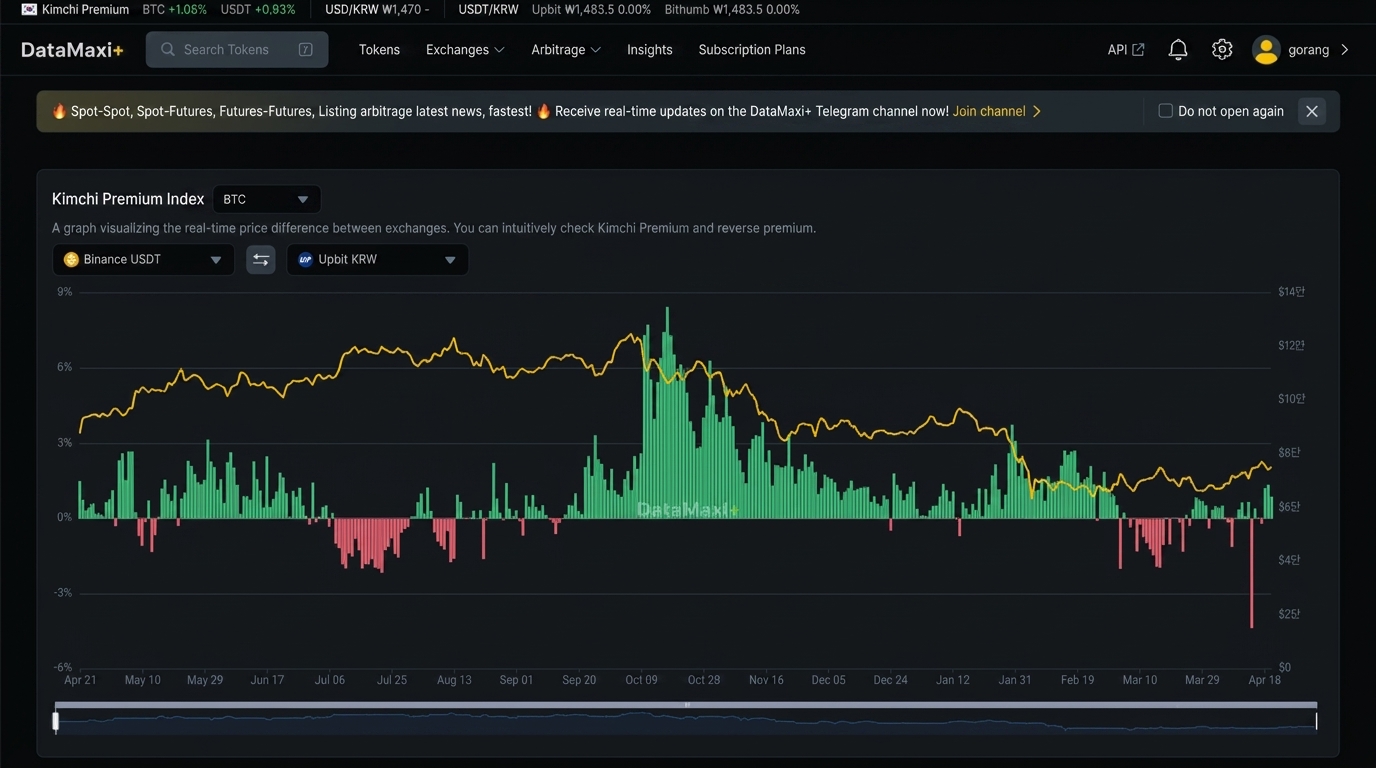
But as we already confirmed in Lecture 4, the Korean market's premium isn't a value that moves completely at random; it's a value that repeatedly widens and narrows according to bull and bear markets, domestic investor sentiment, panic, and FOMO.
Empirically, the positive premium often shows a tendency to return toward the 0–2% range over the long run.
Of course, in an overheated market it can widen much further, and in extreme panic phases a reverse (negative) premium can appear.
But on the whole, because it has a "tendency to eventually converge near 0," repeatedly exploiting this is exactly what positive-premium reversion trading is.
The reason this strategy matters is that
we're now no longer asking "will Bitcoin go up or down,"
but starting to ask "is the dollar key money cheap or expensive in the Korean market right now."
The very nature of the question changes.
3-2. When to Enter and When to Exit
The question that comes up most in this part is:
"At what percentage is the positive premium considered low?"
"At what percentage is it considered high?"
There's no single correct answer here.
That's because the perceived range shifts with market conditions, the exchange rate, domestic investor sentiment, and overseas market conditions.
That said, in practice people usually set their own ranges and move within them, like this.
For example,
when the positive premium is near 0% or in reverse premium → buy Tether in tranches
when the positive premium has widened enough, to 1.5%–2% or more → sell Tether in tranches
something along these lines.
Of course, these numbers are just examples.
One person might enter even at 0.3%, and another might think they should only sell at 2.5%.
What matters is "deciding in advance the range you feel is low and the range you feel is high."
Why decide in advance? Because Kimchi-premium trading is influenced by emotion more than you'd think.
When the positive premium is low, the mood in the domestic market is usually cold.
Everyone wants to hold KRW, everyone wants to sell their coins, and there are even cases where domestic prices look cheaper than overseas.
Buying Tether at this moment is psychologically quite uncomfortable.
Conversely, when the positive premium is high, the market is hot.
It feels like anything you buy domestically will rise, the KRW market is overheated, and the mood around you looks good. Selling Tether at this moment isn't psychologically easy either.
In the end, positive-premium trading is a trade based on numbers, while at the same time being a trade that moves against the crowd's psychology.
3-3. It's Much Easier to Understand with an Example
For example, let's assume the exchange rate is 1,350 KRW.
If one day Tether is trading domestically at around 1,353 KRW,
the positive premium can be seen as near 0% or at a very low level.
If you bought 100,000 USDT at this point, that comes to about 135,300,000 KRW.
Then, after some time passes and the domestic market overheats again,
what if, at the same exchange rate, Tether is trading around 1,375 KRW?
This time you can sell 100,000 USDT for about 137,500,000 KRW.
Even by simple arithmetic, that's a difference of about 2,200,000 KRW.
Subtracting fees would shave the net profit down a bit, but it still clearly shows how the structure of "buy when the positive premium is low and sell when it's high" leads to profit.
If you can catch this kind of opportunity several times a year, repeatedly and without overreaching,
then — ignoring exchange-rate effects for the moment — a view expecting an annual return of around 20% can reasonably emerge.
Of course, this is only possible on the premise that you:
don't get too greedy with your entry/exit ranges
manage fees and slippage
have decided how to handle exchange-rate exposure
and control the risks of holding.
In other words, it's not "buy Tether, sell it expensive later, done."
In the end, this strategy too is a trade that requires fixed rules and risk management.
https://datamaxiplus.com/premium-index
is where you can backtest the Kimchi premium.
3-4. You Can Keep Your Assets Working Even While Holding Tether
Another advantage of this strategy is right here.
While you hold Tether and wait for the positive premium to rise again,
you can deposit that Tether on overseas exchanges or in DeFi to earn additional interest income.
In other words, if the positive-premium reversion itself is the main income,
the stablecoin deposit interest can be supplementary income.
This structure is more attractive than you'd think.
Main income: the spread from buying when the positive premium is low and selling when it's high
Supplementary income: deposit interest while holding Tether
Of course, there are risks here too.
Entrusting it to an overseas exchange carries exchange credit risk,
and entrusting it to DeFi carries smart-contract risk and depegging risk.
So it's best to think of the interest as nothing more than a bonus.
The essence of positive-premium trading is still Kimchi-premium reversion, not the interest.
If you confuse this point, you end up taking on a great deal of unnecessary risk instead.
3-5. How to View the Exchange Rate When Using This Strategy
Now a very important part remains. That's the exchange rate.
Buying Tether is effectively similar to holding dollars.
So even if I decided the positive premium was low and bought Tether,
if the KRW/USD exchange rate moves significantly in the meantime, the final profit and loss can turn out quite different from what you expected.
Here, an investor can make one of two choices.
One is not to hedge the currency.
This case is simple.
You take on the dollar direction as well.
If, over the long term, you keep expecting KRW weakness — that is, dollar strength —
then not bothering to hedge the currency may actually be more convenient.
But in this case there's something you absolutely must recognize.
From that moment on, I'm no longer trading the Kimchi premium alone.
I'm holding two positions at once: the Kimchi-premium movement + the exchange-rate movement.
The Kimchi premium has an arbitrage-like tendency to eventually converge near 0,
but the exchange rate does not. The exchange rate is fundamentally the domain of directional trading.
In other words,
betting on the Kimchi premium
and betting on the dollar direction
are completely different games.
If you can't distinguish between these,
then later, even when you profit you won't know why, and even when you lose it becomes hard to figure out what the problem was.
The other is to attach a currency hedge.
Only then can we approach the trade looking at "the positive premium alone."
The specifics of opening a hedging account, placing orders, and operating it would make this post far too long, so here I'll just touch on the principle.
Sending coins overseas and holding them as Tether is similar to a dollar long position.
So to offset this, you generally attach a hedge on the short-dollar-futures side.
That said, you must always re-check taxes and fees against the brokerage you currently use and the current product structure.
In practice, brokerage fees differ more than you'd think.
For example, some people feel domestic dollar futures are heavy, like "$7.5 per contract,"
but that's often a misperception mixed up with the overseas-futures side.
For domestic products, the perceived cost can vary quite a bit depending on whether you've negotiated fees with your brokerage.
In the end, you can think about currency hedging like this.
"Do I only want to capture the positive premium?"
If so, you should attach a currency hedge.
"I'm also taking a view on the dollar."
If so, you can choose not to attach a hedge.
But in that case, you must acknowledge the fact that you're holding two positions at once.
3-6. A Variation Using USD as the Base Currency for Kimchi-Premium Trading Is Also Possible
In a slightly more advanced form, there's also a method of thinking with your usual asset-management base currency set as USD rather than KRW.
For example, you normally hold financial products with a dollar-long character, and
when the positive premium falls, you partially unwind that dollar-long position and use those funds to buy Tether.
Then, when the positive premium fills back up, you sell the Tether and use that money to rebuild the dollar-long position.
This approach has the advantage of letting you view your overall asset management more three-dimensionally.
That said, it can actually be complicated for beginners, so for now I recommend first mastering positive-premium reversion trading on its own.
4. The Second Method: Reading Individual-Coin Divergence Against the Positive Premium
Now let's move on to the second method.
This part is a bit more delicate than the first method.
That's because here you're not simply looking at "is the positive premium low/high,"
but rather at which coin has diverged from the positive-premium benchmark.
And here there's one very important concept.
4-1. In a Normal Market, Most Coins' Kimchi Premiums Should Sit in a Similar Range
As I also mentioned in Lecture 4,
the Kimchi premium isn't a phenomenon that attaches to just one specific coin; it tends to be reflected fairly similarly across the entire KRW market.
The reason is simple.
Arbitrageurs and bots continuously narrow the premium differences between coins.
For example, suppose most coins show a positive premium of around 2%,
but one coin alone has an 8% premium attached.
If that coin can truly be transferred, traded, and deposited/withdrawn freely,
arbitrageurs will hardly leave that imbalance alone.
As the process repeats — selling that coin domestically,
recycling the funds via a coin with a relatively lower premium or via a stablecoin,
and sourcing inventory overseas to bring back into the country —
ultimately all coins' premiums gather back into a similar range.
In other words, if some coin alone has diverged significantly from the positive premium, that's not so much a matter of "strong demand" as it likely means a path is blocked somewhere.
This is exactly the perspective you need to have.
4-2. A Coin Excessively Higher Than the Positive Premium Is Usually a "Coin Whose Path Is Blocked"
If the positive premium is 1% but some coin spikes high to 6%, 8%, 10%,
a beginner usually thinks:
"Wow, huge Korean demand has piled onto this coin. I'd better get in fast."
But in practice, you often have to think the opposite.
"Why haven't the arbitrageurs eliminated this difference yet?"
You have to ask this question first.
And the candidates to check here are generally similar.
Domestic-exchange deposit/withdrawal suspension
Wallet maintenance
Hot-wallet inventory shortage at the overseas exchange
Bridge issues
Supported-network mismatch
A structure where deposits are possible but the actual crediting is excessively slow
In other words, such a coin is less of an "overheated coin" and
more likely a coin where something in the arbitrage route has broken down.
This is exactly where the reason to use DataMaxi+ lies.
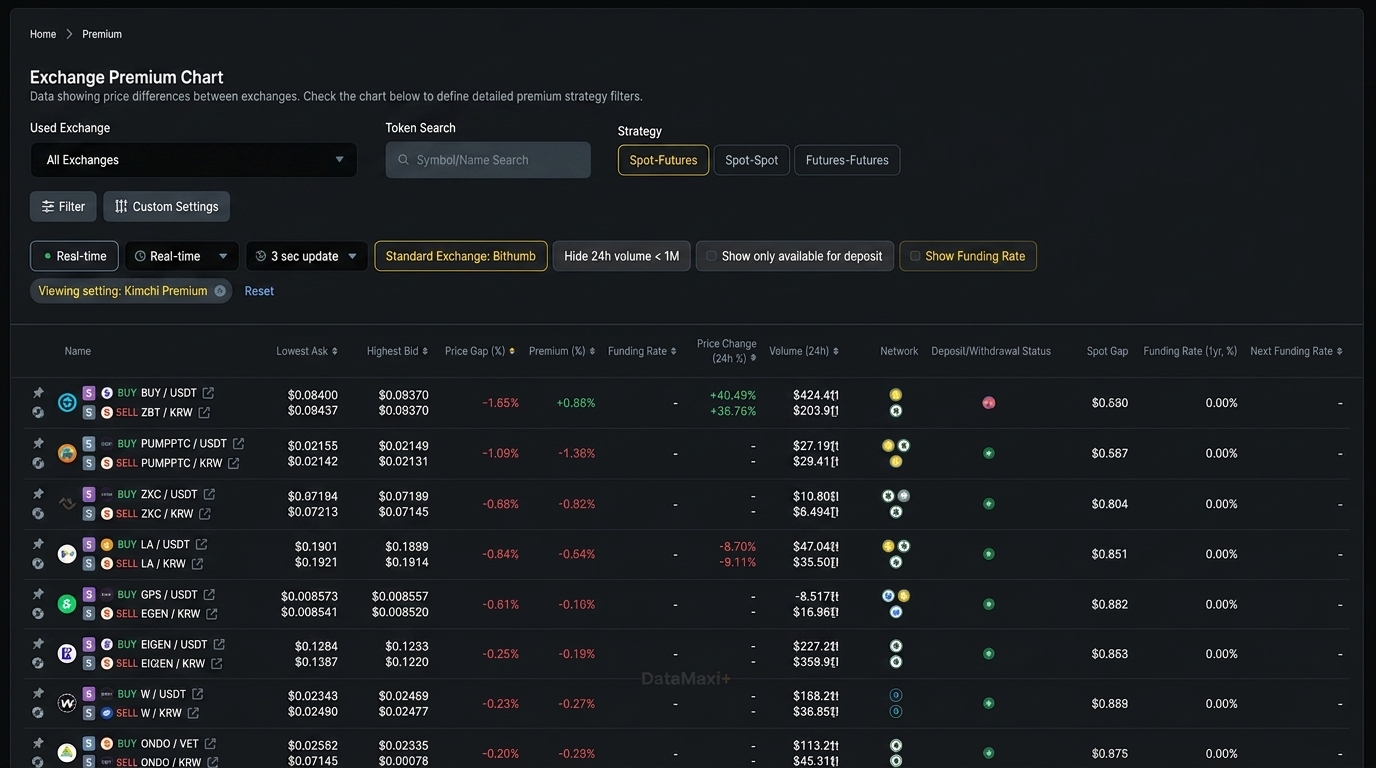
We're not simply trying to see "this coin's Kimchi premium is high."
We're trying to quickly find outliers relative to the positive premium, and structurally check why that outlier arose.
In practice, you usually look at it like this.
First find the outlier on the premium screen,
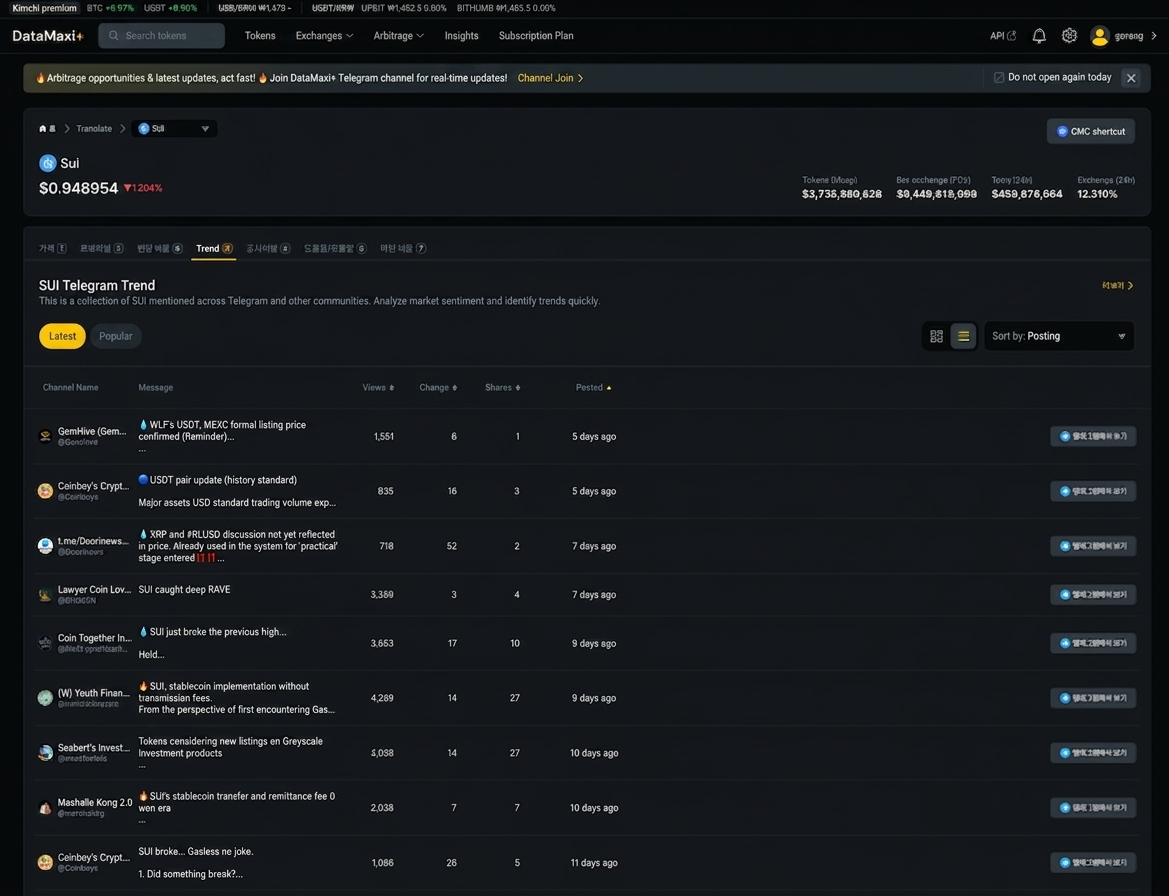
then look together at the exchange notices/events collection or the trends screen,
checking clues such as wallet maintenance, deposit/withdrawal notices, and surging interest.
4-3. A Coin Unusually Weaker Than the Positive Premium Should Be Viewed the Same Way
Conversely, suppose the positive premium is 1.5% but one coin alone is near 0% or close to a reverse premium.
Many people understand this as "domestic demand must be weak" and move on.
But in practice, this too is likely not simply a matter of demand/overheating.
That's because bots correct premium differences extremely quickly.
So if some coin alone is unusually weak,
that too is likely a situation where there's a problem somewhere in the path of buying, selling, or transferring the coin,
so arbitrageurs can't easily resolve that difference.
In other words,
a coin unusually higher than the positive premium
and a coin unusually lower than the positive premium
both ultimately need to be approached with "where is it blocked?"
Having this mindset can reduce the vague interpretation of "strong coins" and "weak coins."
That's because a Kimchi-premium arbitrageur has to look at the path and structure before demand sentiment.
4-4. News- or Community-Driven Overheating Divergences Are Often Hard to Catch by Hand
Of course, there are exceptions.
Sometimes, due to specific news or community overheating, just one coin spikes for a very brief moment.
At times like this, you can catch the trace of domestic interest suddenly piling in on the dashboard or trends screen.
But these phenomena last for a shorter time than you'd think.
Because the market is already full of arbitrage bots that catch these in real time,
if a person tries to watch a screen and enter by hand, they're usually too late.
If you seriously want to catch this kind of opportunity,
alerts or automation using DataMaxi+'s API are a much better fit.
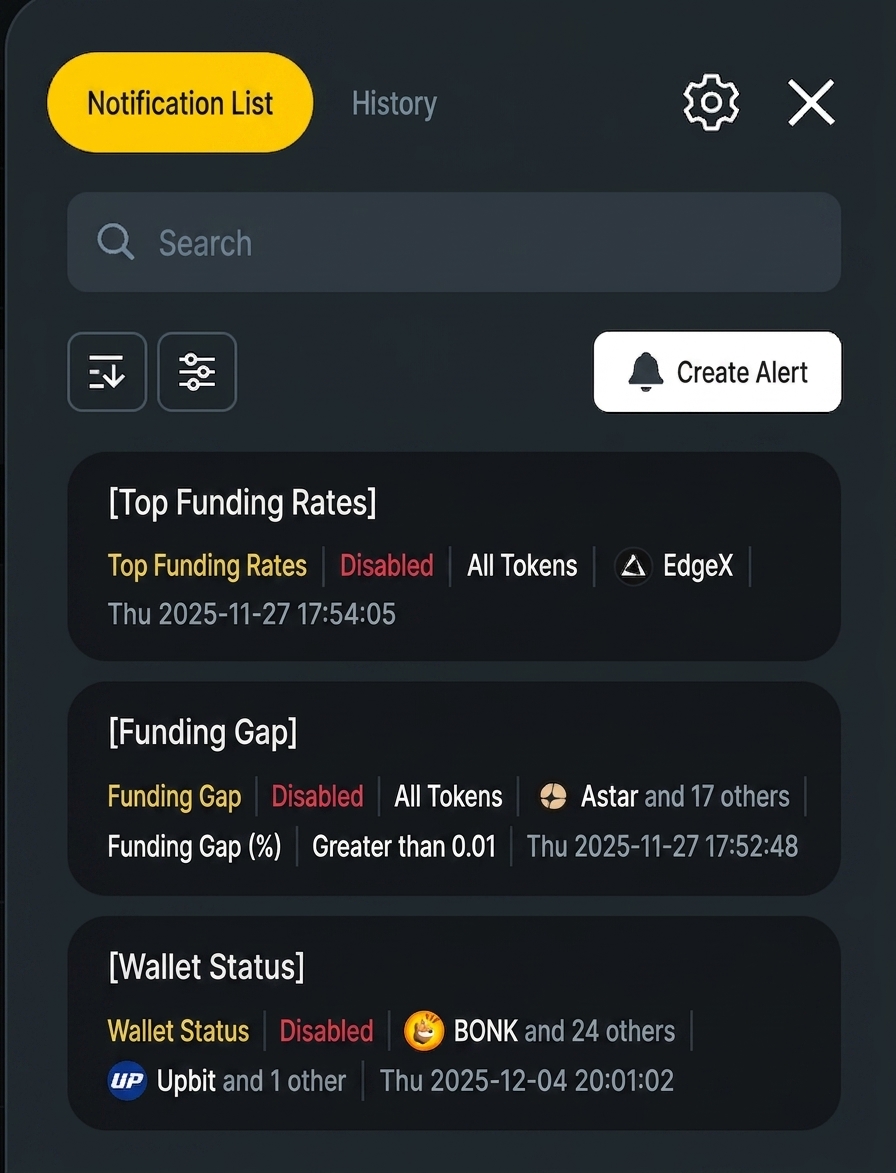
I'll talk about this part in more detail in Lecture 16, when we cover alert-bot setup.
So the one thing to remember from this post is this.
When you see an individual coin that has diverged significantly from the positive premium,
rather than immediately treating it as an opportunity, you must first check "where it's blocked."
5. How to Use DataMaxi+ to Keep Only the "Capturable Kimchi Premium"
Once you've grasped the concept above, now you have to move on to actual execution.
The important point here is that the visible Kimchi premium and the capturable Kimchi premium are different.
This part was strong in the original draft too, so this time I'll again lay it out, practice-focused, just as it was.
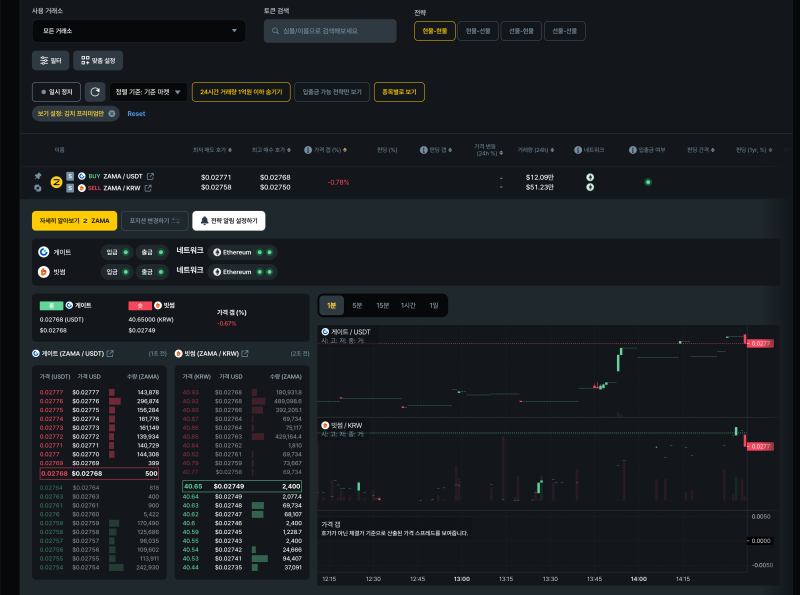
5-1. You Should Look at the Best Quote, Not the Last Traded Price
An arbitrageur's money isn't made at the last traded price.
It's made at the best bid/ask quotes.
Even if a 5% premium is showing on the screen,
when you actually calculate based on the lowest ask at which you can buy overseas
and the highest bid at which you can sell domestically,
there are cases where less than 2% remains.
Especially for an asset like Tether, the premium itself is often not large,
so even a one- or two-tick difference in the quote can sharply reduce the expected return.
This is where one of DataMaxi+'s advantages becomes important.
It helps you judge based not on the simple closing price but on quotes closer to actual execution.
5-2. You Should Look at Volume and Liquidity Together
A pretty premium number doesn't make it a good opportunity.
For example, if an 8% divergence shows on some coin
but the order book is thin, so that even throwing in just 5,000,000 or 10,000,000 KRW slips the price significantly,
that's not an opportunity you can capture in practice.
This problem occurs frequently, especially with individual-coin divergences.
By contrast, Tether positive-premium trading is relatively rich in liquidity,
so it's far more mainstream and reproducible than individual-altcoin divergences.
This too shows well why so many people perceive "Kimchi-premium trading = Tether trading."
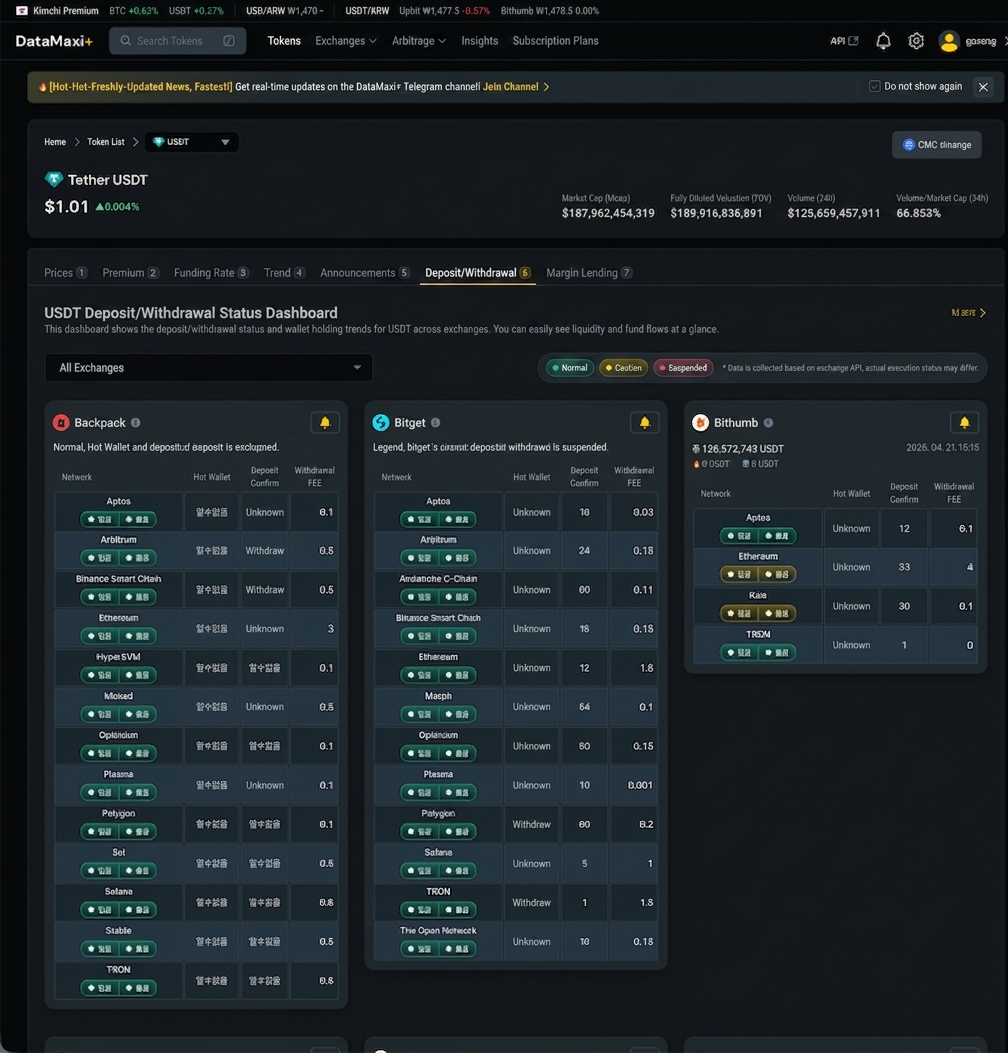
5-3. You Should Look at Deposit/Withdrawal Availability and Supported Networks Together
This is so important that I'll emphasize it again.
If you see a coin that has diverged significantly from the positive premium,
you must always look at the following together.
Is withdrawal possible
Is deposit possible
Which networks are supported
Do the networks of the overseas and domestic exchanges match
If even one of these is off,
that premium is just a number on the screen and is unlikely to lead to actual profit.
For this reason, individual-coin Kimchi premiums more often than you'd think serve as a "warning light" rather than an "opportunity."
In other words, they're often a signal warning of a transfer-route problem rather than a signal to make money.
5-4. "Can Be Sent" and "Arrives on Time" Are Entirely Different Problems
You shouldn't relax just because deposits/withdrawals are open.
If the transfer is slow or the deposit takes a long time to be credited, the character of the premium can completely change in the meantime.
Especially for individual-coin divergences that a person chases by hand,
the market has often already settled by the time it arrives.
So in practice you must always get to this question too.
"Is this premium the kind that will still be there by the time I arrive?"
Positive-premium reversion Tether trading is far more favorable on this point.
That's because it's less a few-minute ultra-short-term game and more a trade that reads the swings between cold and hot in domestic investor sentiment.
5-5. You Must Also Subtract Fees and Currency-Hedging Costs
Finally, no matter how attractive the range,
once you subtract trading fees and currency-hedging costs, the expected return can change significantly.
Tether positive-premium trading looks simple at a glance,
but in practice you have to calculate all of the following.
Spot buy/sell fees
Withdrawal/deposit-related costs
If you've attached a currency hedge, futures fees and spread costs
The opportunity cost of the funds while holding
If you don't calculate these,
a strategy that looks like it captures 1.5% on the surface could in reality be a strategy that leaves 0.7%.
6. The Actual Decision-Making Order Using DataMaxi+
Now let's tie the above into a single flow.
The actual decision-making order for Kimchi-premium arbitrage, as I see it, is as follows.
First, look at the positive premium first
Before looking at individual altcoins, first look at whether today's positive premium is low or high.
You should first judge whether today's task is a range to accumulate Tether or a range to trim it down.
Second, distinguish whether your trade is "positive-premium trading" or "individual-divergence analysis"
Buying Tether because the positive premium is low,
and watching a specific coin that has diverged significantly from the positive premium,
both look like Kimchi-premium trading on the surface but are actually entirely different games.
The former is a trade waiting for reversion,
and the latter is an analysis of reading structure and routes.
Mixing the two clouds your judgment.
Third, if it's positive-premium trading, view it on a Tether basis
Don't muddle in Bitcoin or altcoins;
organize it around the question "is the dollar key money cheap or expensive right now."
In other words, simplify your thinking to: buy Tether on days the positive premium is low,
and sell Tether on days the positive premium is high.
Fourth, decide in advance how to handle exchange-rate exposure
You must first decide whether or not to attach a currency hedge.
You shouldn't change it day to day based on mood.
Want to look at the Kimchi premium only → currency hedge
Taking a view on the dollar too → no hedge
Having this standard makes interpreting profit and loss easier later.
Fifth, view individual-coin divergence only as an outlier relative to the positive premium
Don't bother touching coins that sit in a range similar to the positive premium.
Keep only the coins excessively higher or excessively lower than the positive premium.
And immediately ask next:
"Why hasn't this divergence been corrected yet?"
This question is the very heart of it.
Sixth, check the execution conditions with DataMaxi+
Only then do you look at the quote, the volume, deposit/withdrawal availability, the network, and whether there are notices.
A substantial share of candidates is eliminated here.
In fact, skill shows itself here.
The person who catches many good opportunities survives less long than the person who quickly discards bad ones.
Seventh, don't view positive-premium reversion trading too short-term
Tether positive-premium trading is not ultra-short-term scalping.
If you approach it as a game where everything ends within a few minutes, you'll end up making reckless moves.
What I'm buying isn't an altcoin's pump but
the swing between cold and hot in domestic investor sentiment.
Eighth, don't try to capture every individual-coin divergence by hand
A substantial share of individual-coin Kimchi-premium divergences come from structural problems,
and the news-driven overheating type is too fast for a person to respond to by hand.
It's more realistic to view this part as something to observe, analyze,
and, if needed, connect to automation later.
7. It Becomes Much Clearer with Cases
Case 1. Accumulating Tether When the Positive Premium Is Near 0%
Suppose the domestic market is quiet, the preference for KRW is strong,
and the positive premium has come down to near 0% or a very low level.
At a time like this, there's no need to force yourself to pick an altcoin.
Rather, the simplest move — buying Tether in tranches — is closer to the textbook of Kimchi-premium trading.
Later, when the market heats up again and the positive premium recovers to the 1.5–2% level,
you sell Tether in tranches and realize the spread.
This is exactly the most typical Kimchi-premium trade.
Case 2. You Bought Tether Because the Positive Premium Was Low, but the Exchange Rate Moved Too
This time, let's say your positive-premium judgment was correct.
You bought Tether well in a low range, and later the positive premium attached again.
But what if, in the meantime, the KRW/USD exchange rate had fallen significantly?
Then the positive-premium profit can be substantially offset by the exchange-rate loss.
Conversely, if the exchange rate rose, the profit could be even larger.
Here we come to realize:
Tether trading in an unhedged state is not pure Kimchi-premium trading but a mixed position of Kimchi premium + exchange rate.
This very distinction is what matters.
Case 3. The Positive Premium Is 1% but Some Altcoin Alone Is 7%
A beginner usually gets excited here.
"Shouldn't I grab this fast?"
But a seasoned trader looks at the path first.
Whether deposits/withdrawals are open
Whether the domestic and overseas exchange networks are the same
Whether there was a wallet-maintenance notice
Whether there's overseas hot-wallet inventory
Whether I can actually sell a meaningful quantity
And usually a substantial share of these spots ends not with
"wow, what a great opportunity" but with
"ah, something's blocked somewhere."
In other words, DataMaxi+ here acts more often as a judgment button than an entry button.
Case 4. Looking at a Coin Unusually Weaker Than the Positive Premium
This time, the opposite: suppose the positive premium is 1.2% but some coin is near 0% or close to a reverse premium.
You shouldn't simply view this as "this coin's domestic demand is weak."
In a market where bots automatically correct differences, the fact that such a divergence remains
again likely means there's a problem somewhere in the transfer route or the trading route.
In other words, whether the divergence is high or low, the heart of it is the same.
"Why has this coin's premium diverged from the positive premium?"
Case 5. An Extreme Reverse-Premium Panic Occurs
Opportunity doesn't exist only when the positive premium is positive.
Very rarely, when the domestic market falls into panic, there are times when the reverse premium widens dramatically.
On such a day, opposite to usual,
the dollar key money is effectively trading very cheaply domestically,
so from the standpoint of positive-premium reversion trading it can actually be a good entry point.
Of course, such a spot has very high volatility and is psychologically difficult too,
so it's not a spot to enter with no preparation.
But the principle itself is the same.
Buy when the positive premium has become abnormally cheap, and sell when it returns to the normal range.
A representative case is the day during the December 2024 martial-law incident when every coin's Kimchi premium on domestic exchanges hit -50%.
8. Common Mistakes
8-1. Mixing in Altcoin Directional Trading While Doing Kimchi-Premium Trading
You decide to do positive-premium trading,
but partway through "this altcoin also looks good" creeps in,
and from that moment the character of the game changes.
Capturing the positive premium and timing altcoin direction are completely different strategies.
8-2. Ignoring Exchange-Rate Exposure
If it's unhedged, you have to acknowledge it's unhedged and proceed.
But in reality, many people fail to recognize this
and later attribute all of their profit and loss to the Kimchi premium alone.
Then, even as trade records pile up, skill doesn't improve much.
8-3. Interpreting Divergence Against the Positive Premium Only as a Demand Problem
Just because a specific coin looks unusually high or low,
it's dangerous to view it merely as a problem of domestic demand, overheating, or attention.
In a market where arbitrage bots are already moving,
if a difference of that size lingers for long, you should usually suspect a structural problem first.
8-4. Entering Based on the Last Traded Price
In practice, what matters isn't the last traded price but
the price at which I can actually buy and the price at which I can actually sell.
Kimchi-premium arbitrage in particular often involves trades that repeat small returns,
so one notch in the quote and a few bps of fees act more significantly than you'd think.
9. Wrapping Up
In this post, I've laid out how to actually realize Kimchi-premium arbitrage using DataMaxi+.
There were two main points.
First, what many people generally call "Kimchi-premium trading" is
effectively positive-premium reversion trading — buying Tether when the positive premium is low
and selling Tether when the positive premium is high.
Second, when you look at an individual coin's divergence through DataMaxi+,
you should interpret it first as a problem of the transfer route and the trading structure rather than as simple demand overheating.
If you properly understand these two things,
DataMaxi+ turns from simply "a site with lots of numbers" into
a tool for judging the positive premium, filtering out outliers, and keeping only the spots you can actually capture.
To sum up, the basic order of Kimchi-premium arbitrage is this.
First look at the positive premium,
then think on a Tether basis,
decide how to handle exchange-rate exposure,
and only then interpret individual-coin divergence as an outlier relative to the positive premium.
And finally,
always check the quote, volume, deposits/withdrawals, the network, and time.
In the end, a good Kimchi-premium arbitrageur
isn't the person who chases the flashiest numbers,
but the person who knows which numbers to discard and which numbers to keep.
In the next Lecture 13, I'll cover a topic that naturally follows from this post:
funding-rate arbitrage using DataMaxi+.
Thank you for reading this long post.
- arbitrage
- crypto
- education
- kimchi-premium
- datamaxi